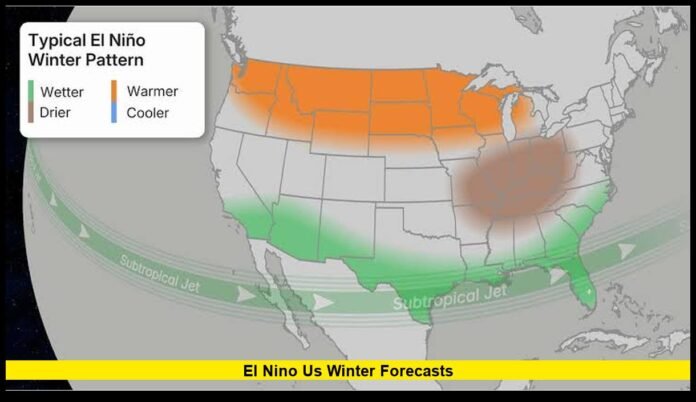

The el nino us winter forecast is drawing national attention as a strong Pacific Ocean climate pattern shapes expectations for winter 2026–2027. The latest National Oceanic and Atmospheric Administration (NOAA) outlook, released October 15, points to above-average temperatures across much of the northern United States and increased chances of wetter-than-normal conditions across the southern states and parts of the East. The developing El Niño could influence winter storm tracks, drought conditions, and regional weather patterns through early 2027.
The forecast presents a divided picture for the country. Northern communities may experience a generally warmer winter, while parts of the South and East could receive more precipitation than usual. These broad trends matter for residents, farmers, water managers, travelers, and communities preparing for winter hazards.
However, the outlook does not promise mild weather everywhere or guarantee heavy rainfall in every southern state. Seasonal forecasts estimate probabilities across several months. Individual cold snaps, snowstorms, and heavy rain events will depend on atmospheric conditions closer to the time they occur.
NOAA’s Latest Winter Outlook for 2026–2027
NOAA’s October seasonal outlook provides an early assessment of likely temperature and precipitation patterns for December, January, and February. It reflects current climate observations, forecast models, and the developing El Niño event in the tropical Pacific.
The agency’s assessment indicates that the El Niño pattern could remain strong into early 2027. NOAA’s October climate update assigned a greater than 83% probability to strong-to-very-strong El Niño conditions during January–March 2027.
The developing event is notable because parts of the eastern equatorial Pacific have experienced sea surface temperatures more than 4 degrees Celsius above average. These unusually warm ocean conditions can affect atmospheric circulation well beyond the Pacific.
The principal signals in the winter outlook include:
- Above-average temperatures: Much of the northern United States has increased odds of a warmer-than-normal winter.
- Above-average precipitation: The southern tier and parts of the East have increased chances of wetter conditions.
- Potential drought relief: Some drought-affected areas could receive enough precipitation to improve moisture conditions.
- Regional contrasts: The forecast favors different temperature and precipitation patterns across the country rather than one uniform winter outcome.
These projections provide a starting point for seasonal planning. They do not establish exact temperatures, monthly rainfall totals, or the dates of major winter storms.
Why the Developing El Niño Matters
El Niño is a natural climate phenomenon that occurs when sea surface temperatures become unusually warm across parts of the central and eastern equatorial Pacific. It is one phase of the El Niño–Southern Oscillation, a climate cycle that influences ocean temperatures, winds, and tropical rainfall.
As the Pacific warms, atmospheric circulation can change. Those changes affect the jet stream, a band of strong winds that helps guide weather systems across North America.
During many El Niño winters, the subtropical jet stream becomes more influential across the southern United States. This can help steer storms toward California, the Southwest, the Gulf Coast, and the Southeast, although the precise track varies from one event to another.
The northern United States may experience a different response. Changes in the jet stream can favor warmer seasonal temperatures in many northern areas, but they do not prevent cold air from moving south temporarily.
The strength of the current event makes its potential influence important to watch. Nevertheless, El Niño is not the only force controlling U.S. weather. Other ocean conditions, atmospheric circulation patterns, and short-term weather systems can reinforce or weaken its typical effects.
For that reason, meteorologists assess El Niño alongside other climate indicators instead of treating it as a complete explanation for every forecast.
Which States Could Experience a Warmer Winter?
The temperature outlook favors above-average conditions across much of the northern United States. Parts of the Pacific Northwest, northern California, the Midwest, and the Mississippi Valley are among the regions with an increased likelihood of warmer-than-normal seasonal temperatures.
Much of the East also has a warmer signal in the national outlook. Alaska has increased chances of above-average temperatures in parts of the state, although local conditions can differ considerably.
For households, a warmer seasonal average could mean fewer sustained periods of extreme cold in some locations. Yet it would be premature to conclude that heating costs will fall everywhere. Energy demand also depends on individual cold outbreaks, fuel prices, home efficiency, and local weather.
A warmer outlook can also affect winter recreation and snow conditions. Mountain areas may experience periods when temperatures make snow accumulation more difficult, especially at lower elevations. However, snowfall remains possible when storms coincide with sufficiently cold air.
It is important to distinguish a seasonal temperature forecast from a prediction for every day. A city could experience a severe freeze in January and still record an overall warmer-than-normal winter across the full three-month period.
Residents should therefore continue monitoring local forecasts for cold-weather warnings, icy roads, and freezing precipitation. The national outlook cannot identify when a specific community will experience its coldest weather.
Southern States Face an Increased Chance of Wetter Conditions
The southern United States stands out in NOAA’s precipitation outlook. Much of the region has increased odds of above-average precipitation during the core winter months.
The favored area extends across portions of the Southwest and Southern Great Plains toward the Gulf Coast and Southeast. Parts of the East Coast also have an increased chance of wetter-than-normal conditions.
This pattern is consistent with a common El Niño influence: a more active southern storm track that can bring repeated precipitation opportunities to the southern states.
California and the Southwest could benefit from additional winter moisture, particularly in areas that have experienced persistent drought. The Gulf Coast and Southeast may also see periods of heavier rain as storms move across the region.
A wetter outlook, however, does not mean uninterrupted rainfall. Some locations may experience several dry weeks between major storm systems. Others may receive a large share of their seasonal precipitation in just a few events.
The distribution of rainfall will matter as much as the seasonal total. Steady precipitation can replenish soil moisture, while intense downpours may produce runoff before water can soak into the ground.
Local conditions will determine whether additional precipitation provides meaningful relief or creates new problems. Communities should follow flood advisories and local weather warnings whenever heavy rainfall threatens.
What the Forecast Means for Winter Snowfall
Snowfall is another major concern as the United States approaches winter. El Niño can influence where storms travel and how much moisture reaches different regions, but it cannot determine snowfall totals by itself.
The southern storm track may increase precipitation opportunities in some areas. Whether that precipitation falls as snow, sleet, freezing rain, or ordinary rain depends on temperatures throughout the atmosphere and near the ground.
Across the southern states, a wetter winter could bring occasional winter weather when cold air reaches the region. However, additional precipitation does not automatically mean more snow. Many storms could produce rain if temperatures remain too warm.
The northern states face a different set of considerations. NOAA’s warmer seasonal temperature outlook does not eliminate the possibility of heavy snowstorms. A powerful storm can still produce substantial snowfall if sufficient moisture and cold air come together.
The Northeast and Great Lakes also require a closer look at individual storm systems. Coastal storms, lake-effect snow, and temporary Arctic air outbreaks can create significant local snowfall even when the broader seasonal outlook favors above-average temperatures.
Mountain snowpack will depend on elevation, storm timing, and the freezing level. Higher elevations may receive snow while nearby valleys experience rain. This distinction is important for ski resorts, winter recreation, and communities that depend on mountain snow for water supplies.
The most useful snowfall information will come from shorter-range forecasts issued as storms develop. Seasonal climate outlooks cannot reliably predict the exact timing or accumulation of individual snow events months in advance.
Could Winter Precipitation Reduce Drought Across the West and South?
Drought relief is one of the potentially beneficial outcomes of the current seasonal outlook. NOAA favors improving drought conditions across portions of the Southwest, Southern Great Plains, Southeast, and East Coast.
Additional precipitation could help replenish soil moisture, improve some reservoir inflows, and support vegetation in areas experiencing water shortages. The extent of the improvement will depend on the amount of rain or snow that actually falls and how much water remains available after runoff and evaporation.
The Southwest deserves particular attention because winter precipitation plays an important role in regional water supplies. A wetter season could improve conditions in some drought-affected areas, but it would not automatically resolve long-term water shortages.
Snowpack is particularly important in mountain watersheds. Snow accumulates during colder months and can release water gradually as it melts. A season with more precipitation but a higher proportion of rain could produce different water-supply benefits than a winter with substantial mountain snowfall.
The outlook also identifies areas where drought conditions could deteriorate. Parts of the northern Rockies, northeastern Oregon, and eastern Washington are among the locations where worsening drought is favored.
This uneven pattern highlights the importance of regional monitoring. A wetter forecast for the southern tier does not guarantee adequate precipitation in every western state or watershed.
How Other Climate Patterns Could Change the Winter Outlook
El Niño provides an important signal, but the atmosphere remains influenced by several overlapping climate patterns.
The Arctic Oscillation affects the distribution of atmospheric pressure at high northern latitudes and can influence how easily cold air moves into the United States. The North Atlantic Oscillation also affects atmospheric circulation over the Atlantic and can influence winter conditions in the eastern part of the country.
These patterns can change over time. Their effects may strengthen or weaken the temperature and storm-track tendencies associated with El Niño.
The Pacific jet stream also responds to changes in ocean temperatures and atmospheric circulation. Small shifts in its position can alter which states receive the greatest amounts of precipitation.
This helps explain why two winters influenced by El Niño can produce different regional outcomes. The broad climate pattern may be similar, but the timing and strength of individual weather systems can vary.
Meteorologists will continue evaluating observations and forecast models as the season approaches. Updated outlooks can refine expectations, although precise local conditions will remain uncertain until individual weather systems become more predictable.
How Reliable Is the 2026–2027 Winter Forecast?
Seasonal outlooks are designed to identify broad climate tendencies rather than forecast daily weather. They estimate whether a region has a greater likelihood of experiencing above-average, near-average, or below-average temperatures and precipitation.
A probability-based forecast does not guarantee that the favored outcome will occur. A region assigned increased odds of above-average temperatures can still experience prolonged cold spells. Likewise, an area favored to receive more precipitation can still experience dry periods.
Forecast confidence also varies across the country. Stronger climate signals can provide useful guidance, but local rainfall, snowfall, and storm timing depend on additional atmospheric factors.
NOAA’s October outlook represents the current seasonal assessment, not a final determination of how the entire winter will unfold. As new observations arrive, forecasters can update the outlook to reflect changes in the Pacific Ocean and atmosphere.
For residents, the best strategy is to use the seasonal outlook for broad preparation while relying on local forecasts for immediate decisions. Travelers should check conditions before driving, and communities facing potential flooding should monitor warnings as storms approach.
What Americans Should Monitor Before Winter Arrives
Several developments will help clarify how the winter pattern evolves over the coming months.
First, changes in Pacific Ocean temperatures will indicate whether El Niño maintains its expected strength. Atmospheric observations will also help determine whether the jet stream responds in ways consistent with the seasonal forecast.
Second, precipitation updates will be important for drought-affected regions. Rainfall totals, mountain snowpack, and soil moisture can help show whether the expected wet pattern is delivering meaningful relief.
Third, local temperature forecasts will provide more practical information about cold outbreaks. Even a generally warm winter can include dangerous freezing conditions, icy roads, and sudden drops in temperature.
Residents in the South and East should pay attention to heavy-rainfall forecasts and flood advisories. Those in the northern states should remain prepared for snow and ice, regardless of the seasonal temperature signal.
Businesses, farmers, and water managers can use the outlook to inform planning, but they should also consider local conditions and updated projections. No single climate indicator can replace a detailed assessment of regional risks.
The Outlook for Winter 2026–2027
The el nino us winter forecast points to a winter with meaningful regional differences rather than a single nationwide weather pattern. NOAA’s latest outlook favors above-average temperatures across much of the northern United States and increased chances of above-average precipitation across the southern tier and parts of the East.
The developing El Niño could also influence drought recovery, mountain snowpack, and the distribution of winter storms. Yet the eventual outcome will depend on how the atmosphere responds and where individual systems travel.
For now, the forecast offers useful guidance for understanding the season ahead, but it does not settle questions about specific snowstorms, extreme cold, or flooding events. Those details will become clearer as winter approaches.
What weather pattern are you expecting in your state this winter? Share your thoughts in the comments and follow the latest updates as the 2026–2027 winter forecast develops.