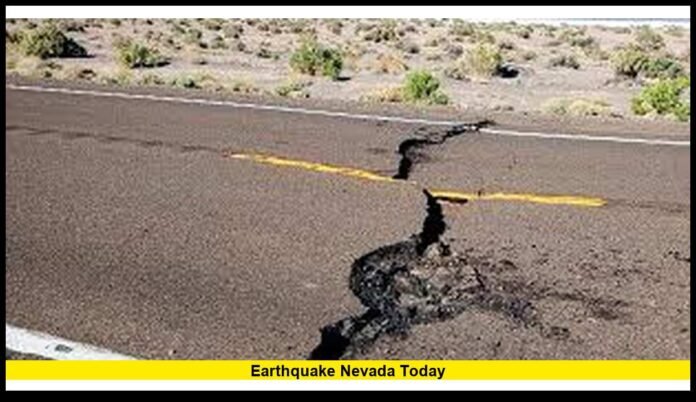

The earthquake Nevada today has caught the attention of residents and scientists after a magnitude 4.6 tremor shook parts of western Nevada early Thursday morning, December 4, 2025. The U.S. Geological Survey (USGS) confirmed that the quake struck at 5:42 a.m. Pacific Time, about 19 miles southeast of Tonopah, Nevada, in Nye County.
While no serious damage or injuries have been reported, the quake was felt across several counties and even into eastern California. Residents described the shaking as strong enough to rattle windows and household items.
Location and Magnitude Details
The USGS Earthquake Hazards Program reported that the event registered a magnitude of 4.6 at a depth of approximately 8.9 kilometers (5.5 miles), which is considered shallow by geological standards. Shallow quakes often produce stronger surface shaking over a localized area.
The epicenter was pinpointed roughly along the Walker Lane Seismic Belt, one of Nevada’s most active geological zones. This region frequently experiences small to moderate earthquakes due to crustal stretching between the Sierra Nevada and the Basin and Range Province.
Earthquake Overview
| Parameter | Details |
|---|---|
| Date | Thursday, December 4, 2025 |
| Time (Pacific) | 5:42 a.m. PT |
| Magnitude | 4.6 |
| Depth | 8.9 km (5.5 miles) |
| Epicenter | 19 miles SE of Tonopah, Nevada |
| Nearest City | Tonopah (Population: ~2,400) |
| Felt Reports | Over 1,100 (USGS “Did You Feel It?”) |
Residents across Tonopah, Goldfield, Hawthorne, and Bishop, California, reported mild to moderate shaking lasting several seconds. Seismologists note that such quakes are common in this area, where the land continues to shift slowly due to tectonic tension.
Aftershocks and Continuing Activity
Following the main shock, several smaller aftershocks were recorded. The largest so far measured 2.9 magnitude, occurring around 6:07 a.m., about 10 miles from the original epicenter.
The Nevada Seismological Laboratory at the University of Nevada, Reno (UNR), confirmed that these smaller tremors are typical after moderate quakes and do not currently suggest an escalating sequence. Monitoring stations across western Nevada and eastern California remain active, tracking ongoing seismic behavior in real time.
Seismologists have reiterated that while Nevada is known for frequent quakes, the majority are too minor to cause structural damage. Events like today’s serve as reminders of the state’s natural seismic character.
Local Impact and Emergency Response
Officials in Nye County and Esmeralda County responded promptly after the quake. Early inspections found no significant damage to roads, utilities, or buildings. Power remained fully functional in Tonopah and surrounding communities.
The Nevada Department of Transportation (NDOT) conducted structural checks along U.S. Route 95 and U.S. Route 6, the two main highways serving the area. Crews confirmed that bridges and roadways were intact and safe for travel.
Law enforcement and emergency management teams coordinated quickly to reassure the public. Nye County’s Emergency Services Office issued a brief statement confirming no injuries and reminding residents of standard earthquake safety practices.
Local schools opened as scheduled Thursday morning after officials performed building checks. Residents described brief but noticeable shaking—strong enough to wake many people before dawn.
Community Reactions and First-Hand Accounts
Many residents in western Nevada woke up to what they described as a loud, quick jolt followed by a light rolling motion.
Tonopah resident Kelly Mason, who lives near downtown, said the shaking startled her early in the morning. “It felt like a truck hit the side of my house,” she said. “It lasted maybe three or four seconds, but it was strong enough to rattle dishes.”
Nearby in Goldfield, local business owners said they noticed minor rattling but no visible damage. Social media posts from across the region show people describing the same short, sharp jolt. Some shared photos of minor household disruptions, such as fallen picture frames or tipped-over decorations.
For many longtime Nevada residents, this morning’s tremor served as a reminder that the state’s seismic history is both deep and active.
Understanding Nevada’s Earthquake Landscape
Nevada ranks third in the United States for earthquake frequency, behind California and Alaska. The state experiences hundreds of small tremors every year, most too weak to be felt.
The region affected by today’s quake lies within the Walker Lane Seismic Belt, a fault zone extending from southern Oregon to eastern California. It accommodates roughly 20–25% of the motion between the Pacific and North American tectonic plates.
Historically, Nevada has experienced several large and damaging earthquakes:
- 1932 Cedar Mountain Earthquake: Magnitude 7.2, one of the largest in state history.
- 1954 Dixie Valley–Fairview Peak Sequence: Magnitudes 6.6 and 7.1, causing widespread faulting and surface cracks.
- 2020 Monte Cristo Range Earthquake: Magnitude 6.5, located near Tonopah, causing rockslides and minor infrastructure damage.
Geologists emphasize that smaller quakes like today’s release built-up stress gradually, potentially reducing the risk of larger events in the near term.
Scientific Insight: Why Tonopah Shakes Often
Tonopah sits within a geologically complex zone where multiple fault systems intersect. The Monte Cristo Fault System, Emigrant Peak Fault Zone, and Big Smoky Valley Fault all contribute to the area’s frequent seismic events.
Because these faults do not move continuously, stress accumulates until it is released through earthquakes. The relatively shallow depth of Thursday’s quake amplified surface shaking in nearby towns.
Dr. Graham Kent, director of the Nevada Seismological Laboratory, explained that Nevada’s earthquakes are driven by regional extension forces. “The crust here is slowly stretching apart,” he said in a recent briefing. “That ongoing movement means earthquakes are a natural and expected part of the landscape.”
Monitoring data from UNR’s network shows steady low-level activity across the western half of the state throughout 2025, consistent with long-term geological trends.
Preparedness and Safety Awareness
State and local officials are reminding Nevadans to stay prepared for future seismic events, no matter how small. The Nevada Division of Emergency Management (NDEM) continues to emphasize community readiness programs.
Recommended Safety Steps
- Before an earthquake: Secure heavy furniture, mirrors, and appliances to walls. Keep flashlights and first-aid kits handy.
- During an earthquake: Drop to the ground, cover your head and neck under sturdy furniture, and hold on until shaking stops.
- After the quake: Check for gas leaks, avoid damaged buildings, and expect aftershocks.
Nevada participates annually in the Great Nevada ShakeOut, a statewide earthquake drill held each October. Officials encourage residents to revisit their preparedness plans regularly, especially in rural regions where emergency response times can vary.
Infrastructure and Transportation Update
Transportation officials confirmed Thursday afternoon that all major highways and rail lines across western Nevada are operating normally.
- U.S. Route 95: Fully open, no reported cracks or obstructions.
- U.S. Route 6: Open to traffic, no safety advisories.
- Tonopah Airport (TPH): No reported damage, air operations remain unaffected.
- Utilities: Power, gas, and water services remain stable across Nye and Esmeralda counties.
The Nevada Department of Public Safety stated that the state’s emergency coordination network functioned effectively during the morning response, ensuring timely inspections and public updates.
Seismologists Continue Monitoring
Throughout Thursday, the USGS and UNR continued analyzing seismic data from the event. Dozens of sensors across Nevada recorded the shaking, providing detailed insights into fault movement.
Initial readings show that the quake’s energy radiated outward primarily to the northeast and southwest, with moderate intensity in a roughly 40-mile radius.
As of 3:00 p.m. Pacific Time, more than a dozen aftershocks had been detected, all under magnitude 3.0. Seismologists expect this pattern to taper off within 24 to 48 hours.
While larger earthquakes cannot be predicted, data from today’s event will help researchers refine hazard models for the region.
Public Response and Education
Public engagement has grown significantly after the morning’s event. Thousands of Nevada residents accessed the USGS “Did You Feel It?” portal, helping scientists map the quake’s felt intensity.
Emergency management agencies used social media platforms to share real-time updates and safety reminders. Posts from the Nevada Department of Emergency Management emphasized calm preparedness, while local governments encouraged residents to inspect their homes and secure loose items.
Many schools and community centers plan to incorporate short earthquake awareness lessons in the coming week, reinforcing practical safety habits.
A Reminder of Nevada’s Resilient Communities
Though Thursday’s earthquake Nevada today was moderate in strength, it served as a timely reminder of Nevada’s resilience and readiness. Communities across the state—particularly in rural areas like Tonopah and Goldfield—have built strong emergency response systems over the years.
The event also highlighted the effectiveness of the USGS ShakeAlert System, which detected the tremor within seconds. Some mobile users in western Nevada reported receiving alerts moments before the shaking began.
Officials praised the coordination between local authorities, state agencies, and federal monitoring systems. “Preparedness and communication are what keep people safe,” said a representative from the Nevada Division of Emergency Management.
While no major damage occurred, today’s event underscores the importance of ongoing awareness and preparation. Earthquakes are part of Nevada’s landscape—but readiness and resilience define its people.