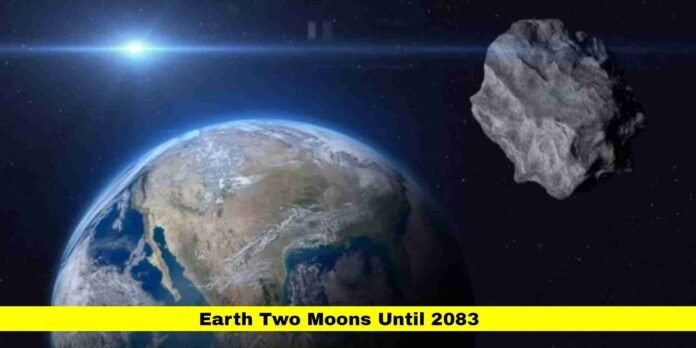

Earth two moons until 2083 has become a topic of excitement as NASA confirms a small asteroid, 2025 PN7, is temporarily sharing Earth’s orbit. Unlike the familiar Moon, this object is a quasi-satellite, appearing to accompany our planet while actually orbiting the Sun. Its presence offers a rare chance to study near-Earth objects and their orbital behavior.
Introducing 2025 PN7
2025 PN7 is a near-Earth asteroid roughly 19 meters (62 feet) wide. It does not orbit Earth in the traditional sense. Instead, it travels around the Sun in a path nearly synchronized with Earth’s orbit. This alignment makes it appear as though Earth has a second moon, though it is only a temporary companion.
The asteroid has likely been near Earth for several decades, moving quietly and unseen due to its small size and faint reflectivity. Its trajectory makes it a unique object for astronomers to study, offering insight into the dynamics of temporary celestial companions.
Orbital Behavior and Duration
Although 2025 PN7 appears to follow Earth, it remains gravitationally bound to the Sun. Its 1:1 orbital resonance with Earth means it completes one solar orbit in the same time as Earth, creating the illusion of companionship.
NASA’s projections indicate that 2025 PN7 will maintain this quasi-moon relationship until approximately 2083. After that, it will drift away and continue orbiting the Sun independently. This multi-decade period allows astronomers a long-term opportunity to monitor its motion and behavior.
Scientific Significance
The presence of a temporary second moon provides several scientific benefits. It demonstrates that Earth can capture or align with small celestial objects for extended periods. Studying 2025 PN7 helps refine understanding of orbital mechanics, gravitational interactions, and near-Earth object trajectories.
It also provides a chance to examine the asteroid’s size, composition, and rotation. Insights from this object could improve planetary defense strategies, inform future asteroid missions, and enhance models of how small bodies behave near Earth.
How a Quasi-Moon Works
A quasi-moon occurs when an asteroid’s speed and orbital path closely match Earth’s, allowing it to appear as a satellite without being gravitationally bound. Objects like 2025 PN7 are drawn into this temporary relationship due to a delicate balance between solar and terrestrial gravity.
Such temporary companions are not unique to Earth. Other planets have been observed to capture small objects in similar ways. What makes 2025 PN7 notable is its size, proximity, and predictability, which allow extended observation over decades.
Observational Opportunities
The extended duration of 2025 PN7’s quasi-moon status gives astronomers a rare chance to track and study a temporary celestial companion. Researchers can collect data on its orbit, trajectory changes, and response to gravitational forces.
Amateur astronomers may attempt to observe it, though its small size and low brightness present challenges. Its predictable orbit until 2083, however, makes it an ideal candidate for long-term study.
Clarifying Misconceptions
Although media coverage has called it “Earth’s second moon,” 2025 PN7 is not a true moon. It does not orbit Earth directly and is far smaller and fainter than the familiar lunar satellite. Its designation as a quasi-moon describes its apparent companionship rather than a permanent gravitational bond.
Understanding this distinction helps the public appreciate the uniqueness of the discovery without overestimating its scale or impact.
Implications for Earth’s Celestial Neighborhood
The discovery of a temporary second moon highlights the dynamic nature of Earth’s orbital environment. It underscores that our planet’s surroundings are not static but include objects that can temporarily accompany Earth.
This event may also prompt a broader definition of moons, including temporary or quasi-stable companions. It demonstrates the ongoing complexity and activity in near-Earth space, challenging the perception of our celestial neighborhood as unchanging.
Looking Ahead
With 2025 PN7 accompanying Earth until 2083, scientists have decades to study its behavior and refine knowledge of near-Earth objects. Observations will inform orbital models, improve asteroid tracking, and potentially aid in planetary defense planning.
This temporary second moon serves as a reminder of the constantly changing dynamics in our solar system. It invites both scientists and the public to watch and learn as Earth shares its orbit with this unique visitor for the next several decades.
Understanding 2025 PN7’s journey enriches our comprehension of Earth’s place in space and highlights the fascinating, ever-changing nature of our cosmic environment.