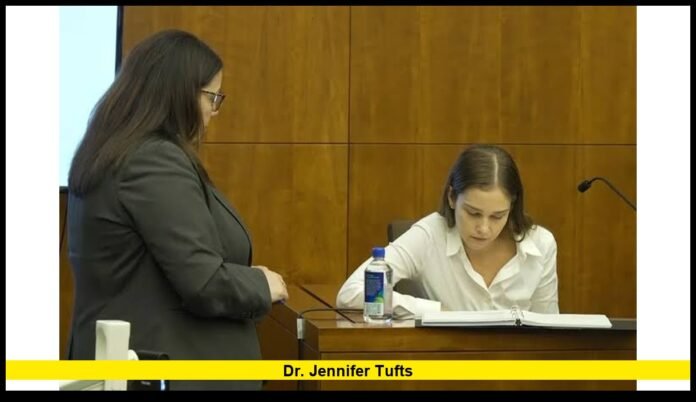

Dr. Jennifer Tufts is at the center of courtroom testimony in the ongoing Lindsay Clancy murder trial in Massachusetts, where attorneys are examining the psychiatric care Clancy received before the deaths of her three children in January 2023.
Tufts treated Clancy from September 2022 into January 2023. Her testimony has become an important part of the trial because she saw Clancy just one day before the killings. Defense attorneys have closely questioned Tufts about her experience, treatment decisions, medication management and use of telehealth appointments.
The trial remains active as of August 10, 2026. Clancy faces charges connected to the deaths of her children, while her defense argues that severe mental illness left her not criminally responsible. Prosecutors dispute that position.
Tufts’ testimony does not determine the outcome of the criminal case. Instead, jurors will consider her evidence alongside testimony from other medical professionals, family members, investigators and psychiatric experts.
Who Is Dr. Jennifer Tufts?
Dr. Jennifer Tufts is a Massachusetts psychiatrist who became involved in Clancy’s care during a period of significant mental-health difficulties.
Tufts completed medical school at the University of Vermont’s Robert Larner, M.D. College of Medicine. She later completed psychiatry residency training at Boston University.
Her professional background includes psychiatric treatment involving conditions such as depression, anxiety, trauma-related disorders, obsessive-compulsive disorder, ADHD and substance-use disorders.
Her professional profile also identifies women’s mental health and perinatal psychiatry among her areas of interest.
Tufts later practiced with Aster Mental Health in Massachusetts. Her professional background has received renewed attention because of her role in the Clancy case.
The defense has focused heavily on whether her experience was sufficient for treating a patient experiencing serious psychiatric symptoms after childbirth.
When Tufts Began Treating Lindsay Clancy
Tufts began treating Clancy in September 2022.
At the time, Clancy was dealing with anxiety, depression, sleep problems and other symptoms that later became important evidence in court.
Clancy had recently welcomed her third child, Callan. She was also preparing for changes involving work and caring for her children.
Court testimony has described a gradual deterioration in Clancy’s mental health during the months that followed.
Tufts testified about the symptoms Clancy reported during their appointments. These included anxiety attacks, depressed mood, excessive worry, guilt, reduced pleasure, difficulty sleeping and racing thoughts.
Clancy did not initially report plans to harm herself or other people.
That distinction has become significant because prosecutors and defense attorneys have offered different interpretations of her psychiatric condition during this period.
The Role of Zoloft in Tufts’ Testimony
One of the earliest treatment decisions discussed in court involved sertraline, commonly known by the brand name Zoloft.
Tufts prescribed the antidepressant after beginning treatment with Clancy.
Court testimony later addressed how Clancy responded to the medication and what happened when the dosage changed.
Clancy reported side effects, and Tufts eventually advised her to stop taking the medication.
The defense has questioned Tufts about how she documented those side effects and how she monitored Clancy’s response.
Tufts acknowledged that not every side effect discussed with Clancy appeared in the medical documentation.
That issue has given defense attorneys an opportunity to challenge the completeness of the treatment records.
Medication management has remained one of the most closely examined subjects in the trial because Clancy received prescriptions from multiple providers during the months before the deaths.
Questions About Clancy’s Worsening Symptoms
Tufts’ testimony has also provided jurors with a timeline of Clancy’s mental-health symptoms.
During the fall of 2022, Clancy reported anxiety and depression. Her sleep problems also became increasingly significant.
Sleep was particularly important because Clancy later described serious difficulties resting while caring for her newborn.
By December, testimony indicated that Clancy was experiencing more concerning emotional symptoms.
Tufts testified that Clancy had denied active suicidal thoughts during an important assessment. However, she also expressed concern about the possibility of developing suicidal thoughts.
That distinction became a major point during questioning.
The defense has argued that the overall pattern showed worsening psychiatric symptoms that required more intensive attention.
Prosecutors have emphasized what Clancy actually told medical providers during appointments and assessments.
The competing interpretations have made Tufts’ records an important part of the trial.
The January 23 Appointment
Tufts’ final appointment with Clancy before the killings is one of the most important parts of her testimony.
The appointment occurred on January 23, 2023.
The following day, Clancy killed her three children inside the family’s Duxbury home and later attempted suicide.
Tufts testified that Clancy did not express suicidal or homicidal intentions during the January 23 appointment.
She also testified that she did not observe signs of psychosis.
Those statements have become central to the prosecution’s presentation.
The defense has challenged the significance of the assessment by examining Clancy’s broader psychiatric history and the symptoms she had reported during earlier months.
The key issue for jurors is not simply what Tufts believed during the appointment. They must also determine how that evidence fits with the rest of the medical and factual record.
Defense Questions Tufts’ Postpartum Experience
During cross-examination on August 10, defense attorney Kevin Reddington questioned Tufts about her experience treating postpartum patients.
Tufts acknowledged that she received training involving postpartum mental health during her psychiatry residency.
She also testified that she had not attended specialized postpartum training or symposiums after completing residency.
That admission became a significant part of the defense questioning.
Reddington asked whether Tufts considered herself an expert in postpartum psychiatry.
Tufts did not describe herself as a postpartum expert. Instead, she identified postpartum mental health as an area of interest.
The defense has used that distinction to question whether Clancy’s condition required specialized expertise that Tufts did not possess.
Tufts’ professional qualifications and training are therefore being examined alongside her actual treatment decisions.
Read More – Lindsay Clancy Trial Today: New Court Developments, Key Evidence, and What the Jury Must Decide
Telehealth Appointments Become a Major Issue
Another important issue is the format of Tufts’ appointments with Clancy.
Tufts testified that the appointments took place through telehealth.
Defense attorneys questioned whether virtual appointments provided enough opportunity to evaluate Clancy’s changing psychiatric condition.
The questioning also addressed how Tufts divided appointment time between medication management and therapeutic support.
Tufts testified that a portion of her appointment time involved psychotherapy or supportive therapy, while the remainder focused on medication management.
The defense challenged the amount of time devoted to each part of the treatment.
This issue matters because Clancy’s defense is presenting a broader argument about the adequacy of the psychiatric care she received before January 2023.
Tufts’ testimony gives jurors a direct account of how she conducted those appointments and what information she considered when making treatment decisions.
Questions About Documentation
Medical documentation has emerged as another major issue involving Tufts.
Defense attorneys questioned her about whether all of Clancy’s reported symptoms and medication reactions appeared in the records.
Tufts acknowledged gaps in some documentation.
The defense has argued that incomplete records make it harder to understand the full severity of Clancy’s condition at the time.
Tufts, however, testified about what she remembered from her appointments and the information available to her while she was treating Clancy.
The distinction between information documented in medical records and information remembered by a treating physician has become important during cross-examination.
Jurors will ultimately decide how much weight to give each part of the testimony.
Clancy’s Other Mental-Health Providers
Tufts was not the only medical professional involved in Clancy’s psychiatric treatment.
Clancy interacted with several providers during the months leading up to January 2023.
Her treatment history included psychiatric evaluations, medication changes and other behavioral-health care.
The trial has examined a large number of prescriptions issued during that period.
Evidence presented in court has described more than 30 prescriptions involving multiple psychiatric medications between September 2022 and January 2023.
That number represents prescriptions rather than proof that Clancy took every medication simultaneously.
Different providers changed medications over time.
The defense has emphasized the complexity of that treatment history as it argues that Clancy’s condition worsened amid extensive medication management.
Prosecutors have presented the same period as part of a broader timeline of Clancy’s behavior, statements and planning.
Tufts and the Civil Lawsuits
Tufts also faces separate civil litigation connected to Clancy’s medical treatment.
Lindsay Clancy filed a malpractice lawsuit in 2026 naming Tufts and other medical providers and organizations.
Patrick Clancy also filed a wrongful-death lawsuit involving medical providers connected to Lindsay’s care.
Those cases allege that medical treatment failed to properly identify or address Clancy’s psychiatric condition.
The allegations remain unresolved.
A lawsuit is not a finding of wrongdoing, and the claims against Tufts have not been established through a final civil judgment.
The civil cases have nevertheless added another layer of scrutiny to Tufts’ role in Clancy’s treatment.
Her criminal-trial testimony is focused on what she observed and did as Clancy’s psychiatrist before the January 2023 deaths.
What Tufts Said About Suicidal Thoughts
Suicidal thoughts have been another recurring subject during testimony.
Tufts testified about assessments in which Clancy denied active suicidal intentions.
At other points, Clancy expressed concern about the possibility of experiencing suicidal thoughts.
That difference is important because psychiatric risk assessments often depend on what a patient reports during a specific appointment.
The defense has highlighted evidence suggesting that Clancy experienced worsening emotional distress.
It has also questioned whether all of her symptoms were communicated to Tufts.
Tufts testified that she did not know about certain calls Clancy had made to a suicide hotline.
She said that information would have surprised her.
The defense has used the lack of that information to raise questions about whether Tufts had a complete picture of Clancy’s mental state.
The Issue of Psychosis
Psychosis is central to the defense theory in the criminal case.
Clancy’s attorneys argue that she was suffering from severe postpartum psychiatric illness, including postpartum psychosis, when the killings occurred.
Tufts testified that she did not observe signs of psychosis during her treatment of Clancy.
She also said Clancy did not report hallucinations or other symptoms that would have led her to conclude that Clancy was psychotic during their appointments.
Other psychiatric witnesses have also discussed whether Clancy displayed psychotic symptoms during earlier evaluations.
The defense is presenting expert testimony intended to support its position that Clancy’s mental illness affected her criminal responsibility.
Prosecutors have challenged that interpretation.
The jury will eventually determine whether the evidence satisfies the applicable Massachusetts legal standard.
Why the Day Before the Killings Matters
Tufts’ January 23 appointment is particularly important because it occurred only hours before the tragedy.
The appointment provides the court with evidence about Clancy’s condition immediately before the killings.
Tufts said she did not see evidence that Clancy intended to harm herself or another person.
She also testified that she did not believe Clancy met the threshold for involuntary psychiatric commitment at that time.
The defense has challenged that assessment by pointing to symptoms that emerged throughout the preceding months.
The prosecution has emphasized Tufts’ direct observations and Clancy’s own statements during treatment.
Those conflicting views will form part of the evidence jurors must evaluate.
Tufts’ Role in the Ongoing Trial
As of August 10, 2026, Tufts remains one of the most closely examined medical witnesses in the Lindsay Clancy case.
Her testimony has addressed her education, psychiatric training, treatment relationship with Clancy, medication decisions, telehealth appointments and assessment of Clancy’s mental state.
The defense has focused particularly on her postpartum experience and the way she handled Clancy’s symptoms.
Prosecutors have relied on her testimony to establish what Clancy reported to a treating psychiatrist shortly before the killings.
Neither Tufts’ testimony nor the civil lawsuits have established that her treatment caused the deaths.
Likewise, the trial has not yet produced a final determination about Clancy’s criminal responsibility.
What Happens Next
The Lindsay Clancy trial remains underway in Massachusetts.
Additional medical experts and other witnesses are expected to address Clancy’s psychiatric history and mental state.
Their testimony will provide the jury with more information for evaluating the competing arguments from prosecutors and the defense.
Tufts’ testimony is significant because she treated Clancy during the critical months before January 2023 and met with her immediately before the deaths.
Her evidence also illustrates the central question confronting the court: how Clancy’s psychiatric condition should be understood in light of her medical records, reported symptoms, behavior and events surrounding January 24, 2023.
For now, Tufts remains a key figure in the medical evidence being presented at trial. Her qualifications, treatment decisions and final appointment with Clancy are all receiving close attention as the proceedings continue.
The continuing testimony about Dr. Jennifer Tufts is expected to remain an important part of the court’s examination of Clancy’s psychiatric history and the events preceding the January 2023 tragedy.