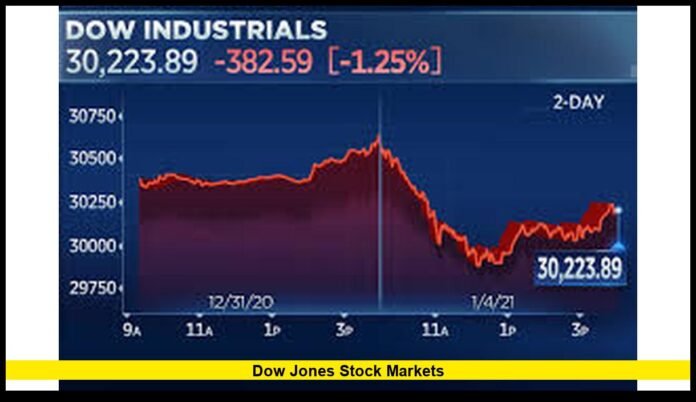

The dow jones stock markets reached a historic milestone as the Dow Jones Industrial Average closed above 50,000 for the first time in its history, marking a defining moment for U.S. equities. The move capped off a powerful rally driven by strength in industrial and financial stocks, though early-week trading quickly reminded investors that volatility remains firmly in play.
The breakthrough above 50,000 reflects strong investor confidence in the broader U.S. economy, even as markets continue to react sharply to economic data, earnings reports, and shifting expectations around interest rates.
Dow Jones Crosses 50,000 for the First Time
The Dow Jones Industrial Average surged more than 1,200 points in a single session to close above the 50,000 mark. This milestone represents a significant psychological level for investors and traders alike. The index, which tracks 30 major U.S. companies, has steadily climbed in recent months, supported by gains in industrial leaders, financial institutions, and select healthcare stocks.
Crossing a round-number milestone often sparks renewed investor enthusiasm. It can also lead to short-term repositioning as traders reassess valuations and future growth potential.
The historic close above 50,000 underscores the resilience of large-cap U.S. companies, many of which have reported solid earnings and maintained steady performance despite broader economic uncertainties.
Early Pullback Signals Ongoing Volatility
After the record-setting session, the Dow slipped below 50,000 during early trading this week. Several major components weighed on the index, including pharmaceutical and industrial names that saw modest declines.
This pullback highlights a recurring theme in the dow jones stock markets: momentum can shift quickly. Investors appear to be locking in profits following the milestone surge, while others are positioning ahead of key economic data releases.
Short-term fluctuations remain common, especially when indices reach new highs. Market participants are carefully balancing optimism with caution as they evaluate incoming economic signals.
S&P 500 and Nasdaq Show Mixed Performance
While the Dow experienced volatility, the S&P 500 hovered near record territory and the Nasdaq Composite demonstrated relative strength in select technology sectors.
Technology stocks, particularly those tied to artificial intelligence and semiconductor production, have fueled gains in recent months. However, some investors are questioning whether valuations remain justified after a strong rally. That uncertainty has led to uneven trading patterns across tech-heavy indexes.
The broader market continues to show resilience, but leadership has rotated between sectors. Industrial and financial stocks have recently outperformed, helping support the Dow’s record move, while certain growth names have experienced consolidation.
Sector Rotation Shapes Market Direction
One of the clearest trends shaping Wall Street right now is sector rotation. Investors have shifted capital between technology, financials, healthcare, and industrial companies as they adjust to evolving economic expectations.
Financial stocks have benefited from steady economic growth and stable credit conditions. Industrial companies have gained momentum amid continued infrastructure investment and corporate expansion. Meanwhile, some high-growth tech stocks have faced intermittent pressure after extended rallies.
This rotation reflects a broader strategy among institutional investors: diversify exposure while managing risk in an environment defined by rapid changes.
Economic Data in Focus
Investors are closely monitoring upcoming economic reports, including the delayed January jobs report and the latest Consumer Price Index figures. These reports are expected to provide critical insight into inflation trends and labor market strength.
Strong employment data could reinforce confidence in economic stability. At the same time, hotter-than-expected inflation numbers might influence expectations around Federal Reserve policy decisions.
Interest rate outlook remains one of the most significant drivers of stock performance. Any shift in rate expectations tends to impact valuations across sectors, particularly rate-sensitive industries such as technology and real estate.
Federal Reserve Policy Remains Key
The Federal Reserve’s stance on interest rates continues to shape investor behavior. Markets remain highly sensitive to signals regarding potential rate adjustments.
If inflation continues to cool, investors may anticipate rate cuts later in the year. Conversely, persistent inflation could lead to a more cautious approach from policymakers. Either scenario could trigger renewed volatility across equity markets.
Traders are paying close attention to speeches and statements from Federal Reserve officials for clues about the policy path ahead.
Psychological Impact of the 50,000 Milestone
Round-number milestones often carry outsized psychological significance. Crossing 50,000 may encourage additional buying from momentum-driven investors. However, it can also prompt profit-taking from those who view the level as a natural pause point.
Historically, markets have experienced both continued gains and short-term pullbacks after reaching major numerical benchmarks. The direction often depends on underlying economic fundamentals and earnings performance.
The Dow’s recent breakout suggests strong investor appetite for blue-chip stocks, but sustained growth will likely depend on continued economic strength and corporate profitability.
Corporate Earnings Support Optimism
Corporate earnings have played a central role in supporting the Dow’s climb. Several major companies reported solid quarterly results, reinforcing confidence in revenue growth and operational resilience.
Profit margins have held steady in many industries, even as companies navigate higher input costs and evolving consumer demand patterns. Positive earnings surprises have helped offset concerns about broader economic headwinds.
As earnings season continues, investors will closely examine forward guidance for insight into business confidence and spending trends.
Global Influences on U.S. Markets
International markets have also influenced recent U.S. trading sessions. Strong rallies in parts of Asia and Europe provided early momentum for U.S. futures before domestic trading reflected more cautious sentiment.
Global economic stability plays an important role in shaping the outlook for multinational corporations within the Dow. Supply chain developments, energy prices, and geopolitical dynamics remain key variables.
Despite global uncertainties, the U.S. market continues to attract capital due to its relative stability and strong corporate performance.
What Comes Next for Wall Street
Looking ahead, traders will focus on three major themes:
- Inflation Trends: Upcoming CPI data will provide clarity on whether price pressures are easing or persisting.
- Labor Market Strength: The delayed January jobs report could significantly influence market direction.
- Interest Rate Expectations: Any adjustments to rate forecasts could reshape investor positioning.
Market momentum remains strong, but volatility is likely to continue as new data emerges.
The dow jones stock markets have demonstrated remarkable resilience in reaching historic highs, yet short-term fluctuations remind investors that markets rarely move in a straight line.
Final Takeaway
The Dow’s close above 50,000 represents a historic achievement for U.S. equities and underscores investor confidence in leading American companies. At the same time, early pullbacks signal that traders remain cautious as they digest economic reports and Federal Reserve signals.
Investors navigating this environment should expect continued swings in both directions as markets respond to fresh data and earnings updates.
What do you think the Dow’s next move will be? Share your thoughts and stay tuned for the latest market developments.