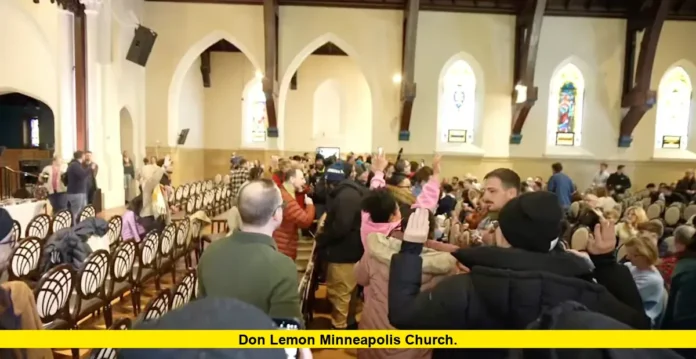

Don Lemon Minneapolis church events moved into the national spotlight after a Sunday worship service in the Minneapolis–St. Paul area was disrupted by anti-ICE protesters, triggering a federal review and igniting a wide-ranging debate about religious freedom, protest rights, and the role of media during politically charged demonstrations.
The incident unfolded at Cities Church, where congregants had gathered for a regular weekend service. What began as a routine morning of prayer and preaching quickly turned into a scene of tension when a group of activists entered the sanctuary and interrupted the service with chants and slogans opposing U.S. Immigration and Customs Enforcement.
Former CNN anchor and independent journalist Don Lemon was present and recorded the confrontation as it unfolded, sharing real-time footage and interviews from inside the church. His involvement brought national attention to the event and placed the incident at the center of a broader conversation about where peaceful protest ends and unlawful disruption may begin.
How the Protest Unfolded
Shortly after the service began, a group of demonstrators walked into the church and began chanting anti-ICE slogans. Their voices echoed through the sanctuary, interrupting prayers and the sermon. Worshippers, many of whom had families and children with them, appeared visibly unsettled as the disruption continued.
The protest lasted for several minutes, with activists accusing church leadership of alleged ties to federal immigration authorities. No physical violence was reported, but the disruption was loud and sustained enough that many congregants chose to leave the sanctuary rather than remain amid the chanting.
Church officials later described the moment as deeply distressing for their community, emphasizing that the gathering was a religious service, not a political event, and that those in attendance had not consented to the protest taking place inside the sanctuary.
Don Lemon’s Presence and Coverage
Don Lemon was on site as the protest unfolded and streamed portions of the incident live. He interviewed protesters, captured the confrontation with church leaders, and documented the reaction of worshippers as the service was brought to a halt.
Lemon stated that he was there in a journalistic capacity, asserting that his role was to record and report what was happening rather than to organize or participate in the protest itself. He later defended his actions as protected under the First Amendment, which safeguards both freedom of the press and the right to document public events.
Critics, however, questioned whether entering the sanctuary during an active disruption crossed a line between reporting and involvement. Supporters countered that journalists routinely document protests and civil unrest in sensitive locations and that recording events inside the church was part of accurately capturing the reality of what took place.
The Claim That Sparked the Demonstration
The activists’ stated motivation centered on allegations that one of the church’s pastors had professional ties to Immigration and Customs Enforcement. That claim circulated rapidly on social media in the days leading up to the protest and became the rallying point for the demonstration.
As of today, no official confirmation has established that the pastor in question holds or has held a position with ICE. Church leaders have denied institutional involvement with immigration enforcement agencies and have said that the protest was based on unverified information.
Despite the lack of confirmed evidence, the allegation was enough to draw protesters into the sanctuary, illustrating how quickly online claims can translate into real-world action, even in settings traditionally regarded as private or sacred.
Federal Authorities Step In
Following the incident, the U.S. Department of Justice confirmed that it is reviewing the disruption to determine whether federal law was violated. The review focuses on statutes that protect access to houses of worship and safeguard individuals’ right to practice their religion without interference.
One law under consideration is the Freedom of Access to Clinic Entrances Act, which, beyond healthcare facilities, also covers places of religious worship. The statute makes it unlawful to use force, threat of force, or physical obstruction to intentionally interfere with people exercising their religious beliefs.
Investigators are examining whether the protesters’ actions inside the church could meet the legal threshold for obstruction or intimidation under federal civil rights protections. No charges have been announced, and the review remains ongoing.
Political Reactions Across the Spectrum
The church disruption and Lemon’s presence at the scene immediately drew responses from national political figures and commentators.
Some lawmakers and advocacy groups called for accountability under federal law, arguing that interrupting a worship service constitutes an infringement on religious liberty. They contended that houses of worship should be protected spaces and that political demonstrations should not intrude on religious gatherings.
Others defended the protesters’ right to express opposition to federal immigration policy, while also acknowledging that the setting raised sensitive constitutional issues. Civil liberties advocates emphasized the importance of balancing free speech rights with the protection of religious practice.
The debate quickly moved beyond Minneapolis, with commentators framing the incident as a test case for how the nation handles protests that cross into spaces traditionally reserved for worship and reflection.
Impact on the Congregation
For the members of Cities Church, the disruption was more than a political controversy; it was a personal and emotional experience. Many congregants reported feeling shocked and unsettled that a place they considered a refuge for prayer and community had become the stage for a confrontation.
Some families left the service early, choosing to avoid further disturbance. Church leaders later addressed the congregation, emphasizing their commitment to peace, dialogue, and the safety of those who gather for worship.
They also reaffirmed that the church does not endorse immigration enforcement actions and that it seeks to serve its community without political affiliation, underscoring that the protest was neither invited nor coordinated with church leadership.
Broader Context: Immigration Protests in Minnesota
The incident occurred amid heightened tensions in the region related to immigration enforcement. Demonstrations against ICE operations have taken place in several Minnesota cities in recent weeks, reflecting broader national debates over border policy, deportations, and the role of federal agencies in local communities.
Minneapolis, in particular, has a long history of civic activism, and protests have become a familiar sight in the city’s public spaces. What made the Cities Church incident stand out was the choice of venue and the direct interruption of a religious service.
That distinction has made the case a focal point in discussions about where protest is appropriate and how far activists can go without infringing on the rights of others.
Legal and Constitutional Questions
The unfolding federal review highlights a complex intersection of constitutional protections:
- Freedom of Religion: The First Amendment guarantees the right to worship freely, without government interference or private obstruction. Federal laws reinforce that protection by criminalizing certain forms of disruption and intimidation at religious sites.
- Freedom of Speech and Assembly: Protesters also have constitutional rights to express dissent and assemble peacefully. Courts have long held, however, that these rights are subject to reasonable time, place, and manner restrictions, especially when they conflict with the rights of others.
- Freedom of the Press: Journalists, including independent reporters, are protected in their efforts to document events of public interest. Determining where observation ends and participation begins can be a nuanced legal question, particularly in emotionally charged settings.
The outcome of the DOJ’s review could clarify how these principles apply when protests move from public streets into houses of worship.
What Happens Next
Federal officials have not yet indicated whether charges will be filed, but they continue to assess video evidence, eyewitness accounts, and the specific actions taken by those who entered the sanctuary.
Church leaders have called for calm and for the legal process to run its course. Protest organizers have maintained that their actions were motivated by moral opposition to immigration enforcement and that their intent was to draw attention to what they view as injustice.
Don Lemon has continued to defend his role as a journalist, stating that documenting moments of conflict is essential to informing the public and fostering dialogue, even when those moments are uncomfortable or controversial.
The Don Lemon Minneapolis church incident has become a defining moment in the national conversation about the boundaries of protest, the sanctity of worship, and the responsibilities of the media in covering civil unrest. Readers are invited to share their perspectives and stay connected as this story continues to develop.