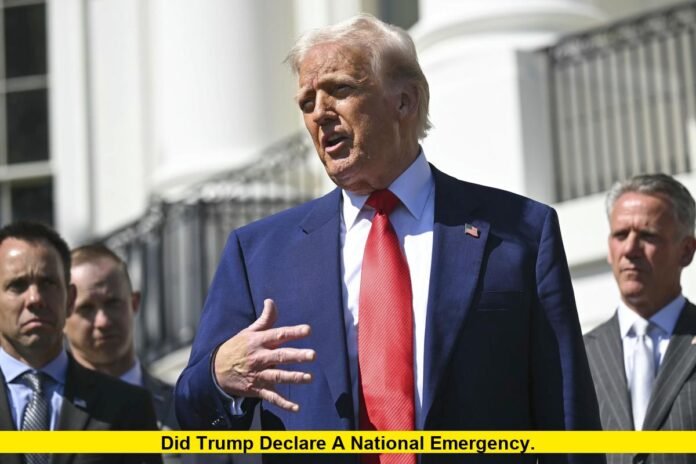

Did Trump declare a national emergency? Yes. President Donald Trump declared a national emergency on August 26, 2026, over what his administration described as foreign threats to the security of the U.S. bulk-power system. The declaration came through an executive order focused on foreign-produced equipment used throughout the nation’s electricity infrastructure.
The action does not declare a general national emergency covering the entire United States. Instead, it targets a specific national-security concern involving foreign-made equipment, software, and related technologies that can be incorporated into the country’s bulk-power system.
The White House says the measure is intended to protect the reliability, security, and integrity of America’s electricity infrastructure. The order gives federal officials new authority to scrutinize certain transactions and, in some circumstances, require equipment already in use to be secured, isolated, replaced, or removed.
What Did Trump Declare?
Trump signed Executive Order 14420 on August 26, formally titled “Declaring a National Emergency to Secure the United States Bulk-Power System.” The order invokes both the National Emergencies Act and the International Emergency Economic Powers Act, commonly known as IEEPA.
The emergency declaration concerns what the executive order calls an “unusual and extraordinary threat” originating substantially outside the United States.
The administration argues that foreign-produced electrical equipment can create national-security vulnerabilities. Those risks could involve cybersecurity, unauthorized remote access, sabotage, supply disruptions, or other interference with critical infrastructure.
The order points to America’s growing dependence on reliable electricity. It specifically highlights the expansion of data centers, artificial intelligence, advanced manufacturing, and defense production as factors increasing the importance of a secure electricity grid.
Why Did Trump Declare the Emergency?
The central concern is the possibility that foreign-made equipment incorporated into the power grid could create vulnerabilities that hostile foreign actors might exploit.
Modern electrical infrastructure relies on equipment with increasingly sophisticated digital components. Some equipment can include software, firmware, remote-access capabilities, communications systems, and other technologies that connect physical infrastructure to digital networks.
The executive order says these characteristics can create potential opportunities for malicious activity. It also identifies supply-chain dependence as a separate concern.
If the United States becomes heavily dependent on foreign suppliers for critical grid components, an international disruption could potentially affect the country’s ability to maintain or replace essential infrastructure.
The administration therefore considers the issue both a cybersecurity concern and a supply-chain security issue.
The White House says the emergency declaration is designed to address these risks before they result in a disruption to the country’s electricity infrastructure.
What Equipment Is Covered by the Order?
The executive order covers a broad range of equipment associated with the bulk-power system.
The list includes major electrical and control equipment such as:
- Substation transformers
- Generators
- Grid-connected inverters
- Battery energy-storage systems
- High-voltage circuit breakers
- Protective relaying equipment
- Metering equipment
- Industrial control systems
- Remote terminal units
- Programmable logic controllers
- Intelligent electronic devices
- Generation turbines
- Voltage regulators
- Safety instrumented systems
- Uninterruptible power supply systems supporting critical infrastructure
The order also allows federal officials to consider associated software and firmware, remote-access capabilities, maintenance systems, update mechanisms, and other supply-chain dependencies when assessing potential risks.
That means the policy is not limited to physical hardware. Digital components connected to covered equipment can also become part of the government’s security assessment.
Does the Order Ban All Foreign-Made Grid Equipment?
No.
The declaration does not establish a blanket ban on every foreign-made component used in America’s electricity system.
Instead, the executive order establishes a framework for restricting transactions involving foreign-produced bulk-power equipment when the transactions present specified security risks.
The order gives federal officials authority to determine whether particular transactions create an undue risk of sabotage, subversion, unauthorized access, malicious remote activity, supply disruption, or catastrophic consequences for U.S. critical infrastructure and the economy.
The distinction is important because foreign-produced equipment is not automatically prohibited simply because it was manufactured outside the United States.
Federal agencies must evaluate the relevant risks and apply the authorities established by the order.
What Happens to Equipment Already Installed?
The action also addresses equipment that may already be operating inside the United States.
Under the order, the Energy Secretary can impose conditions on the continued use, operation, maintenance, servicing, or updating of certain foreign-manufactured or foreign-operated equipment that was acquired or installed before August 26.
Possible measures include requirements to identify, isolate, monitor, secure, disconnect, replace, or remove equipment that is determined to pose an unacceptable risk.
The order also directs officials to consider practical consequences before requiring equipment to be disconnected or removed.
Those considerations include electricity reliability, safety, the availability of secure replacement equipment, and the need to maintain essential services.
This approach means the administration is not automatically ordering utilities to remove every piece of foreign-produced equipment from the grid.
Instead, the federal government is establishing a process for identifying equipment that presents specific security concerns and determining appropriate mitigation measures.
Which Foreign Entities Can Be Targeted?
The executive order creates the concept of a “Covered Foreign Entity.”
The designation can apply to certain countries or entities subject to U.S. arms embargoes or sanctions regimes. It can also cover entities that the relevant U.S. officials determine are engaged in conduct detrimental to U.S. national security or foreign policy.
The administration can use that framework when determining which foreign-produced equipment and transactions require additional scrutiny.
The order also permits implementing rules to identify specific countries, individuals, entities, or equipment that warrant heightened attention.
Those rules are expected to provide additional details about how the new authorities will operate.
What Federal Agencies Must Do Next
The executive order directs the Energy Secretary to work with several senior officials and agencies to implement the policy.
Federal officials are instructed to identify vulnerable bulk-power equipment and develop recommendations for securing, isolating, monitoring, or replacing equipment that poses significant risks.
The order also requires the Energy Department to develop implementing rules or regulations as needed.
Those rules are due within 120 days of the August 26 order.
That implementation period matters because the executive order establishes the authority and policy framework, while additional federal action will determine many of the practical details.
Utilities, equipment suppliers, manufacturers, and other industry participants will therefore need to follow subsequent government guidance as the program develops.
Why the Electricity Grid Is a National-Security Issue
America’s bulk-power system supports virtually every major part of the modern economy.
Electricity is essential for hospitals, emergency services, communications, financial systems, manufacturing facilities, military operations, transportation infrastructure, water systems, and millions of homes and businesses.
A major disruption could therefore have consequences far beyond the power sector itself.
The Trump administration argues that the growing importance of electricity makes the security of grid equipment a national-security priority.
The White House specifically connects the issue to the country’s expanding electricity demand from data centers, artificial intelligence, manufacturing, and defense-related production.
The emergency declaration reflects that broader concern. Protecting the grid is being treated not simply as an energy-policy issue but as part of protecting U.S. national security and economic stability.
Is This the Same as a General Emergency Declaration?
No.
This is an important distinction when answering the question, “Did Trump declare a national emergency?”
Trump did declare a national emergency, but the August 26 declaration is narrowly connected to foreign threats involving the U.S. bulk-power system.
It does not mean that the federal government has declared a nationwide emergency affecting ordinary daily life.
The order focuses on specific transactions, equipment, foreign entities, and security risks connected to critical electricity infrastructure.
The National Emergencies Act provides a legal framework for presidential emergency declarations, while the executive order uses authorities available under federal law to address the specific threat identified by the administration.
What the Latest Update Means for Americans
For most Americans, the immediate effect is not a change to household electricity service.
The order is primarily aimed at infrastructure, procurement, utilities, equipment manufacturers, and federal regulators.
Its significance lies in how the United States evaluates equipment entering or operating within critical parts of the power grid.
The administration wants to reduce the possibility that foreign-produced equipment could provide an avenue for cyberattacks, sabotage, unauthorized access, or other forms of interference.
The policy could also encourage greater use of equipment produced or secured through trusted supply chains.
However, the practical effects will become clearer as the Energy Department develops the regulations and identifies specific equipment or transactions that require action.
What Happens Next?
The next major step is implementation.
The Energy Department and other federal agencies will assess equipment and supply chains, identify potential vulnerabilities, and develop measures for addressing equipment that presents unacceptable risks.
The executive order also requires recurring and final reports to Congress concerning the national emergency.
As those actions move forward, utilities and other industry participants will have to determine whether particular equipment falls within the government’s restrictions or requires additional security measures.
The administration’s stated objective is to strengthen the U.S. electricity system without compromising reliability or essential services.
That balance will be important because replacing major grid equipment can be complicated, expensive, and time-consuming.
Did Trump Declare a National Emergency? The Answer
So, did Trump declare a national emergency? Yes. President Donald Trump formally declared a national emergency on August 26, 2026.
The emergency concerns what his administration describes as foreign threats to the U.S. bulk-power system. The accompanying executive order creates new federal authorities for reviewing certain foreign-produced grid equipment and addressing equipment that presents national-security, cybersecurity, operational, or supply-chain risks.
The declaration is therefore real and officially documented, but it is specific rather than a broad emergency declaration covering the country as a whole.
The next phase will focus on implementation, including federal assessments, regulations, equipment identification, and potential mitigation measures.
The August 26 action marks a significant new federal effort to treat the security of America’s electricity infrastructure as a national-security priority, and further developments will determine how broadly the policy affects the U.S. power industry.