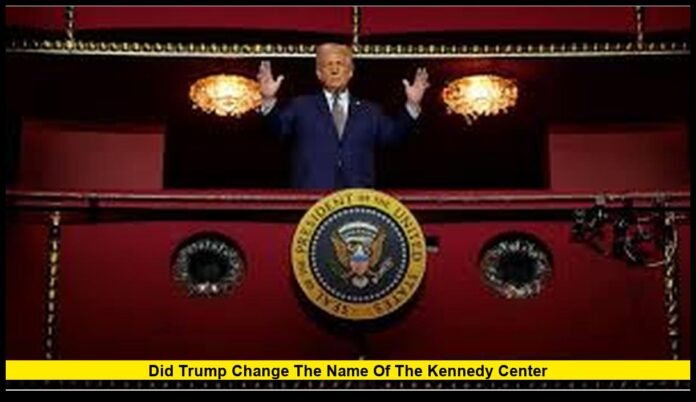

Did Trump change the name of the Kennedy Center is a question that has circulated widely across the United States, especially during periods of heightened political debate and online misinformation. Despite persistent rumors and viral claims, the official answer remains clear and unchanged: the Kennedy Center has not been renamed, and its legal name continues to honor President John F. Kennedy.
The continued confusion reflects how easily cultural institutions can become entangled in political narratives, even when no formal action has taken place.
Understanding Why the Question Keeps Resurfacing
The John F. Kennedy Center for the Performing Arts occupies a unique position in American life. It is not only a premier arts venue but also a federally established national memorial. Because of its symbolic weight, even unfounded claims about changes to the institution quickly attract attention.
Over the years, President Donald Trump’s relationship with the Kennedy Center has been closely scrutinized. His public criticism of certain honorees, absence from annual events, and changes in board leadership created fertile ground for speculation. These developments led many Americans to ask whether Trump went further and altered the center’s name.
He did not.
The Legal Status of the Kennedy Center
The Kennedy Center was created by an act of Congress and formally designated as a living memorial to President John F. Kennedy. This status is not symbolic alone. It is embedded in federal law.
Because of this structure:
- The name of the Kennedy Center cannot be changed by a president
- A board of trustees does not have naming authority
- Congressional action would be required to alter its official designation
No such legislation has ever been introduced, debated, or passed.
As a result, the name remains legally and formally unchanged.
Trump’s Relationship With the Kennedy Center
While Donald Trump did not change the name of the Kennedy Center, his presidency did mark a departure from tradition in other ways.
Trump declined to attend the Kennedy Center Honors during his term, becoming the first modern president to do so. His decision followed criticism of some honorees and public backlash from artists who opposed his policies. Several performers openly stated they would not appear at events attended by him.
These moments fueled the perception of conflict between Trump and the arts community, which later fed into rumors about institutional changes that never occurred.
Board Appointments and Misinterpretation
One factor that contributed to confusion was Trump’s influence over board appointments. As president, he exercised his authority to appoint and remove trustees, a power shared by previous administrations.
However, board membership does not equate to control over naming or mission. Trustees oversee programming, fundraising, and administration, but they do not have the legal power to rename the center or alter its memorial status.
Online discussions often blurred this distinction, leading to false assumptions about what board changes could accomplish.
Viral Claims and Social Media Confusion
In recent years, social media posts and short-form videos have falsely claimed that Trump renamed the Kennedy Center or intended to do so. These claims often lacked context or relied on misinterpreted quotes and altered images.
Some posts showed manipulated photos of signage. Others cited unnamed sources or anonymous insiders. None were supported by official documentation.
Despite repeated debunking, such claims continue to circulate, especially during election cycles or major political news events.
Why the Name Matters So Much
The intensity of the debate says more about American cultural identity than administrative reality.
The Kennedy Center represents:
- Presidential legacy
- Federal commitment to the arts
- Cultural unity across political lines
Any perceived attempt to alter its identity triggers strong emotional reactions, regardless of accuracy. This explains why the question did Trump change the name of the Kennedy Center remains so persistent.
What Has Actually Changed at the Kennedy Center
Although the name has not changed, some operational and cultural shifts have occurred over time.
These include:
- Changes in programming emphasis
- Leadership transitions
- Fluctuations in public engagement
- Political symbolism attached to attendance decisions
None of these changes affected the center’s legal identity or dedication.
The Kennedy Family’s Position
Members of the Kennedy family have consistently supported preserving the center as a memorial to President Kennedy. They have not acknowledged any legitimate effort to rename the institution because none has occurred.
Their stance reinforces the legal reality that the center’s name is protected and stable.
Public Trust and Institutional Stability
National institutions rely on public trust. When false claims spread unchecked, they can undermine confidence even when facts remain unchanged.
The Kennedy Center continues to operate under its original charter, host performances, and serve as a cultural landmark for Americans of all backgrounds.
Clarity matters, especially when political narratives risk overshadowing institutional truth.
Why No Renaming Ever Took Place
Several factors explain why renaming the Kennedy Center never happened:
- Strong legal safeguards
- Congressional oversight
- Historical precedent
- Public sensitivity to memorials
Even presidents with significant influence cannot unilaterally alter national memorials established by law.
The Broader Pattern of Political Misinformation
The debate surrounding the Kennedy Center highlights a wider pattern in modern American discourse, where cultural institutions increasingly become symbolic battlegrounds and facts often take a back seat to narrative-driven claims. In highly polarized environments, even well-established national landmarks can be pulled into political storytelling that reshapes public perception regardless of legal or historical reality.
Visual cues play a powerful role in this process. Images of signage, edited graphics, and short video clips can circulate rapidly online without explanation or context. When such visuals appear authoritative, they can convince viewers that a change is official even when the underlying legal status remains unchanged. Repetition across social platforms further reinforces these impressions, making them feel factual through sheer visibility.
Another contributing factor is the blending of satire, opinion, and reporting. Parody content, humorous posts, and speculative commentary are often shared alongside genuine news, blurring the line between entertainment and verified information. Many readers encounter these claims without realizing their original intent, allowing misinformation to spread unintentionally.
Political polarization also accelerates the cycle. When an issue aligns with existing beliefs or emotions, people are more likely to share it without scrutiny. Supporters and critics alike may amplify simplified versions of events that fit their viewpoint, leaving nuance behind. Over time, these partial narratives can overshadow official explanations and factual records.
Institutional responses, while accurate, often struggle to gain the same attention as sensational claims. Clarifications and formal statements tend to move more slowly than viral content, allowing misleading interpretations to persist long after they are corrected. This imbalance contributes to ongoing confusion even when the facts are clear.
The situation surrounding the Kennedy Center reflects how quickly misinformation can embed itself into public conversation when culture and politics intersect. It serves as a reminder that national institutions, despite legal protections and historical grounding, are not immune to distortion in the digital age. Recognizing these patterns is essential for readers seeking to separate verified information from narrative-driven claims and to maintain trust in public institutions.
Where Things Stand Today
As of now, the controversy over the Kennedy Center’s name remains one of the most discussed cultural and political stories in the nation, with both symbolic changes and real-world effects continuing to unfold.
- The official legal name of the Kennedy Center remains unchanged. Federal law still designates the building as the John F. Kennedy Center for the Performing Arts, and no act of Congress has amended that status.
- No executive order has formally renamed the center. Presidents do not have the legal authority on their own to alter the name of a federally established memorial without congressional approval.
- There has been no congressional action authorizing a name change. Despite public debate and plans proposed by some lawmakers, Congress has not passed any legislation that would legally change the center’s name.
- However, new signage and branding on the building now reflect the addition of Donald Trump’s name. Workers installed letters on the exterior that read The Donald J. Trump and The John F. Kennedy Memorial Center for the Performing Arts, and digital platforms and promotional materials have been updated to match the new branding. This visual change has been a flashpoint in the dispute.
- The renaming vote by the center’s trustees and the updated signage have triggered a wave of performance cancellations. A growing number of artists and ensembles have pulled out of scheduled shows at the venue, citing objections to the name change. Some performers have explicitly linked their cancellations to the updated signage and rebranding efforts.
- The leadership of the Kennedy Center has signaled legal and financial responses to pushback. In one high-profile case, the center’s president announced plans to pursue a lawsuit seeking significant damages against a jazz musician who canceled his holiday performance in protest of the name addition.
- Legal challenges against the renaming process have begun. A lawsuit was filed by a member of Congress who questioned the process used by the trustees to approve the change, including claims that dissenting voices were suppressed during the vote.
- Partnerships have been affected. Long-standing collaborations between the Kennedy Center and arts organizations have been suspended as a result of disagreements over the leadership changes and the name controversy.
- Public and institutional reactions continue to vary. Some broadcasters have even altered how they refer to the Kennedy Center in televised events, reflecting the new branding in voiceovers and title cards, while critics and historians emphasize that the traditional name remains the legally recognized designation.
In short, while the John F. Kennedy Center for the Performing Arts remains unchanged in law, the visible identity and cultural environment of the institution have shifted dramatically. The name debate continues to shape performances, partnerships, legal battles, and public perception moving into 2026.
Frequently Asked Questions
Did Trump change the name of the Kennedy Center?
No. The name has never been changed and remains legally protected.
Can a president rename the Kennedy Center?
No. Congressional approval would be required.
Why do people believe the name was changed?
Political controversy, social media misinformation, and confusion over board appointments contributed to the rumor.
Final Thoughts
The continued interest in whether did Trump change the name of the Kennedy Center highlights how easily cultural institutions become entangled in political storytelling. Despite widespread claims, the facts are straightforward: the Kennedy Center’s name has never been altered.
Understanding the difference between political controversy and legal reality is essential for maintaining trust in national institutions. As debates evolve, staying grounded in verified information matters more than ever.
What are your thoughts on how misinformation spreads around cultural landmarks? Join the conversation and stay engaged as this discussion continues.
Disclaimer
This article is intended for general informational and news purposes only. The information presented reflects publicly available facts as of the date of publication and does not constitute legal, political, or professional advice. Readers are encouraged to review official records and updates for the most current information.