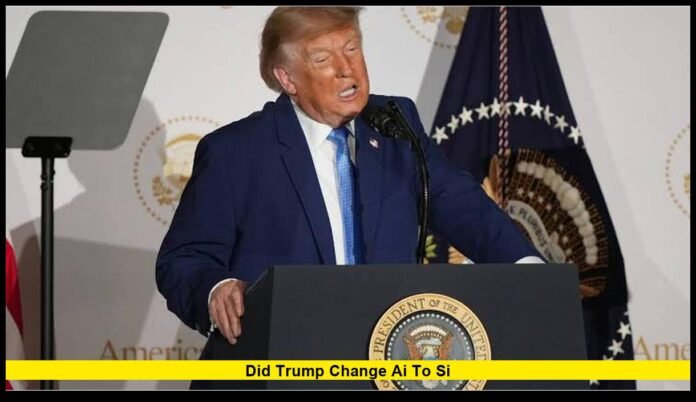

Did Trump change AI to SI? Yes, but the change is limited to how the federal executive branch refers to the technology in covered government communications. President Donald Trump signed an executive order on September 29, 2026, directing federal departments and agencies to use “Super Intelligence” (SI) instead of “Artificial Intelligence” (AI) where the order applies.
The change followed Trump’s public remarks at the United Nations General Assembly on September 22, when he introduced “Super Intelligence” as a preferred alternative to the familiar term “Artificial Intelligence.” The White House later formalized the terminology through an executive order.
The distinction is important. Trump did not change the underlying technology, and the order does not automatically rewrite every federal law that uses the term artificial intelligence. Existing statutes, regulations, contracts, grants and historical documents can continue to contain the older terminology.
What Did Trump Change From AI to SI?
The Trump administration has adopted Super Intelligence, abbreviated as SI, as the preferred terminology for artificial intelligence-related technology within the federal executive branch.
The September 29 executive order instructs federal departments and agencies to use “Super Intelligence” and “SI” instead of “Artificial Intelligence” and “AI” in covered official communications, to the maximum extent permitted by law.
That can include government correspondence, public communications, websites, reports and other materials produced by executive agencies.
The change is therefore primarily a government terminology policy.
It does not mean that every company, university, state government or individual in the United States must stop using the term AI.
The word “AI” also remains present in existing federal laws and other official records. The executive order specifically provides that previously issued regulations, presidential actions, contracts, grants and historical documents do not automatically have to be changed.
Why Did Trump Replace AI With SI?
Trump’s push for the new terminology began publicly during his September 22 address to the United Nations General Assembly.
During that speech, Trump argued that “artificial” did not accurately convey the capabilities of modern AI systems. He promoted the phrase “Super Intelligence” as a way to describe the technology’s increasing capabilities.
Trump later repeated the terminology during remarks at the White House.
The administration’s reasoning centers on the rapid development of advanced computing systems and AI models. The White House has described these systems as increasingly capable of assisting with complex tasks, scientific research, problem-solving and other activities.
The executive order turns that terminology preference into an official policy for the executive branch.
However, changing the terminology does not itself establish that every AI system qualifies as superintelligent in the technical or scientific sense.
That distinction remains important when discussing the policy accurately.
When Did Trump Announce the AI-to-SI Change?
The terminology change unfolded over several days in September 2026.
Trump first publicly promoted “Super Intelligence” during his September 22 speech at the United Nations General Assembly.
The administration then began implementing the terminology within parts of the federal government.
On September 29, Trump signed the executive order that formally directed executive-branch agencies to adopt the new terminology where legally permissible.
The same day, Trump met with major technology executives at the White House to discuss advanced AI technology, infrastructure and related issues.
The September 29 executive order became the central document establishing the federal government’s current terminology policy.
Did the United States Officially Rename Artificial Intelligence?
The answer depends on what “officially” means.
The executive branch has officially adopted Super Intelligence and SI as preferred terms under Trump’s September 29 order.
However, the United States has not eliminated the words “Artificial Intelligence” and “AI” from federal law.
That distinction prevents the change from being described as a complete nationwide renaming of artificial intelligence.
Congress has passed federal laws containing references to artificial intelligence, and those statutory references remain in place unless Congress changes them.
The executive order recognizes this legal limitation.
It instructs agencies to use the new terminology only to the extent permitted by law.
Therefore, Americans can still encounter “AI” in federal legislation, older regulations and existing government records.
Does the Executive Order Change Existing AI Laws?
No, not by itself.
The September 29 executive order does not automatically rewrite existing federal statutes.
Federal legislation remains governed by the language Congress enacted.
The administration has, however, started a process that could eventually lead to legislative changes.
The executive order directs the Assistant to the President for Science and Technology to develop proposed legislative language concerning a federal definition of “Super Intelligence” and “SI.”
That proposal is expected to examine how the new terminology could interact with existing federal definitions of artificial intelligence.
The administration has 60 days to submit the proposed legislative language.
Any changes that require amendments to federal statutes would ultimately involve Congress.
Until such legislative action occurs, existing statutory references to artificial intelligence remain legally relevant.
What Does Super Intelligence Mean Under Trump’s Order?
The phrase “super intelligence” has a broader history in discussions about advanced AI.
In technology and academic discussions, superintelligence is often used to describe a theoretical form of intelligence that exceeds human intellectual abilities across many areas.
Trump’s executive order uses the phrase differently for federal policy purposes.
For the initial implementation of the order, SI is connected to technologies and systems covered by the existing federal definition of artificial intelligence.
This means the federal government’s use of SI should not automatically be interpreted as a declaration that all current AI systems have become superintelligent.
The terminology serves an administrative purpose within the executive branch.
The administration’s planned legislative proposal could eventually provide a more specific legal definition.
Does the AI-to-SI Change Apply to Private Companies?
No.
Trump’s executive order is directed at the federal executive branch.
It does not require private technology companies to rename their AI products.
Companies such as OpenAI, Google, Microsoft, Meta, Anthropic and other technology firms can continue using the terms “AI” and “artificial intelligence.”
The same applies to universities, researchers and private organizations.
A federal agency may use SI in a government report while a private company continues to describe the same general category of technology as AI.
There is currently no requirement under Trump’s September 29 terminology order for private businesses to replace AI with SI in their products or marketing.
Will Americans Have to Start Saying SI Instead of AI?
No.
The order does not impose a general requirement on Americans to change their everyday language.
People can continue saying AI when discussing artificial intelligence.
Technology companies can continue using AI terminology.
News organizations, researchers, universities and state governments can also continue using the established terminology unless they separately adopt different policies.
The immediate change affects federal executive-branch communications.
Americans interacting with federal agencies may therefore begin seeing “SI” in new government materials.
That does not mean the term AI disappears from everyday American life.
What Happens to Existing Government Documents That Mention AI?
Existing federal documents are not automatically rewritten.
The executive order specifically protects the continued use of previous terminology in certain existing materials.
That includes previously issued regulations, presidential actions, contracts, grants and historical documents.
This creates an important distinction between old federal records and new executive-branch communications.
A government document created before the terminology change can continue to refer to artificial intelligence.
New materials covered by the order are expected to use SI where legally permitted.
As a result, both terms may appear in federal records for some time.
The coexistence of AI and SI terminology is therefore expected during the transition.
Why Is the Change Significant?
The terminology change has attracted attention because “AI” has become one of the most widely recognized technology terms in the United States.
Artificial intelligence covers a broad range of technologies, from machine-learning systems and automated tools to sophisticated generative AI models.
Trump’s administration is attempting to introduce a new federal term at a time when AI technology is expanding rapidly across government and the private sector.
The change also matters because the word “superintelligence” already has an established meaning in technology discussions.
Using SI as a broad government term could therefore create differences between ordinary federal terminology and specialized technical terminology.
The executive order addresses this by connecting its initial federal definition of SI to existing statutory definitions.
What Changed on September 29, 2026?
September 29 was the key date for the formal federal policy.
Trump signed the executive order directing executive agencies to use SI and Super Intelligence instead of AI and Artificial Intelligence in covered communications.
The order also began a process for developing a possible federal statutory definition.
The White House described the move as part of a broader effort to establish what it calls an era of Super Intelligence.
The same day, Trump held discussions with prominent technology executives about advanced AI systems and the future of the technology industry.
The executive order and those discussions formed part of a broader administration effort focused on advanced technology.
However, they should not be treated as the same policy action.
The terminology change comes specifically from the executive order.
What Is the Difference Between AI and SI?
The difference depends on context.
Artificial Intelligence, or AI, is the established broad term for computer systems capable of performing tasks associated with human intelligence.
Those tasks can include analyzing information, generating content, recognizing patterns, processing language and making predictions.
Super Intelligence, or SI, is the terminology adopted by the Trump administration for covered federal communications.
The administration intends the term to reflect the capabilities it associates with increasingly advanced AI systems.
The technical meaning of superintelligence can be narrower than the federal government’s current use of SI.
That is why readers should pay attention to context when encountering the abbreviation.
A government document using SI does not necessarily mean that the system being discussed has achieved a level of intelligence exceeding humans in every intellectual domain.
Will AI Disappear From Government Websites?
Some new federal materials may begin using SI instead of AI.
However, the transition will not remove every reference to artificial intelligence.
Existing documents remain relevant, and some statutory language cannot simply be changed through an executive order.
Federal agencies also must follow applicable laws when implementing the terminology policy.
This means Americans could encounter both AI and SI across government websites and documents.
Over time, the balance could change if agencies consistently adopt the new terminology and if Congress considers related legislative proposals.
For now, the confirmed policy is an executive-branch terminology change rather than a universal replacement.
Could Congress Change the Definition Later?
Yes.
The executive order specifically calls for proposed legislative language concerning the federal definition of SI.
That creates a potential next stage for the administration’s policy.
The science and technology adviser is expected to submit proposed language within 60 days of the September 29 order.
That proposal could address whether the existing statutory definition should be modified, expanded or replaced.
However, a proposal is not the same as enacted legislation.
Until Congress passes and the president signs any required legislation, existing federal statutes continue to control their respective definitions and requirements.
This distinction is essential when reporting on the current status.
What Does the Change Mean for the AI Industry?
The immediate impact on the private AI industry is limited.
Technology companies are not required by the executive order to rename their businesses or products.
Developers can continue referring to artificial intelligence, AI models, generative AI and related technologies.
The industry may nevertheless encounter the new terminology when dealing with federal agencies.
Companies seeking federal contracts, grants or regulatory interactions could see SI appear more frequently in government communications.
That represents a terminology adjustment rather than an automatic change to how commercial AI products operate.
Is SI Now the Official Name of All AI Technology?
No.
The federal government has adopted SI as its preferred terminology for covered executive-branch communications.
That does not make SI the universal official name for all artificial intelligence technology.
The private sector, academic community and other levels of government are not automatically bound by the terminology order.
AI remains the widely established term outside the scope of the executive order.
The most precise description is that the Trump administration has changed the preferred federal executive-branch terminology from AI to SI.
Key Facts About Trump’s AI-to-SI Change
| Issue | Current status |
|---|---|
| New federal term | Super Intelligence |
| Abbreviation | SI |
| Previous common term | Artificial Intelligence |
| Previous abbreviation | AI |
| Executive order date | September 29, 2026 |
| First major public announcement | September 22, 2026 |
| Applies to | Federal executive branch |
| Applies automatically to private companies | No |
| Rewrites existing federal statutes | No |
| Automatically changes historical documents | No |
| Proposed SI legislation | Required for consideration |
| Legislative proposal deadline | 60 days after the order |
What Happens Next?
The next major development will be the administration’s proposed legislative language for defining SI.
That proposal could provide additional information about how the White House wants the term to function within federal law.
Congress would then have to consider any statutory changes that require legislation.
Meanwhile, federal agencies will begin implementing the terminology change in applicable communications.
Americans should therefore expect to see more references to “Super Intelligence” and “SI” in federal materials while “Artificial Intelligence” and “AI” continue to appear in existing laws, records and private-sector communications.
The terminology transition is already official within the executive branch, but the broader legal meaning of SI remains a developing issue.
Frequently Asked Questions
Did Trump really change AI to SI?
Yes. Trump signed an executive order on September 29, 2026, directing federal executive-branch agencies to use “Super Intelligence” and “SI” instead of “Artificial Intelligence” and “AI” in covered communications where legally permitted.
What does SI stand for?
SI stands for “Super Intelligence” under the Trump administration’s new federal terminology policy.
Did Trump ban the word AI?
No. The order does not create a nationwide ban on the term AI. It establishes new terminology for covered executive-branch communications.
Does the change apply to private companies?
No. Private companies are not required by this executive order to replace AI with SI.
Did Trump change federal law?
The executive order does not automatically rewrite federal statutes. Existing laws containing references to AI remain in effect unless changed through the legislative process.
Why did Trump want to use SI?
Trump argued that “Super Intelligence” better represents the capabilities of modern advanced AI systems and avoids the implication that the technology is simply “artificial.”
When did Trump first announce SI?
Trump publicly promoted the term during his September 22, 2026 address to the United Nations General Assembly.
Will Americans have to use SI instead of AI?
No. The terminology change applies to the federal executive branch and does not require Americans to change their everyday language.
Will all government documents saying AI be changed?
No. The executive order does not require previously issued regulations, presidential actions, contracts, grants and historical documents to be rewritten.
Is SI the same thing as technical superintelligence?
Not necessarily. The executive order uses SI as a federal policy term connected initially to existing statutory definitions of artificial intelligence. The technical concept of superintelligence can have a more specific meaning in AI research.
What happens next?
The administration must develop proposed legislative language addressing a federal definition of SI within 60 days of the September 29 executive order. Any statutory changes would require the legislative process.
The federal government has begun the shift from AI to SI terminology, and the next stage will determine how far that change extends beyond executive-branch communications.