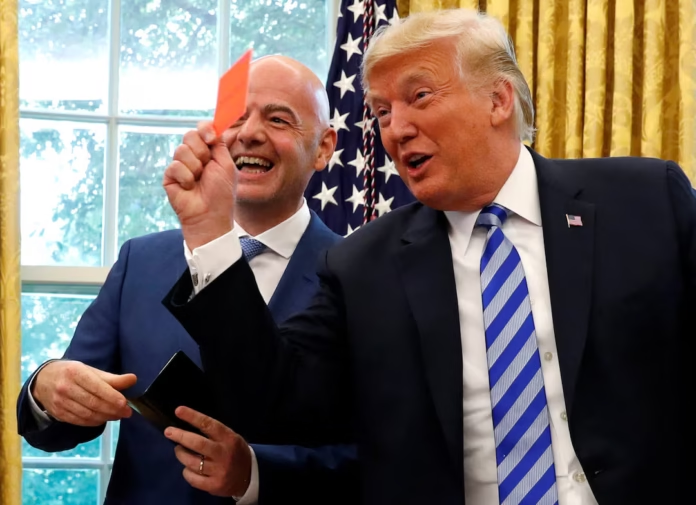

The question on many soccer fans’ minds this week is simple: did Trump call FIFA for a red card review during the 2026 World Cup? The answer, according to multiple credible reports, is yes. President Donald Trump reportedly phoned FIFA President Gianni Infantino to ask him to review a controversial red card issued to U.S. Men’s National Team striker Folarin Balogun, and the timing of FIFA’s subsequent decision to lift the suspension has stirred plenty of debate across the soccer world.
Background: What Led to Balogun’s Red Card
Folarin Balogun, a U.S.-born forward who grew up in the United Kingdom and has become one of the USMNT’s most productive attackers at this tournament, was sent off during the team’s Round of 32 match against Bosnia and Herzegovina. In the 64th minute of that game, Balogun stepped on the back of defender Tarik Muharemović’s leg. The referee did not call a foul in real time, but video assistant referee officials sent the match official to review the replay monitor, and he ultimately issued a straight red card.
Under FIFA’s disciplinary code, a red card automatically triggers a one-match suspension without appeal, a rule that has applied consistently throughout the tournament. That meant Balogun would miss the Round of 16 clash against Belgium, a significant blow for a USMNT side hosting the World Cup and hoping to advance past the knockout rounds for the first time since 2002. Balogun had already scored three goals in the tournament, including a go-ahead strike against Bosnia, putting him among the top American scorers in World Cup history.
The Main Story: Trump’s Call to FIFA
According to reporting from several major outlets, Trump called FIFA president Gianni Infantino earlier in the week to ask the organization to review Balogun’s suspension. The exact content of the conversation between Trump and Infantino has not been made public, and there is no official confirmation from the White House detailing what was discussed. What is confirmed is that the call took place, and it came before FIFA’s unusual decision.
On Sunday, FIFA announced that Balogun’s one-match ban would be suspended for a probationary period of one year, citing Article 27 of its disciplinary committee rules, which allows a judicial body to fully or partially suspend a disciplinary measure. This meant Balogun was cleared to play against Belgium in the Round of 16 match in Seattle, despite the automatic suspension rule having applied to every other red card issued during the tournament.
FIFA’s reversal was historic. Before this decision, the only prior instance of a player being allowed to play in the match immediately following a red card came in 1962, when Brazil’s Garrincha was permitted to play in the final after being sent off in the semifinal. Brazil went on to win that tournament, and remains the most recent team to win consecutive World Cups.
Shortly after FIFA’s announcement, Trump posted on Truth Social, thanking FIFA “for doing what was right, and reversing a great injustice.” Notably, Trump did not explicitly state in his post that his phone call had influenced the outcome, and FIFA’s official statement did not reference any conversation with the president.
Trump and Infantino’s Relationship
Part of why the story gained so much traction is the well-documented relationship between Trump and Infantino. The two have appeared together publicly on several occasions, and Infantino has referred to Trump as a supporter of the sport. Trump received FIFA’s inaugural Peace Prize during the World Cup draw event, and his 2025 financial disclosure revealed that Infantino had given him tickets valued at $15,000 to the FIFA Club World Cup final, which Trump attended alongside Infantino on the field for the trophy presentation. The two are also expected to appear together again at the 2026 World Cup final on July 19, where Trump is anticipated to take part in the trophy ceremony.
This existing rapport is part of why questions about whether Trump influenced FIFA’s ruling have persisted, even though there is no official confirmation from FIFA that the phone call directly changed the outcome of Balogun’s case.
Reaction From Belgium and the Soccer World
Not everyone welcomed FIFA’s decision. The Royal Belgian Football Association said it was “astonished” by the reversal, and Belgium head coach Rudi Garcia offered a pointed comparison during a press conference, joking that FIFA seemed to think July 5 was April Fools’ Day. Garcia declined to say directly whether he believed Trump’s involvement had swayed FIFA’s ruling, but the Belgian federation confirmed it was “investigating all potential options” to challenge the decision, which could include an appeal to the Court of Arbitration for Sport.
Team USA’s camp, understandably, welcomed the news. U.S. Soccer released a statement saying it accepted and was “pleased” with the Disciplinary Committee’s decision. USMNT head coach Mauricio Pochettino had earlier said Balogun was disappointed by the red card and maintained that the contact with Muharemović was unintentional. Star midfielder Christian Pulisic also defended his teammate publicly, saying the foul showed “zero intent” and that he had seen far more egregious challenges go unpunished earlier in the tournament.
Balogun himself had commented before the reversal that he believed a yellow card, rather than a red, would have been the fair outcome. Following news of his reinstatement, he shared a celebratory social media post rather than speaking directly to the press, as U.S. Soccer opted not to make him available for comment that day.
Public Interest and Why This Story Matters
The reason this story has captured such widespread public interest goes beyond a single soccer match. It touches on questions of political influence in international sports governance, the credibility of FIFA’s disciplinary process, and fairness in officiating during one of the most-watched sporting events in the world. For an American audience hosting the World Cup for the first time since 1994, the stakes around Balogun’s eligibility were especially high, given the USMNT’s push to reach the quarterfinals for the first time in over two decades.
The controversy also plays into a broader storyline about FIFA’s rules on red cards and suspensions. Former USA World Cup player John Harkes, who was himself suspended during his playing career for accumulated cautions, has publicly called for FIFA to reconsider how it handles suspension appeals going forward, suggesting the current system may need more flexibility.
Latest Updates
As of the most recent reporting, Balogun was cleared to play for the United States against Belgium in the Round of 16 match at Lumen Field in Seattle. FIFA’s official statement confirmed that the suspension of his ban would remain in effect on a probationary basis for one year, meaning a similar disciplinary infraction during that period could result in the original suspension being reinstated alongside any new penalty. The Belgian federation had not, as of the latest updates, filed a formal appeal, though it left the door open to further action. There has been no official statement from FIFA acknowledging that Trump’s call played a direct role in the disciplinary committee’s ruling, and the White House has not issued a detailed public statement confirming the specifics of the conversation.
Final Thoughts
So, did Trump call FIFA for a red card review? Multiple independent reports from major news organizations confirm that he did reach out to Gianni Infantino regarding Folarin Balogun’s suspension, and that call came before FIFA’s unprecedented decision to lift the ban. What remains unconfirmed is whether the phone call was the deciding factor in FIFA’s ruling, since the organization has not officially linked the two events. What is clear is that the episode has added a new layer of intrigue to an already high-stakes World Cup, raised questions about the intersection of politics and international sports governance, and set the stage for continued scrutiny as the tournament heads toward its final stages. Fans, players, and soccer officials alike will likely be watching closely to see whether this becomes a one-time exception or a sign of things to come in how FIFA handles disciplinary decisions under public and political pressure.
Stay tuned for more updates on this developing story, and share your thoughts in the comments below on whether you think FIFA made the right call.