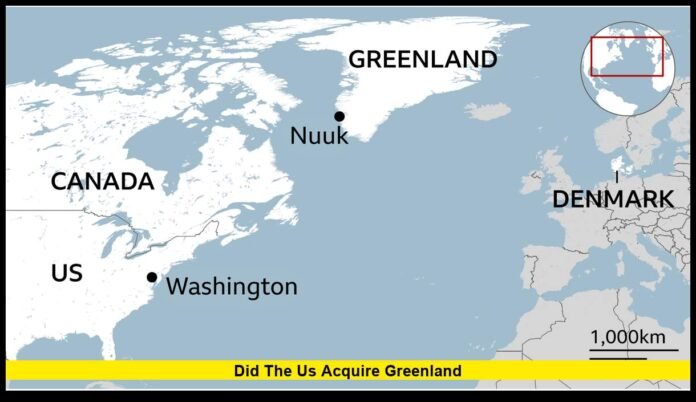

Did the US acquire Greenland? No. As of September 19, 2026, Greenland has not become U.S. territory, and the United States has not purchased or taken sovereignty over the Arctic island. The latest development is a new security agreement involving the United States, Denmark and Greenland that would give Washington permanent access, basing and overflight rights while allowing a larger American military presence.
The announcement represents a major development in the long-running dispute over Greenland. President Donald Trump has repeatedly argued that Greenland is important to U.S. national security and has previously pushed for American control of the island.
The new agreement takes a different route. Rather than transferring Greenland to the United States, it focuses on military access and security cooperation.
Denmark and Greenland have emphasized that the arrangement recognizes the sovereignty and territorial integrity of the Kingdom of Denmark. Greenland’s right to self-determination also remains part of the political framework.
Greenland Remains Part of the Kingdom of Denmark
Greenland remains part of the Kingdom of Denmark.
It has extensive self-government and operates its own parliament and government. Denmark retains responsibility for areas including foreign policy, security and defense under the current constitutional arrangement.
That status has not changed because of the latest U.S.-Denmark-Greenland agreement.
The distinction is important because military access does not automatically mean territorial ownership. Countries can provide another nation with permission to operate military forces, use airspace or maintain bases without transferring sovereignty.
That is essentially the central point in the latest Greenland development.
The United States is receiving broader security rights, but Greenland has not been transferred to Washington.
What the United States and Its Partners Agreed To
President Trump announced the agreement on September 18, 2026.
The publicly reported terms provide the United States with permanent access, basing and overflight rights in Greenland. The agreement is also intended to prevent U.S. adversaries from establishing military bases or maintaining military forces on the island without American approval.
The arrangement also addresses sensitive foreign investment.
According to information released about the agreement, countries regarded as U.S. adversaries would face restrictions on sensitive investments in Greenland without American approval.
The United States would therefore gain a much stronger long-term security position on the island.
However, the agreement does not make Greenland American territory.
That difference answers the central question directly.
Why the New Agreement Is Not a U.S. Purchase
A territorial acquisition would require a transfer of sovereignty.
The current agreement does not describe such a transfer.
Instead, it establishes military and security rights for the United States while leaving Greenland within the Kingdom of Denmark. Danish and Greenlandic officials have specifically said that the arrangement recognizes Danish sovereignty and Greenlandic self-determination.
The agreement is therefore better understood as a security arrangement rather than a real estate transaction or territorial sale.
The United States may receive significant operational rights, but those rights are different from ownership.
This distinction also explains why headlines about expanded U.S. control can sometimes create confusion.
What Trump Announced
Trump described the agreement in unusually broad terms.
In announcing the deal, he said the United States would have permanent control over security and other security-related needs in Greenland. He also said Washington would begin developing a larger military presence on the island.
Trump further stated that U.S. adversaries would not be allowed to establish bases, maintain military forces or make sensitive investments in Greenland without American approval.
The administration views the arrangement as a way to secure long-term American access to Greenland.
The agreement also seeks to ensure that countries such as China and Russia cannot establish strategic military or economic footholds on the island.
Despite the strong language surrounding U.S. security control, the arrangement does not amount to American ownership of Greenland.
Denmark and Greenland Have a Different Emphasis
The Danish and Greenlandic governments have described the agreement in terms of security cooperation.
Danish Prime Minister Mette Frederiksen said the agreement recognizes the sovereignty and territorial integrity of the Kingdom of Denmark as well as Greenland’s right to self-determination.
Greenland’s Prime Minister Jens-Frederik Nielsen said the arrangement would strengthen security for Greenland, Denmark, the United States and the broader Western alliance.
Those statements are significant because Greenland’s political status remains unchanged.
The island continues to have its own elected government and extensive domestic authority.
The agreement instead creates a new framework for cooperation over defense and strategic security.
The Agreement Has Not Yet Fully Taken Effect
Another important detail is the timing.
Although Trump announced that the United States, Denmark and Greenland had reached an agreement, the arrangement still requires formal steps before it takes effect.
The Danish government has said the three sides are expected to formally sign the agreement during the United Nations General Assembly in New York.
The agreement will then go through the necessary parliamentary procedures.
This means the September 18 announcement should not be confused with an immediate change in Greenland’s legal status.
There has been no completed transfer of territory.
The current development is a political and security agreement that still has formal procedures ahead.
What Happens to U.S. Military Presence in Greenland?
The United States already has an important military installation in Greenland.
Pituffik Space Base sits in the northwestern part of the island and supports U.S. space and missile-warning missions.
The new agreement could allow Washington to develop additional military facilities and increase its presence.
Reuters reported that the agreement provides permanent access, basing and overflight rights. It also reported that the arrangement would remain relevant even if Greenland eventually became independent.
That provision is particularly important to U.S. planners because Greenland has a separate political identity and a continuing independence movement.
Washington would have long-term security access regardless of future changes in Greenland’s political relationship with Denmark, based on the reported terms.
Again, that does not mean the United States owns the island.
The Existing U.S. Presence Predates the New Agreement
American military involvement in Greenland did not begin in 2026.
The United States has maintained a defense relationship with Denmark and Greenland for decades.
During World War II, the United States took on responsibility for defending Greenland after Germany occupied Denmark.
The American military presence continued after the war and later became part of the broader defense relationship between Washington and Copenhagen.
The United States still operates Pituffik Space Base today.
The new agreement therefore does not create the first American military presence in Greenland.
Instead, it establishes a broader and potentially more permanent framework for American security activity.
Why Greenland Matters to U.S. Security
Greenland occupies a strategically important position in the Arctic and North Atlantic.
Its location makes it valuable for missile warning, space surveillance, air defense and monitoring activity across the northern approaches to North America.
The island also sits between North America and Europe.
That geography has made Greenland important to both the United States and its NATO allies for decades.
The new agreement reflects those security concerns.
Washington wants to ensure that hostile powers cannot establish military facilities or gain sensitive strategic access to the island.
The agreement also provides the United States with a long-term framework for military operations.
China and Russia Are Central to the Security Issue
One of the main purposes of the new arrangement is to limit the strategic influence of countries outside the NATO alliance.
The reported terms prohibit adversarial military bases and military presence in Greenland without U.S. approval.
They also address sensitive investments.
The State Department has said the agreement ensures that the United States can maintain permanent access and prevent adversaries from establishing a strategic foothold on the island.
This gives the agreement a broader purpose than simply increasing the number of U.S. troops or facilities.
It establishes rules intended to keep Greenland within the strategic defense area of North America and its Western allies.
Greenland’s Self-Government Has Not Disappeared
Greenland’s political system remains intact.
The island has its own parliament, government and domestic responsibilities.
Greenland’s self-government arrangement allows its political authorities to manage areas of responsibility transferred from Denmark. Denmark continues to handle certain national functions, including major aspects of foreign and defense policy.
The new security agreement does not eliminate Greenland’s self-government.
Nor does it turn Greenland into a U.S. territory.
The agreement instead involves all three governments in a security framework.
That makes the current situation different from an outright territorial transfer.
Could Greenland Become Independent Later?
Greenland has a recognized right to self-determination within its existing political framework.
Its self-government arrangement provides a process through which independence could eventually be pursued.
The new agreement does not remove that possibility.
In fact, reports about the deal indicate that the United States wants its security rights to continue even if Greenland’s political status changes in the future.
That means the security agreement and the question of Greenland’s ultimate political future are separate issues.
Greenland can remain within Denmark while the agreement operates.
Its political future could also develop differently without automatically changing the U.S. security provisions described in the reported agreement.
How the Latest Deal Differs From Trump’s Earlier Position
The new arrangement represents a significant change from the territorial goal Trump previously promoted.
Earlier in 2026, Trump continued to argue that the United States needed to acquire Greenland.
Danish and Greenlandic officials repeatedly rejected the idea of a U.S. takeover and maintained that Greenland was not for sale.
The September agreement does not accomplish that territorial objective.
Instead, it provides Washington with many of the security capabilities it has sought.
The United States receives permanent access and military rights without Greenland becoming American territory.
That is the fundamental difference between the earlier acquisition proposal and the agreement announced this week.
What the United States Gains
The latest arrangement gives Washington several important security advantages.
These include:
- Permanent access to Greenland.
- Basing rights.
- Overflight rights.
- A framework for expanding U.S. military infrastructure.
- Greater ability to conduct security operations.
- Restrictions on adversarial military activity.
- Restrictions on certain sensitive foreign investments.
- A long-term security relationship involving Greenland and Denmark.
Those rights could substantially increase America’s strategic position in the Arctic.
They do not, however, amount to territorial ownership.
What the United States Did Not Gain
The United States did not gain sovereignty over Greenland.
Greenland did not become a U.S. state.
It did not become a U.S. territory.
Denmark did not announce the sale of Greenland.
There has also been no announcement that Greenland has been annexed by the United States.
Instead, Denmark remains the sovereign state responsible for the Kingdom’s constitutional and international position, while Greenland continues to exercise extensive self-government.
This is why the answer to the question remains straightforward.
Did the US Acquire Greenland? The Current Answer
Did the US acquire Greenland? No.
As of September 19, 2026, the United States has not acquired Greenland as territory.
What has changed is the security relationship.
Washington, Copenhagen and Nuuk have reached an agreement that would give the United States permanent access, basing and overflight rights and permit a larger American military presence.
The agreement also seeks to prevent adversarial countries from establishing military bases or making certain sensitive investments on Greenland.
The deal still requires formal signing and parliamentary procedures before it fully takes effect.
Greenland remains part of the Kingdom of Denmark.
Its self-government remains in place.
The United States gains a much stronger long-term security position, but that is not the same thing as owning the territory.
For Americans following the issue, this distinction is the most important point to remember. The latest development concerns security, military access and strategic control—not a completed transfer of Greenland to the United States.
What do you think about the latest U.S.-Greenland security agreement? Share your thoughts in the comments and stay updated as the arrangement moves through its next formal steps.
Greenland is believed to have oil and other natural resource potential beneath its waters, making its energy resources a topic of interest. Do you want to read more about whether Greenland has oil and what its resource potential looks like?