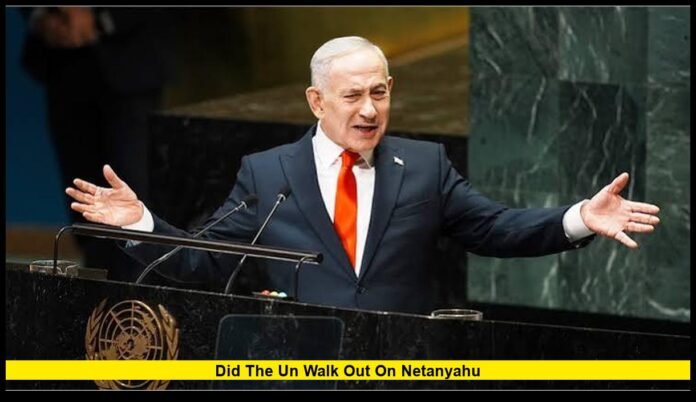

Did the un walk out on netanyahu? The answer requires an important distinction: the United Nations itself did not leave the chamber, but dozens of representatives from member-state delegations walked out as Israeli Prime Minister Benjamin Netanyahu began speaking at the General Assembly on September 24, 2026.
The highly visible departure took place at U.N. headquarters in New York during the 81st session of the General Assembly. As Netanyahu approached the podium, numerous diplomats stood and exited the hall. The departure left many seats empty while other representatives stayed and listened.
The incident quickly became one of the most prominent moments of Netanyahu’s appearance at the annual international gathering.
Netanyahu did not leave the podium. Instead, he responded directly to the departing delegates before continuing with an extended defense of Israel’s actions.
What Happened When Netanyahu Took the Podium
The walkout happened almost immediately as Netanyahu began his address.
Representatives from numerous countries stood from their seats and moved toward the exits. Video from inside the chamber showed a large number of delegates leaving while Netanyahu prepared to speak.
The departure did not stop the session.
Netanyahu remained at the podium and waited as the movement continued. Once he began speaking, he addressed the delegates who had departed and challenged others who were considering doing the same.
He referred to those leaving as “moral cowards” and invited anyone else who wanted to leave to do so.
The remark drew cheers from people who remained in the chamber.
The Israeli delegation also showed support for Netanyahu, with members standing and chanting “Am Yisrael Chai,” a Hebrew expression meaning “the people of Israel live.”
General Assembly President Khalilur Rahman repeatedly called for order as the reaction unfolded.
The result was a dramatic opening to a speech that had already attracted significant international attention.
The United Nations Did Not Formally Walk Out
The wording surrounding the event is important.
The United Nations did not make a collective decision to abandon Netanyahu’s speech. There was no formal U.N. action ordering the organization or all member states to leave the chamber.
Instead, individual national delegations made the decision to walk out.
The General Assembly continued operating.
The presiding officer remained in place.
Netanyahu was permitted to deliver his address.
This means descriptions suggesting that the entire United Nations walked out are misleading if they imply a formal institutional action.
A more precise description is that dozens of representatives walked out of the General Assembly chamber during the beginning of Netanyahu’s address.
That distinction is particularly important for readers trying to understand videos and headlines circulating online.
Why Did Delegates Leave?
The departure was a protest against Israel and its military operations.
The Palestinian delegation had encouraged other diplomatic missions to participate in the walkout. The protest came amid continuing international criticism of Israel’s conduct in Gaza and its wider military actions in the region.
Delegates who participated in the departure used their presence, or absence, to send a public diplomatic message.
The timing made the protest especially visible.
Rather than leaving during a less prominent portion of the meeting, representatives exited as Netanyahu took the podium. Television cameras captured the movement, making the event immediately visible to audiences around the world.
The walkout therefore became part of the political and diplomatic story surrounding the speech itself.
How Large Was the Walkout?
Reports consistently described the departure as involving dozens of delegates or envoys.
There is no single confirmed figure that should be treated as the exact total number of individual representatives who left.
That is because national delegations can include several people, and the number of people physically present can change throughout a General Assembly session.
The clearest confirmed description is that dozens of representatives from numerous countries walked out.
Images and video showed a substantial portion of the chamber emptying as Netanyahu began speaking.
Other representatives remained.
The Israeli delegation stayed in the hall.
Supporters in the gallery also continued to back Netanyahu.
The Chamber Became a Symbol of the Dispute
The visual contrast was striking.
One group of diplomats left.
Another group stayed.
Netanyahu continued speaking.
Supporters applauded and chanted.
The presiding officer called for order.
The scene demonstrated the sharp divisions surrounding Israel’s conduct and Netanyahu’s government at the General Assembly.
For viewers watching from the United States, the footage could easily appear to show the entire international body rejecting Netanyahu.
The reality was more specific.
The walkout represented the actions of numerous national delegations. It did not represent a formal decision by the United Nations as an organization.
Netanyahu’s Immediate Response
Netanyahu used the first moments of his address to respond to the departures.
Rather than ignoring the emptying chamber, he made it a central part of his opening.
He questioned the decision of those who left and described them in sharply critical terms.
The remaining supporters responded with applause.
Netanyahu then moved into the substance of his address.
He defended Israel’s military actions and argued that Israel’s security operations were necessary to protect the country and confront threats across the region.
The opening exchange ensured that the walkout remained closely connected to the rest of his speech.
What Netanyahu Said About Iran
A major part of Netanyahu’s address concerned Iran.
He defended Israel’s military campaign against Iranian targets and described the destruction of Iran’s nuclear facilities as a necessary decision.
Netanyahu argued that Israel had acted to prevent a potentially catastrophic threat.
He also claimed that Israel’s actions benefited countries whose representatives had walked out.
Netanyahu said some foreign leaders had privately thanked Israel for its actions against Iran.
Those remarks formed part of his broader argument that Israel was fighting threats that extended beyond its own borders.
The Iranian conflict therefore became one of the main subjects of his address.
Netanyahu Also Defended Israel Over Gaza
The Israeli prime minister also addressed accusations surrounding Israel’s conduct in Gaza.
He rejected claims that Israel had committed genocide.
Netanyahu argued that Israel’s military actions were intended to defend the country and defeat Hamas.
The Gaza conflict has generated intense international criticism, with governments and international organizations sharply divided over Israel’s conduct and the humanitarian consequences of the fighting.
Netanyahu used the General Assembly platform to present Israel’s position directly to an international audience.
His comments came shortly after the walkout, meaning the empty seats remained an important backdrop throughout the speech.
Why the Palestinian Delegation Was Central to the Protest
The Palestinian delegation played an important role in organizing the protest.
A memo circulated to diplomatic missions encouraged other representatives to join the departure when Netanyahu began speaking.
The decision reflected the Palestinian leadership’s opposition to Netanyahu’s policies and Israel’s military campaign.
The walkout therefore had an organized diplomatic component rather than being an entirely spontaneous reaction.
Representatives who participated were visibly joining a broader protest as Netanyahu took the stage.
This helped explain why so many people moved toward the exits at roughly the same time.
Not Every Delegation Left
Another important point is that the chamber did not become completely empty.
Some representatives stayed.
The Israeli delegation remained.
Supporters of Netanyahu continued applauding and chanting.
Other officials remained seated while the speech proceeded.
That means the event cannot accurately be described as unanimous opposition among all U.N. members.
Instead, the scene showed a sharp division among the representatives attending the General Assembly.
Some chose to make their opposition visible through a walkout.
Others chose to remain.
Netanyahu Continued His Speech
Despite the departure, Netanyahu completed his address.
The walkout did not prevent him from speaking.
The General Assembly meeting continued, and Netanyahu used the platform to discuss Israel’s security concerns, Iran, Gaza and international criticism of his government.
The speech lasted roughly 40 minutes and took on a strongly political tone.
He also criticized figures and governments that have condemned Israel.
His appearance became both a diplomatic address and a forceful defense of his government’s position.
Why the Event Drew So Much Attention
Netanyahu’s appearance was already highly anticipated before he entered the General Assembly chamber.
Israel’s war in Gaza remains a major international issue. The conflict involving Iran has also created additional regional tensions.
Those disputes have produced increasingly sharp disagreements among governments.
Against that background, the General Assembly provided a global stage where Netanyahu could address criticism directly.
The walkout amplified the confrontation.
Instead of simply delivering a speech before a full diplomatic audience, Netanyahu began speaking after numerous delegates had visibly left.
The empty seats became part of the imagery surrounding the event.
The Difference Between a Walkout and a U.N. Decision
Understanding the institutional difference is essential.
The United Nations is an international organization whose General Assembly includes 193 member states.
National governments send representatives to the Assembly.
Those representatives can participate in debates, remain seated, leave meetings or stage diplomatic protests.
A decision by representatives to leave does not automatically mean that the United Nations organization itself has taken a formal position.
In Netanyahu’s case, there was no indication of a formal decision by the General Assembly to cancel or block his address.
He was still recognized as the scheduled speaker.
The meeting continued.
That is why the phrase “the U.N. walked out” needs to be interpreted carefully.
What the Images Showed
Images from the chamber provided a clear visual record of the event.
Delegates could be seen moving toward exits as Netanyahu took the podium.
The Israeli prime minister remained at the front of the chamber.
After the departures, many seats were visibly empty.
Other representatives stayed in place.
The Israeli delegation and Netanyahu’s supporters reacted positively to his appearance.
The contrasting reactions created an unusually dramatic scene for a General Assembly address.
It also helped the footage spread rapidly across television, news websites and social media.
How This Compares With Earlier Netanyahu Appearances
The 2026 event was not the first time delegates walked out during a Netanyahu General Assembly appearance.
A similar mass departure occurred during his 2025 address.
That earlier protest also attracted widespread attention and showed the depth of international disagreement surrounding Israel’s policies.
The 2026 walkout followed the same broad pattern.
Delegates left when Netanyahu began speaking.
Netanyahu continued.
Supporters remained.
The difference in 2026 was the broader regional context, including the continuing Gaza conflict and the confrontation involving Iran.
What the Walkout Means in Practical Terms
The walkout had symbolic and diplomatic significance.
Leaving the chamber allowed participating delegations to publicly distance themselves from Netanyahu’s government and its policies.
However, the action did not prevent Israel’s prime minister from addressing the General Assembly.
It did not cancel the speech.
It did not remove Israel from the United Nations.
It did not represent a unanimous decision by all member states.
The immediate effect was therefore diplomatic and symbolic rather than procedural.
The images communicated disagreement without stopping the scheduled proceedings.
Why Headlines Can Be Misleading
Short headlines often simplify complex international events.
A headline saying the “U.N. walked out” may refer to delegates leaving the U.N. chamber rather than the organization itself taking action.
That difference matters.
For readers searching for the facts, the most accurate description is that dozens of delegates walked out during Netanyahu’s address.
The United Nations continued its General Assembly proceedings.
Netanyahu remained at the podium.
Those facts can coexist.
The walkout was real.
The institutional claim that the United Nations itself walked out is not accurate.
The Latest Confirmed Picture
As of September 25, 2026, the confirmed account is straightforward.
Netanyahu addressed the 81st General Assembly in New York on September 24.
As he began speaking, dozens of representatives from different national delegations left the chamber.
The Palestinian delegation had encouraged missions to participate in the protest.
Netanyahu responded by criticizing those who departed.
His supporters applauded and chanted.
General Assembly President Khalilur Rahman called for order.
Netanyahu continued his speech and defended Israel’s actions concerning Iran and Gaza.
The General Assembly remained in session throughout the address.
No formal institutional walkout by the United Nations occurred.
Why the Distinction Matters for U.S. Readers
For American readers following international affairs, the distinction between the U.N. and its member-state delegations provides essential context.
The General Assembly is a forum for governments to present their positions.
Individual countries frequently use diplomatic gestures to express disagreement.
A walkout is one such gesture.
It can attract international attention without changing the legal or institutional status of the meeting.
In this case, the event demonstrated the intensity of disagreement surrounding Netanyahu while also showing that diplomatic participation continued despite the protest.
The speech proceeded.
The meeting remained active.
The delegates who stayed heard Netanyahu’s arguments.
Those who left made their opposition visible.
Both actions occurred within the same General Assembly session.
The Bottom Line
The September 24 event was a significant diplomatic protest, but it should not be described as the United Nations itself abandoning Netanyahu.
Dozens of delegates walked out as the Israeli prime minister began his address. Their departure was connected to opposition to Israel’s military operations and policies, particularly regarding the Palestinian territories.
Netanyahu responded forcefully and continued his speech despite the largely reduced audience.
The episode showed the depth of disagreement surrounding Israel at the 2026 General Assembly while also making clear that the United Nations’ proceedings continued.
The most accurate summary is simple: numerous national representatives walked out, while the General Assembly itself remained in session.
What do you think about the dramatic scenes at the General Assembly? Share your thoughts and stay informed as this story develops.