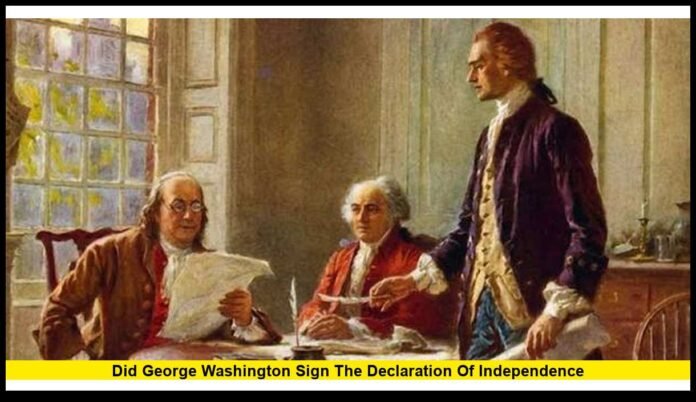

The question did George Washington sign the Declaration of Independence is one that has puzzled generations of Americans. Because George Washington became the leading military commander of the American Revolution and later the first President of the United States, many people naturally assume his signature appears on the nation’s most famous founding document. However, the historical record tells a different story. Washington did not sign the Declaration of Independence, and there are well-documented reasons why his name does not appear on it.
Understanding why George Washington did not sign the Declaration of Independence requires looking at the events of 1776, his role during the Revolutionary War, and the process through which the Declaration was drafted, approved, and signed.
Introduction
Few figures are more closely associated with American independence than George Washington. His leadership of the Continental Army transformed him into a national hero, while his later presidency helped establish the foundations of the new republic. Yet despite his central place in American history, George Washington was not among the signers of the Declaration of Independence.
This fact sometimes surprises students, history enthusiasts, and even lifelong Americans. The misunderstanding often arises because Washington’s contributions to independence were so significant that many assume he participated in every major founding event. In reality, his responsibilities as commander of the Continental Army kept him away from Philadelphia when Congress adopted and signed the Declaration.
George Washington Before American Independence
Before becoming the military leader of the American Revolution, George Washington had already built an impressive career.
Born on February 22, 1732, in Virginia, Washington worked as a surveyor before serving as a military officer during the French and Indian War. His experience earned him respect throughout the American colonies and established his reputation as a capable leader.
As tensions with Great Britain increased during the 1760s and early 1770s, Washington became increasingly involved in colonial resistance. Although he initially hoped for reconciliation with Britain, he gradually came to support stronger action as disputes over taxation, representation, and colonial rights intensified.
When the Second Continental Congress met in Philadelphia in 1775, delegates selected Washington as Commander-in-Chief of the Continental Army. This appointment would define the remainder of his career and explain why he was absent during one of America’s most famous political events.
The Creation of the Declaration of Independence
To understand why George Washington did not sign the Declaration of Independence, it helps to understand how the document came into existence.
By the summer of 1776, many colonial leaders believed that complete independence from Great Britain had become necessary. The Continental Congress appointed a committee to prepare a declaration explaining why the colonies were separating from British rule.
The committee included:
- Thomas Jefferson
- John Adams
- Benjamin Franklin
- Roger Sherman
- Robert R. Livingston
Thomas Jefferson drafted most of the document, with input from the other committee members. After revisions and debate, Congress formally adopted the Declaration of Independence on July 4, 1776.
The Declaration announced that the thirteen colonies considered themselves free and independent states, no longer subject to British authority.
Did George Washington Sign the Declaration of Independence?
The simple historical answer is no.
George Washington did not sign the Declaration of Independence because he was not serving as a delegate in the Continental Congress when the document was signed. Instead, he was leading the Continental Army in New York, preparing to defend American forces against an expected British attack.
Washington’s military responsibilities were considered essential. Congress believed his presence with the army was more important than attending legislative proceedings in Philadelphia.
As a result:
- His name does not appear on the Declaration.
- He was never invited to sign it later.
- Historical records consistently confirm he was absent because of military duty.
This is not an overlooked detail or missing signature. Washington simply was not among the congressional delegates authorized to sign the document.
Where Was George Washington on July 4, 1776?
On July 4, 1776, Washington was headquartered in New York with the Continental Army.
British forces were preparing what would become one of the largest military campaigns of the Revolutionary War. Washington faced enormous challenges, including:
- Organizing inexperienced troops.
- Strengthening defensive positions.
- Preparing for a major British invasion.
- Maintaining morale among soldiers.
His focus remained entirely on military leadership rather than congressional proceedings.
After Congress approved the Declaration, officials quickly sent copies to military commanders throughout the colonies.
Washington received an official copy only days later.
Washington’s Reaction to the Declaration
Although George Washington did not sign the Declaration of Independence, he strongly supported its principles.
On July 9, 1776, Washington ordered the Declaration to be read aloud to his soldiers in New York.
The public reading served several important purposes:
- It informed soldiers that they were now fighting for an independent nation rather than seeking reconciliation with Britain.
- It strengthened morale among Continental troops.
- It unified the army around the goal of complete independence.
Washington believed the Declaration gave political purpose to the military struggle already underway.
Read More – Did George Washington Have a British Accent? Here’s What Historians Believe Today
Who Actually Signed the Declaration?
The Declaration bears the signatures of 56 delegates representing the thirteen colonies.
The signing process occurred over several weeks rather than entirely on July 4.
Among the best-known signers were:
- John Hancock
- Thomas Jefferson
- Benjamin Franklin
- John Adams
- Samuel Adams
- Richard Henry Lee
John Hancock, serving as President of the Continental Congress, signed first and placed his signature prominently on the document.
Many delegates signed on August 2, 1776, while some signatures were added later as additional representatives joined Congress.
George Washington was never eligible to sign because he was not serving as a congressional delegate during this period.
Why People Think Washington Signed
The misconception has several understandable causes.
His Role in Winning Independence
Washington became the face of the Revolutionary War.
His victories, leadership, and eventual triumph over Britain made him one of the most recognizable figures in American history. Many people naturally associate him with every major founding document.
His Presidency
As the nation’s first President, Washington signed many important federal laws and official documents after the Constitution took effect in 1789.
This leads some people to mistakenly believe he also signed the Declaration.
School Lessons and Popular Culture
Textbooks, paintings, films, and historical reenactments frequently place Washington at the center of stories about America’s founding.
While he played a crucial leadership role, these portrayals sometimes blur the distinction between military leadership and congressional action.
Washington’s Actual Contribution to American Independence
Although he did not sign the Declaration, Washington’s contribution to American independence was arguably just as important.
His leadership included:
- Commanding the Continental Army from 1775 to 1783.
- Maintaining the army despite severe shortages of food, supplies, and funding.
- Leading successful campaigns that preserved the revolutionary cause.
- Coordinating with French allies.
- Accepting the British surrender at Yorktown in 1781 through his command structure, effectively ending major combat operations.
Without Washington’s military leadership, the Declaration of Independence may never have become a lasting reality.
The Declaration announced independence. Washington’s army helped secure it.
The Difference Between the Declaration and the Constitution
Another source of confusion involves the U.S. Constitution.
George Washington did not sign the Declaration of Independence, but he did sign the United States Constitution.
In 1787, Washington served as President of the Constitutional Convention in Philadelphia.
After delegates completed the Constitution, Washington became one of the thirty-nine signers of that document.
This distinction is important:
| Document | Did George Washington Sign It? |
|---|---|
| Declaration of Independence | No |
| United States Constitution | Yes |
Because both documents are central to American history, people sometimes confuse which one bears Washington’s signature.
The Historical Record
The original engrossed Declaration of Independence has been carefully preserved for more than two centuries.
Its signatures have been extensively documented by historians, archivists, and government officials.
No historical evidence suggests that George Washington ever signed the Declaration.
Similarly, there is no indication that Congress intended him to sign later or that any version containing his signature ever existed.
Modern historical scholarship remains unanimous on this point.
Public Interest in the Question Today
Interest in whether George Washington signed the Declaration of Independence remains high because the question appears frequently in classrooms, history quizzes, genealogy discussions, and online searches.
Many people are surprised to learn that one of America’s most famous Founding Fathers was not among the Declaration’s signers.
The question also serves as an opportunity to better understand how the American Revolution involved both political leadership and military leadership. Members of the Continental Congress crafted and approved the Declaration, while Washington’s army fought to defend the newly declared independence.
Recognizing these different roles provides a more accurate understanding of how the United States came into existence.
Why the Distinction Matters
Historical accuracy is important because each founding figure contributed in different ways.
Thomas Jefferson authored most of the Declaration’s text.
Members of the Continental Congress debated, revised, approved, and signed it.
George Washington led the military effort that defended the colonies’ decision to declare independence.
Each role was essential, but they were distinct responsibilities carried out by different individuals at different locations.
Understanding these differences helps preserve the historical record and avoids common misconceptions about America’s founding.
Final Thoughts
The answer to did George Washington sign the Declaration of Independence is clear: he did not. At the time Congress approved and signed the Declaration, Washington was commanding the Continental Army in New York, preparing for one of the Revolutionary War’s most critical campaigns.
Although his signature does not appear on the Declaration, his leadership was indispensable to the success of the American Revolution. By guiding the Continental Army through years of conflict and helping secure victory over Britain, Washington ensured that the principles proclaimed in the Declaration of Independence became the foundation of a new nation.
Enjoyed this article? Share your thoughts in the comments and stay updated for more accurate American history insights and breaking historical features.