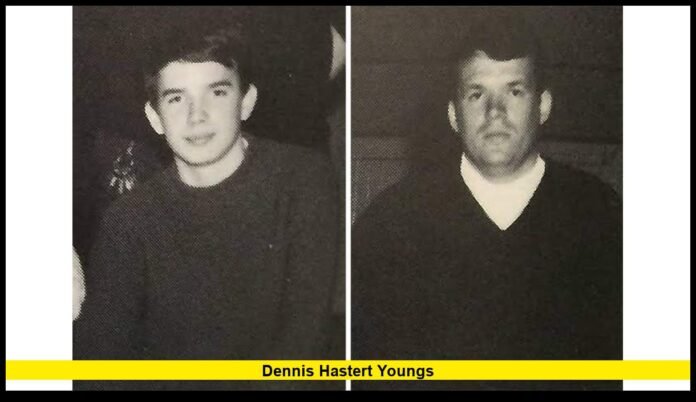

The story of dennis hastert young begins in the Illinois suburbs, where the future U.S. House speaker grew up in a working family, attended local schools, played sports and eventually built a career as a teacher and wrestling coach. Dennis Hastert, who died at age 84 in October 2026, would later become one of the most powerful Republicans in Washington, serving as speaker of the U.S. House from 1999 to 2007. His early years, however, were spent far from Capitol Hill and were shaped largely by family, education, athletics and life in Kendall County, Illinois.
Hastert’s life has attracted renewed attention following news of his death from natural causes at his Illinois home. His career included a remarkable rise from high school teacher and coach to the highest-ranking Republican position in the House. It also ended in a major criminal scandal that dramatically changed the way his public record was viewed.
Understanding his early life helps explain the personal and professional path that eventually took him from Oswego and Yorkville to Congress.
Dennis Hastert’s Childhood in Illinois
John Dennis Hastert was born on January 2, 1942, in Aurora, Illinois. He grew up in nearby Oswego, a community that was much smaller and more rural during his childhood than it is today.
His family had strong ties to agriculture and local business. Hastert’s father operated a feed and agricultural supply business, and the young Hastert worked around the family enterprise. His upbringing included the type of physical work associated with a small-town agricultural community.
That environment became an important part of his identity. Long before he was known nationally, Hastert was familiar with the responsibilities of working for a family business and participating in community life.
His childhood also introduced him to organized sports, an interest that would eventually become a major part of his professional career.
A Young Athlete in Oswego
Hastert attended Oswego High School, graduating in 1960.
During his high school years, he participated in football and wrestling. Wrestling eventually became the sport most closely associated with his name.
The discipline involved in wrestling would remain a constant throughout his early adult life. After high school, he continued his education while remaining involved in athletics.
His interest in wrestling was more than recreational. It eventually became the foundation for his work as a high school coach, a career that preceded his entry into politics.
For a young man from a relatively small Illinois community, the combination of athletics and education provided Hastert with opportunities to develop leadership skills and establish relationships beyond his immediate family.
College Years at Wheaton College
Hastert attended Wheaton College in Illinois after graduating from high school.
He studied economics and graduated in 1964. His college education gave him an academic foundation that later complemented his work in government and politics.
Wheaton also allowed Hastert to continue his involvement in wrestling. His athletic background remained important even as he moved toward a career in education.
After completing his undergraduate education, Hastert continued studying at Northern Illinois University. He earned a master’s degree in education in 1967.
The combination of economics and education was unusual in the sense that it prepared him for both classroom work and, eventually, public policy.
Becoming a Teacher and Coach
Hastert began teaching at Yorkville High School in Illinois in the mid-1960s.
He taught history and became involved with the school’s football and wrestling programs. His professional identity during these years was primarily that of an educator and coach.
He spent approximately 16 years working in education.
For much of this period, wrestling was at the center of his professional life. Hastert developed the Yorkville wrestling program and became increasingly prominent within Illinois high school athletics.
His coaching achievements eventually brought him statewide recognition.
The Yorkville program reached the top of Illinois high school wrestling under his leadership, winning a state championship during the 1975-76 school year. Hastert was also recognized as Illinois Wrestling Coach of the Year in 1976.
Those accomplishments established him as a respected figure in Illinois sports circles.
The Importance of Wrestling in Hastert’s Early Career
When examining dennis hastert young, it is impossible to separate his early biography from wrestling.
The sport followed him from his teenage years through college and into his teaching career. As a coach, he was responsible for training young athletes, organizing competitions and building a competitive program.
Wrestling also helped create the local reputation that later supported his political ambitions.
Before entering elected office, Hastert had already spent years working directly with students and families in the Yorkville area. He knew the community, had established local relationships and was recognizable beyond the classroom.
His success as a coach became one of the defining achievements of his pre-political career.
At the same time, the later revelations concerning his conduct as a coach would become central to the darkest chapter of his life.
Marriage and Family
Hastert married Jean Kahl in 1973. Kahl was also a teacher in the Yorkville area.
The couple had two sons, Joshua and Ethan.
By the time Hastert entered politics, he had established a family and had spent years building a professional career in education.
His background was therefore very different from that of a traditional Washington political insider. He came from a local Illinois community and had spent much of his adult life working in schools.
That background later became part of the political image that helped him rise within the Republican Party.
From Education to Illinois Politics
Hastert entered electoral politics in 1980.
His first attempt to win a seat in the Illinois House did not initially produce a straightforward victory. He finished third in the Republican primary. However, circumstances changed when the candidate who had won the nomination became seriously ill.
Republican officials selected Hastert to take his place on the general-election ballot.
He won the election and began serving in the Illinois House of Representatives.
The transition from teacher and coach to politician marked a major change in his career, but his local roots remained important.
His years in the state legislature gave him experience with public policy, legislative negotiations and Republican political organization.
Election to Congress
Hastert’s next major political step came in 1986, when he ran for the U.S. House of Representatives.
He won election to Congress and began representing an Illinois district in Washington in 1987.
Initially, he was not among the most nationally prominent members of Congress. His rise was gradual.
Hastert developed a reputation as a reliable Republican lawmaker and eventually moved into leadership roles as the Republican Party gained control of the House.
His experience working with other Republicans became increasingly valuable after the party’s 1994 congressional victory.
The Road to the Speaker’s Office
Republicans captured control of the House in the 1994 elections, and Hastert became part of the leadership structure.
He served as chief deputy whip and worked with influential Republican leaders.
His political style was generally less confrontational than that of some of the more outspoken figures in the party. That reputation for being able to work with different factions became especially important during a period of internal Republican disputes.
When Newt Gingrich stepped down as speaker in 1998, Republicans faced another leadership crisis. Bob Livingston, who had been expected to become speaker, also withdrew after acknowledging extramarital affairs.
Hastert eventually emerged as the Republican choice.
In January 1999, he became speaker of the U.S. House.
His rise was striking because he had gone from a small-town Illinois teacher and coach to one of the three most powerful constitutional officers in the federal government.
Hastert as House Speaker
Hastert served as speaker for eight years, from 1999 through 2007.
His tenure covered several major events in modern American history.
He became speaker during President Bill Clinton’s impeachment proceedings and later worked closely with President George W. Bush after Bush took office.
Hastert supported major Republican legislative priorities, including tax reductions and changes to Medicare prescription-drug benefits.
His tenure also included the September 11, 2001, terrorist attacks and the subsequent wars in Afghanistan and Iraq.
Within the House, Hastert became associated with an informal Republican leadership principle commonly called the Hastert Rule. The concept held that Republican leaders generally should not bring legislation to the House floor without support from a majority of House Republicans.
Although the rule was never a formal House rule, it became closely associated with his speakership and later Republican congressional leadership.
Why Hastert Left Congress
Hastert remained speaker until Democrats won control of the House in the 2006 elections.
Nancy Pelosi became speaker in January 2007.
Hastert later resigned from Congress in November 2007 rather than complete his term.
After leaving elected office, he worked in lobbying and remained connected to political and business circles.
For several years, his public legacy centered largely on his unusual rise from Illinois educator to House speaker.
That changed dramatically in 2015.
The Scandal That Changed His Legacy
Federal authorities announced in 2015 that Hastert had been charged with violating banking laws in connection with large cash withdrawals.
The investigation eventually revealed that the payments were connected to allegations of sexual abuse dating back decades, when Hastert had been a teacher and wrestling coach.
Prosecutors said Hastert had abused teenage boys who were members of his wrestling teams.
Because the alleged sexual offenses had occurred many years earlier, Hastert was not prosecuted for the underlying abuse. Instead, he pleaded guilty to illegally structuring bank withdrawals in an effort to make payments to an individual identified in court documents as Individual A.
The case became one of the most significant scandals involving a former congressional leader.
Hastert’s Prison Sentence
In 2016, Hastert was sentenced to 15 months in federal prison.
He became one of the highest-ranking former U.S. politicians ever sentenced to prison.
The court proceedings also brought previously unknown details about his conduct as a wrestling coach into public view.
Hastert acknowledged that he had mistreated athletes and expressed shame and regret. The allegations permanently changed the public perception of the teacher and coach who had once been celebrated for his success in Illinois wrestling.
His imprisonment added another defining chapter to a political career that had once appeared to represent a remarkable American rise.
Dennis Hastert’s Death in 2026
Hastert died at age 84 in October 2026.
According to the Kendall County coroner, he died of natural causes at his Illinois home while receiving hospice care.
His death prompted renewed attention to the full arc of his life, from his childhood in Oswego and years as a teacher and coach to his two decades in Congress, eight years as House speaker and later criminal conviction.
Hastert’s wife, Jean, and his two adult sons survived him.
A Complicated Historical Record
The history of Hastert’s life cannot be reduced to either his political achievements or his criminal case.
His early career demonstrated a long connection to education, athletics and Illinois community life. He successfully transitioned from teaching to state politics and then to national office.
As speaker, he presided over the House during some of the most consequential years in recent American history.
But the allegations involving his former wrestling athletes and his subsequent federal conviction fundamentally altered his legacy.
His story therefore remains one of the more complicated biographies in modern American political history.
The young Illinois teacher who eventually reached the speaker’s office became a major national political figure, only for revelations about his conduct decades earlier to overshadow much of what he had accomplished.
Final Look at Hastert’s Early Years
The early life of Dennis Hastert offers a clear picture of how his career developed over several decades.
He grew up in Oswego, worked in his family’s agricultural business, played sports, attended college and became a teacher. Wrestling then gave him a prominent role in Illinois high school athletics.
His success at Yorkville High School provided the community recognition that helped him enter politics. From the Illinois House, he moved to Congress and eventually reached the speakership.
That progression made his life story unusual even before the scandal that later changed his reputation.
Hastert’s death in 2026 has brought renewed public interest in the man behind the political title. His childhood, education, coaching career and political rise remain important parts of understanding how he became one of the most influential Republicans in the U.S. House, while the later revelations remain an unavoidable part of the historical record surrounding his name.
Refocus the article on Hastert’s youthReduce later-life material substantially