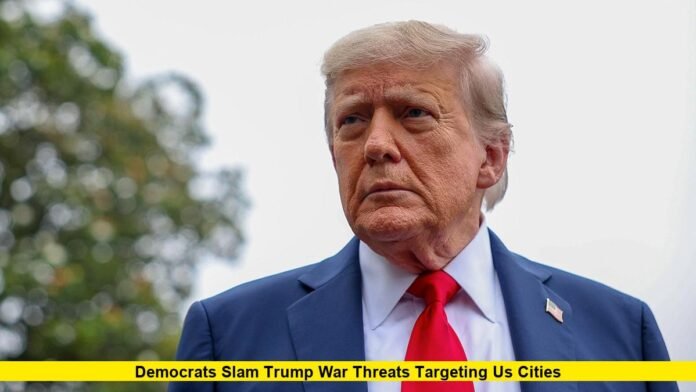

Democrats slam Trump war threats targeting US cities after a weekend of fiery remarks from the former president that sent shockwaves through Chicago and other communities. His latest comments, framed in militaristic language, quickly drew condemnation from Democratic leaders who accused him of trying to intimidate rather than govern.
Trump’s post, shared on social media, used wartime rhetoric and memes suggesting a “Department of War” targeting Chicago. He compared his approach to military campaigns and even hinted at the idea of using federal forces to “restore order.” Within hours, Democratic leaders at both the state and city levels pushed back, calling the remarks dangerous and irresponsible.
Illinois leaders respond strongly
Illinois Governor J.B. Pritzker denounced the language, warning that threatening an American city with the imagery of war undermines democratic values. He described the statement as “abnormal” and said Illinois would resist any effort to turn Chicago into a battlefield.
Chicago Mayor Brandon Johnson echoed those concerns. He described Trump’s threats as an attempt to stoke fear and divide communities, particularly immigrant neighborhoods that already feel vulnerable. Johnson said the city would not cooperate with any federal attempt to militarize policing in Chicago.
National Democrats join the backlash
The uproar in Illinois quickly spread to Washington. Prominent Democratic lawmakers condemned Trump’s remarks as reckless, saying no president should frame U.S. cities as war zones. They argued that such language is not only inflammatory but also unconstitutional if it leads to deploying federal troops domestically.
Democrats warned that the comments could set a dangerous precedent. They said the president’s job is to unite citizens, not pit them against each other with imagery of war. Several party leaders also noted that Chicago’s crime numbers have been steadily improving, undercutting the narrative of chaos.
Legal concerns over military force
Beyond politics, Trump’s threats carry serious legal implications. The Posse Comitatus Act limits the use of the U.S. military in domestic law enforcement. Deploying troops in American cities without proper legal authority would almost certainly face court challenges.
State officials have already indicated they are prepared to sue if federal forces are sent without consent. Governor Pritzker emphasized that Illinois would use every legal tool available to block what he called an “unconstitutional power grab.”
Impact on Chicago communities
In Chicago, the rhetoric is not being treated as abstract politics. Local leaders and community organizations report a chilling effect in neighborhoods with large immigrant populations. Families fear that talk of “war” could translate into intensified raids or mass arrests.
Events celebrating cultural traditions were scaled back, and some community centers noted lower attendance at public gatherings. Residents said the threats make them feel unsafe in their own city, creating tension where trust is already fragile.
Why Democrats say this matters
- Erosion of norms: Democrats argue the remarks undermine long-standing limits on military involvement in civilian life.
- Political motivation: Critics say the threats are less about crime and more about energizing Trump’s political base.
- Community harm: The rhetoric spreads fear in immigrant neighborhoods and weakens relationships between residents and local government.
By framing a U.S. city as a war zone, Democrats argue Trump is normalizing authoritarian tactics that could destabilize communities across the country.
Wider context of federal deployments
This clash comes after months of heightened tension over federal intervention in local matters. Trump has previously sent National Guard troops into major cities, claiming it was necessary to curb crime and illegal immigration. In several cases, state officials objected, but the federal government moved forward anyway.
Democrats now warn that the latest comments signal an even broader willingness to bypass local authority. They believe the administration is testing how far it can push the boundaries of federal power, using cities like Chicago as symbolic battlegrounds.
Looking ahead
The coming weeks are expected to bring more confrontations between the White House and Democratic-led states. Lawsuits, protests, and legislative efforts may all emerge as tools to counter the threats. Meanwhile, community leaders in Chicago say their priority is ensuring residents feel safe and protected despite the heated national debate.
In the end, Democrats slam Trump war threats targeting US cities as more than just provocative words—they see them as a warning sign of how fragile democratic norms can become when presidential power is stretched to its limits.
The story is far from over, and Americans across the country will be watching closely as Chicago and Washington brace for the next chapter. What do you think—should presidential power extend this far, or is this a step too far? Share your thoughts below.