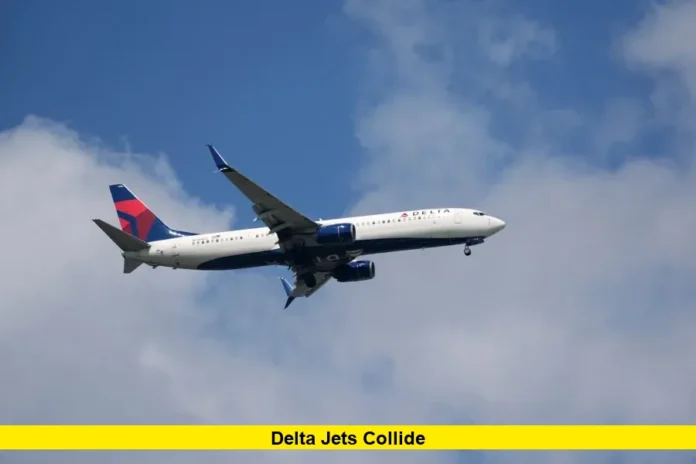

Late Wednesday night, Delta jets collide at LaGuardia Airport in a ground incident that left one flight attendant injured and raised new questions about airfield safety at one of the nation’s busiest airports. The accident, which occurred around 10:00 p.m. Eastern Time on October 1, 2025, involved two Delta Connection regional jets operated by Endeavor Air.
The Incident
The collision happened as one aircraft was departing and another was arriving. Delta Connection Flight 5155 was preparing to leave LaGuardia for Roanoke, Virginia, when its right wing clipped the fuselage of Delta Connection Flight 5047, which had just arrived from Charlotte, North Carolina.
The point of contact was on the taxiway, as both planes were moving at low speed. Despite the minor velocity, the collision caused significant damage to the nose and windshield area of one jet and visible damage to the wing of the other.
Passenger and Crew Impact
The most serious injury reported was to a flight attendant, who sustained a non-life-threatening knee injury. That individual was transported to a nearby hospital for further evaluation. No passengers were hurt during the incident.
Between the two flights, a total of about 85 passengers were on board — 57 inbound from Charlotte and 28 preparing to depart for Roanoke. Following the collision, passengers were safely deplaned and transported by bus back to the terminal. Delta provided hotel accommodations, meals, and rebooking options to those whose travel plans were disrupted.
Damage and Initial Pilot Reports
Radio traffic between the pilots and air traffic control shortly after the incident captured the seriousness of the situation. One of the pilots reported that the other aircraft’s wing had “clipped the nose,” causing cracks to the windshield and affecting cockpit display screens. Despite this, the flight crew was able to keep passengers calm and manage the situation until everyone was safely off the aircraft.
Airport and Airline Response
The Port Authority of New York and New Jersey, which oversees LaGuardia Airport, confirmed the collision and stressed that the incident did not disrupt overall airport operations. Arrivals and departures continued with minimal impact, although the two affected aircraft were towed for inspection and removed from service.
Delta issued a public statement apologizing to passengers and thanking airport staff and crew for their professionalism. The airline emphasized that safety remains its highest priority and pledged full cooperation with federal investigators.
Investigation Underway
The Federal Aviation Administration (FAA) and the National Transportation Safety Board (NTSB) have launched investigations into the incident. While ground collisions are rare, they can carry significant safety implications, particularly in high-traffic airports such as LaGuardia.
Investigators are expected to review:
- Taxiway congestion at the time of the accident
- Cockpit communication between the two flight crews
- Ground crew guidance and coordination
- Whether weather or visibility played any role
- Potential procedural improvements to reduce risk
The findings will help determine if this was an isolated incident or if changes to taxiway management and ground operations should be implemented more broadly.
Why This Matters
Ground incidents often receive less attention than in-flight emergencies, yet they highlight the complexity of airport safety. Even when planes move slowly on the ground, there is little margin for error. A wing strike can damage sensitive systems, delay flights for hundreds of passengers, and result in costly repairs.
For passengers, the most important takeaway is that such collisions, while disruptive, are rarely life-threatening. The rapid response from the crew, airport authorities, and emergency services ensured that the situation at LaGuardia remained under control.
For the aviation industry, however, each collision represents a chance to re-evaluate and strengthen safety protocols. With air travel demand steadily rising, especially at crowded airports in New York City, minimizing risks during ground operations is critical.
The Bigger Picture at LaGuardia
LaGuardia is one of the busiest airports in the United States, serving millions of travelers annually. With multiple airlines operating hundreds of daily flights, taxiway congestion is a constant challenge. This makes coordination between pilots, ground controllers, and airline staff essential to maintaining smooth operations.
Recent years have seen major infrastructure upgrades at LaGuardia, including new terminals and redesigned concourses. While these improvements aim to streamline passenger flow and airline operations, the airport’s physical constraints still present risks. The limited space between taxiways, runways, and terminals leaves little room for error when aircraft maneuver on the ground.
Next Steps
The investigation into why these Delta jets collide at LaGuardia Airport will take weeks, if not months, to complete. The FAA and NTSB will issue a preliminary report in the coming days, followed by a full analysis later. Depending on the findings, new safety recommendations could be implemented not only at LaGuardia but across other major U.S. airports.
Delta has already begun assisting its customers, arranging alternative travel options, and coordinating with authorities. Both aircraft involved are undergoing damage assessments to determine repair needs and whether they will return to service.
Lessons for Travelers
For passengers, this incident serves as a reminder of the following:
- Flight delays are often about safety. When ground collisions occur, airlines prioritize customer safety over on-time departures.
- Communication matters. Clear instructions from crew members are key in keeping passengers calm and ensuring orderly evacuations or transfers.
- Airport operations are complex. Even routine taxiing requires careful coordination across multiple teams, from pilots to ground controllers.
Conclusion
Though classified as a low-speed taxiway accident, the collision at LaGuardia underscores how vital constant vigilance is in aviation safety. Investigators will now work to understand how two regional jets came into contact and what steps can be taken to prevent a repeat.
For Delta and its passengers, the incident was a disruption but not a disaster. The professionalism of the flight crews, quick response from emergency staff, and coordinated passenger support demonstrated the resilience of the system, even in challenging moments.
What do you think about this incident at LaGuardia? Share your thoughts in the comments and check back for updates as the investigation continues.