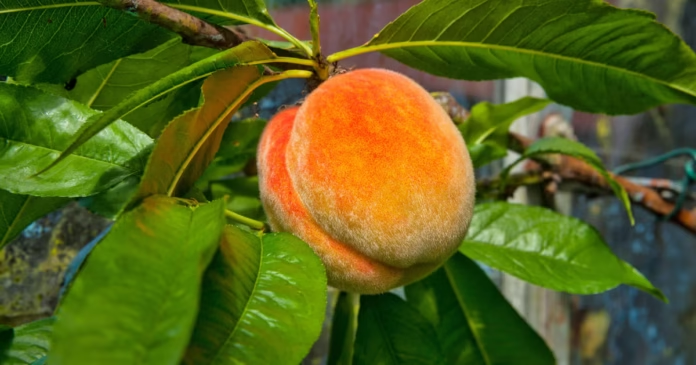

The collapse of Del Monte Foods has sent shockwaves through California’s Central Valley, triggering one of the most devastating agricultural crises in the state’s recent history. Hundreds of multi-generational farming families are now facing an impossible reality — destroying the very orchards their livelihoods depend on.
What Happened to Del Monte Foods?
Del Monte Foods, one of America’s most iconic canned food brands with over a century of history, filed for Chapter 11 bankruptcy in July 2025. The company cited a crushing $1.2 billion debt load, a sharp decline in demand for canned goods as consumer habits shifted away from pandemic-era stockpiling, and relentless inflationary pressure as key factors behind the collapse.
During the COVID-19 pandemic, demand for canned goods had soared as people ate at home. Del Monte responded aggressively — expanding production capacity and locking in long-term contracts with dozens of California peach growers. Some of those contracts, signed as recently as 2024, were valid through 2044. But when consumer behavior returned to pre-pandemic patterns, Del Monte found itself dangerously overextended, trapped in what its own legal team described in court filings as “excessive volume commitments.”
The bankruptcy filing was only the beginning.
The Cannery Closures That Shook the Central Valley
In April 2026, Del Monte officially shuttered its cannery plants in Modesto and Hughson, California — two facilities that had been the lifeblood of the region’s clingstone peach industry for decades. The closures came swiftly and left hundreds of workers unemployed almost overnight.
One of those canneries alone had processed approximately 30% of California’s entire cling peach crop. For the farmers who had built their businesses around these facilities, the shutdowns were catastrophic.
Under U.S. federal bankruptcy law, Del Monte exercised its right to reject contracts with members of the California Canning Peach Association — an organization representing roughly 70% of the state’s clingstone peach growers. With the stroke of a legal filing, billions of dollars’ worth of long-term agreements simply ceased to exist.
420,000 Peach Trees and $550 Million in Lost Revenue
The scale of the damage is staggering. California farmers are now preparing to destroy an estimated 420,000 clingstone peach trees spread across roughly 3,000 acres of Central Valley orchards. These are not sick or dying trees — they are productive orchards that simply have no buyer.
The canceled contracts represent an estimated $550 million in lost revenue for affected growers. Last season, Del Monte’s contracted peach growers had produced approximately 74,000 tons of cling peaches. With the canneries gone, there is now nowhere to send that fruit.
Pacific Coast Producers, a Lodi-based peach canner, stepped in with one-year contracts covering around 24,000 tons of the displaced crop — a meaningful gesture, but one that still leaves roughly 50,000 tons of peaches with no processor and no market.
Sutter County farmer and California Canning Peach Association board chair Ranjit Davit captured the mood bluntly: “A lot of growers are affected.” Third-generation farmer Richard Lial described it as potentially “devastating” — he had even pulled out a productive almond orchard specifically to plant peaches for Del Monte, a decision that now looks heartbreaking in hindsight.
The Human Cost: Multi-Generational Farms on the Brink
This crisis is not an abstract agricultural statistic. It is a human story unfolding across dozens of family farms that have cultivated the same land for two, three, and even four generations.
These growers had done everything right. They secured contracts before planting, invested heavily in developing their orchards — typically spending several thousand dollars per acre — and trusted that a century-old brand would honor its commitments. When Del Monte voided those agreements through bankruptcy, it left farmers with fully planted orchards, no buyer, and debt tied to land improvements that may now never pay off.
Representative Mike Thompson, who helped rally Congressional support for relief, put it plainly: “When a processing facility closes and 55,000 acres of fruit suddenly have nowhere to go — that’s not something a family farm can just absorb.”
Federal Aid: $9 Million to Remove Orchards
In response to the crisis, the U.S. Department of Agriculture approved up to $9 million in emergency funding to help California peach growers remove their orchards before the upcoming harvest season. The California congressional delegation — including Senator Adam Schiff, Representative David Valadao, Representative Mike Thompson, and 39 other members of Congress — had sent a letter to Agriculture Secretary Brooke Rollins urging action, warning of “long-term structural damage to our nation’s agricultural base” if farmers were left without support.
The California Farm Bureau welcomed the announcement. Farm Bureau President Shannon Douglass called it “a glimmer of hope after a devastating period,” adding that the funding would help ensure farmers can “transition to new crops and stay on their land.”
The aid will cover the cost of tree removal across the roughly 3,000 acres affected — but it is widely understood to be a lifeline, not a full recovery. Removing trees clears the land; it does not replace the years of income those orchards were meant to produce.
What Comes Next for California’s Peach Industry?
The Del Monte collapse raises serious long-term questions about the future of clingstone peach farming in California. Unlike fresh-market peaches, clingstone varieties are grown almost exclusively for processing — meaning their survival as a crop is entirely dependent on the existence of nearby canneries.
With Del Monte’s capacity gone and Pacific Coast Producers unable to absorb the full volume, growers face a stark choice: wait and hope new processing arrangements emerge, or pull out their trees now and pivot to other crops. The $9 million in federal aid is effectively subsidizing the latter choice, helping farmers transition before the cost of maintaining unharvestable orchards consumes what little financial runway they have left.
For California’s broader agricultural ecosystem, the episode is a cautionary tale about concentration risk — what happens when a significant portion of an entire crop type flows through a single corporate buyer, and that buyer collapses.
Have you been following the Del Monte collapse and its impact on California farmers? Drop your thoughts in the comments below — and make sure to bookmark this page for the latest updates as this story continues to develop.