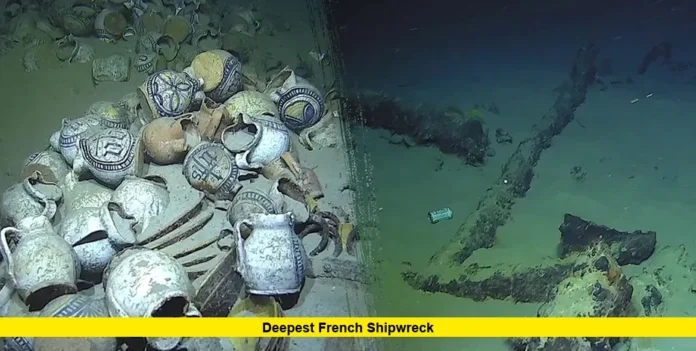

The ocean rarely gives up its secrets—but when it does, the impact can be extraordinary. The Deepest French Shipwreck ever identified has emerged from the silent depths of the Mediterranean, revealing a 16th-century vessel preserved in astonishing condition and reshaping what experts thought was possible in underwater archaeology.
Discovered off the southern coast of France near Ramatuelle, the wreck rests more than 2,567 meters (over 8,400 feet) below the surface. At that depth, the environment is pitch black, near freezing, and under immense pressure—conditions that have effectively sealed the ship in time for centuries.
If you’ve ever wondered what history looks like when it’s untouched, this discovery offers a rare and powerful answer.
A Discovery That Feels Almost Unreal
What makes this find so compelling is not just its age—but its condition.
When deep-sea robots first illuminated the wreck, they didn’t find scattered debris. Instead, they revealed a ship that appeared almost intact. Its structure remains visible, its cargo is still arranged in place, and even smaller objects look as though they were left just moments ago.
This level of preservation is extremely rare.
Most shipwrecks deteriorate quickly due to currents, marine life, or human interference. But here, none of those forces reached the vessel. The deep-sea environment created a natural barrier, protecting it for more than 500 years.
The Moment That Changed Everything
The discovery itself was completely unexpected.
During a routine seabed mapping mission, French naval teams detected an unusual signal. At first, it seemed like a minor anomaly—something easily overlooked. But when remotely operated vehicles were sent down to investigate, the images that came back told a different story.
A full shipwreck sat on the ocean floor.
That single moment transformed a standard operation into a major historical breakthrough. Within hours, experts realized they were looking at one of the most significant underwater finds in recent memory.
Stay with this story as new details continue to emerge from one of the deepest and most fascinating discoveries ever recorded.
Inside the Ship: A 16th-Century Time Capsule
The vessel is believed to date back to the Renaissance period and was likely part of a Mediterranean trade route connected to northern Italy.
What it carried offers a vivid picture of life and commerce from that era:
- Hundreds of ceramic jugs, many still intact
- Stacks of decorated plates, carefully arranged
- Iron bars used for trade and transport
- Cannons positioned for protection
- Cooking tools and storage containers
The layout of these items suggests the ship sank quickly, leaving little time for the crew to react. Everything appears frozen in place, offering a rare, unfiltered look at a working merchant vessel from the 1500s.
Why This Discovery Is Capturing Global Attention
This isn’t just another shipwreck—it’s a milestone.
Here’s why the story has gained widespread traction:
Record-Breaking Depth
No other shipwreck in French waters has been found this deep. The depth alone sets a new benchmark for exploration.
Unmatched Preservation
The ship’s condition provides a level of detail rarely seen in underwater archaeology.
Historical Value
The cargo reveals trade patterns, cultural connections, and economic activity from a defining period in European history.
Technological Achievement
The discovery highlights how far underwater exploration has advanced, with modern robotics reaching depths that were once inaccessible.
The Mystery That Still Remains
Despite the clarity of the wreck, one crucial question remains unanswered: what caused the ship to sink?
There are no visible signs of combat or catastrophic damage. The hull appears largely intact, and the cargo has not shifted significantly.
Several possibilities are being considered:
- Sudden and severe weather conditions
- Structural failure during the voyage
- Navigational challenges in unfamiliar waters
- Imbalance in cargo or loading
One detail has drawn particular attention—sections of the ship appear underloaded, which is unusual for a merchant vessel of that time. This raises new questions about the ship’s route and purpose.
Modern Technology Meets Ancient History
This discovery is as much about the present as it is about the past.
It was made possible through advanced tools such as:
- High-resolution sonar systems
- Autonomous underwater vehicles scanning the seabed
- Remotely operated robots capturing detailed imagery
- Digital modeling techniques for reconstruction
Researchers are now building a full 3D representation of the wreck, allowing experts to study it without physically disturbing the site.
This approach ensures that the ship remains preserved while still unlocking its historical value.
A Hidden Detail That Changes the Conversation
While the ship itself tells a story from centuries ago, the surrounding environment reveals something more current.
During exploration, traces of modern debris were identified near the wreck. Even at such extreme depths, signs of human activity are present.
The contrast is striking: a perfectly preserved relic of the past sitting alongside evidence of today’s environmental challenges.
It’s a powerful reminder that no part of the ocean is beyond human reach—or impact.
What People Are Missing About This Discovery
Most headlines focus on how deep the ship is and how old it might be. But the real significance goes far beyond those details.
This discovery represents a rare intersection of timing, technology, and preservation.
If the ship had sunk in shallower waters, it likely would have been destroyed or looted. If it had been discovered decades earlier, the available technology wouldn’t have captured its full detail. And if it had remained hidden longer, environmental changes could still threaten its condition.
What makes this moment unique is not just the ship itself—but the fact that it was found at exactly the right time, with exactly the right tools.
That combination is what turns a discovery into a breakthrough.
What Comes Next
For now, the wreck will remain where it is—deep beneath the Mediterranean.
Researchers plan to continue studying the site using non-invasive methods, including:
- Expanded digital mapping
- Detailed artifact analysis
- Continued remote exploration
Future updates are expected as new data is processed and additional insights are uncovered.
This discovery is likely to influence underwater research for years to come.
Final Takeaway
The discovery of the deepest French shipwreck marks a turning point in how we explore and understand the ocean. It reveals not just a lost vessel, but an entire chapter of history preserved in extraordinary detail.
As technology continues to push boundaries, more hidden stories are waiting to be found—and each one has the potential to change what we know about the past.
What do you think this discovery reveals about the mysteries still hidden beneath the ocean? Share your thoughts and follow along for more updates.