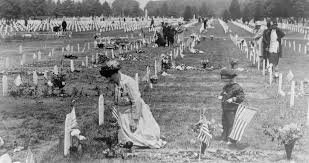

Most Americans observe Memorial Day with backyard barbecues, beach trips, and retail sales. Few know that the holiday began not in a general’s proclamation or a politician’s decree — but in the grief and gratitude of formerly enslaved people who wanted to honor those who had died to set them free. The story of Decoration Day and Black history is one of the most powerful, and most suppressed, chapters in American memory.
Key Points Summary
╔════════════════════════════════════════════════════════════════════╗
║ – Decoration Day was organized by freed Black Americans in         ║
║   Charleston, South Carolina, on May 1, 1865.                     ║
║ – Nearly 10,000 people — mostly formerly enslaved men, women,      ║
║   and children — participated in the first known observance.      ║
║ – 257 Union soldiers were exhumed from a mass grave and given      ║
║   individual, dignified burials before the ceremony.              ║
║ – The event took place at the Washington Race Course, a former     ║
║   Confederate prison camp, now known as Hampton Park.             ║
║ – The story was suppressed after Reconstruction, erased by white   ║
║   Southerners who recast Memorial Day as a racially neutral        ║
║   holiday of reconciliation.                                       ║
║ – Pulitzer Prize-winning historian David Blight rediscovered the   ║
║   story from a Harvard archive in the late 1990s.                 ║
╚════════════════════════════════════════════════════════════════════╝
What Is Decoration Day?
Decoration Day is the original name for what Americans now call Memorial Day. The name comes from the practice of decorating soldiers’ graves with flowers, flags, and wreaths to honor their sacrifice. While the tradition of adorning graves dates back to classical antiquity, in the American context it emerged directly from the devastation of the Civil War — a conflict that claimed approximately 620,000 lives.
The first national observance was proclaimed by General John A. Logan of the Grand Army of the Republic on May 30, 1868, designating the date for decorating the graves of Union soldiers. However, local and unofficial observances predated Logan’s proclamation by years — and the earliest and most remarkable of them all was organized not by generals or politicians, but by freed Black Americans.
May 1, 1865: The First Decoration Day
To understand the origins of Decoration Day and its place in Black history, you have to travel to Charleston, South Carolina, in the spring of 1865. The Civil War had just ended. Confederate forces had evacuated the city, leaving behind ruins, ash, and a population made up almost entirely of Black residents — many of them newly liberated from slavery.
Among the horrors left behind was the Washington Race Course and Jockey Club, a once-glamorous venue for wealthy white planters that the Confederacy had converted into a prison camp for captured Union soldiers. More than 250 Union prisoners died there and were buried in a mass grave behind the grandstand.
The formerly enslaved people of Charleston could not let that stand.
For two weeks in April 1865, Black residents and freedmen exhumed the bodies from the mass grave, reburied each soldier in an individual, dignified plot, landscaped the grounds, and built a fence with an archway above its entrance inscribed with the words: “Martyrs of the Race Course.”
Then, on May 1, 1865 — just weeks after the Confederacy surrendered — something extraordinary happened.
The Procession: 10,000 Strong
On that Monday morning, nearly 10,000 people marched to the grounds of the old Washington Race Course. Most were formerly enslaved African Americans. They were joined by white missionaries, teachers, and regiments of Black Union soldiers, including members of the famed 54th Massachusetts Infantry and the 34th and 104th United States Colored Troops.
Leading the procession were approximately 3,000 Black schoolchildren, carrying armfuls of flowers and singing “John Brown’s Body,” the Union marching hymn. Behind them came women carrying roses and crosses to lay at the graves. Adults, aid societies, and soldiers followed, performing parade ground maneuvers around the consecrated burial ground.
The ceremony included nearly 30 speeches by invited guests, prayers, spirituals, and national hymns. Afterward, the crowd dispersed into picnics — an act of joy and communal celebration in a city that had, just weeks before, been described as “a city of the dead.”
This was Decoration Day. This was the first Memorial Day. And it was created by Black Americans.
The Groups Who Made It Happen
Two organized groups of Black men are directly credited with making the first Decoration Day possible. They called themselves the Friends of the Martyrs and the Patriotic Association of Colored Men. Twenty-four men are recorded as the core organizers. They are among the most consequential civic figures in American history — and most people have never heard their names.
Their act was not just ceremonial. It was profoundly political. Charleston was the birthplace of secession — the city where the Civil War had begun in April 1861. To consecrate the graves of Union soldiers in that very soil, surrounded by the vestiges of the plantation aristocracy, was a bold declaration: the war had been about emancipation, not merely about states’ rights or soldiers’ valor.
How the Story Was Suppressed
If the first Decoration Day was so significant, why do so few people know about it?
The answer lies in the politics of Reconstruction and its violent dismantling. After 1877, when Reconstruction ended and white Southerners reclaimed political power, the story of Black Americans founding Decoration Day was systematically erased from public memory. White Southerners reinterpreted Memorial Day as a holiday of national reconciliation — one that honored sacrifices on both sides of the war, while marginalizing Black Americans from the narrative entirely.
A striking example of this suppression occurred about 50 years after the 1865 event, when someone at the United Daughters of the Confederacy asked the Ladies Memorial Association of Charleston to confirm that the May 1 tribute had occurred. The reply from a representative named S.C. Beckwith read: “I regret that I was unable to gather any official information in answer to this.” Whether or not Beckwith actually knew about the event, historians argue the exchange illustrates how thoroughly white Charlestonians had buried the memory.
A 1937 book went even further, incorrectly attributing the tribute to a single white organizer named James Redpath, changing the date to May 30, and describing the Black participants as mere “black hands” — diminishing the entire community’s role to anonymous labor.
Throughout the Reconstruction era, Black Americans had maintained a prominent role in Memorial Day observances, particularly in the South, where they made up the vast majority of participants. After Reconstruction ended, that prominence was deliberately erased.
Rediscovery: David Blight and the Harvard Archive
The story of the first Decoration Day might have remained buried indefinitely had it not been for a chance discovery by Yale historian David W. Blight in the late 1990s. While working at Harvard’s Houghton Library, a curator invited Blight to examine two boxes of unsorted material from Union veterans. Inside one box was a file labeled “First Decoration Day,” containing a handwritten narrative by an old veteran and a reference to an 1865 article in the New York Tribune.
That discovery sent Blight to the Avery Research Center for African American History and Culture at the College of Charleston, where he found a newspaper account documenting the event in detail. The research ultimately became part of his landmark 2001 book, Race and Reunion: The Civil War in American Memory, which brought the story to national attention.
For Blight, the significance of the event goes beyond who can claim “first.” As he put it: “It’s the fact that this occurred in Charleston at a cemetery site for the Union dead in a city where the Civil War had begun, and that it was organized and done by African American former slaves, is what gives it such poignancy.”
Decoration Day in African American Communities
Long before the national holiday took its modern form, Decoration Day had a rich, parallel life in African American communities across the South. In rural Tidewater, Virginia, for instance, oral histories passed down through families described Decoration Day commemorations stretching back to the 1880s. Parades began in Black communities and ended at local Black cemeteries — often overcrowded, underfunded, and subject to the same indignities of Jim Crow that pervaded every aspect of Southern life.
These community observances continued as many African American cemeteries became overgrown and neglected, their graves lost to highway construction, gentrification, and racialized vandalism. Through all of it, Black communities continued to gather, to place flowers, to remember — even when the rest of the nation had co-opted their tradition and written them out of the story.
Through the 1880s and into the early 1900s, Black American veterans claimed prominent positions in Memorial Day observances. After Reconstruction fell, Black American orators used Memorial Day speeches to actively push back against attempts to rehabilitate the Confederate cause and rewrite the meaning of the Civil War.
The Washington Race Course Today
The site of the first Decoration Day still exists — though it is largely unrecognized for what it is. The old oval roadway of the Washington Race Course is now the walking path of Hampton Park in Charleston — a park named, with painful irony, for Wade Hampton, the Confederate general and white supremacist “Redeemer” governor who helped end Reconstruction in South Carolina.
A historical marker at the site does recognize the 1865 ceremony as one of the earliest Memorial Day observances in the country. However, the original cemetery dedicated to the “Martyrs of the Race Course” is gone — the Union dead were reinterred in the 1880s to a national cemetery in Beaufort, South Carolina.
Why This History Matters in 2025 and Beyond
The story of Decoration Day and Black history is not merely a historical curiosity. It strikes at the heart of how America tells its own story — and who gets included in that story.
In an era when debates over history curricula, monuments, and collective memory have become intensely politicized, the origins of Memorial Day offer a clear example of how Black contributions to American civic life have been systematically written out of the national narrative. The first people to honor America’s war dead with a formal, organized ceremony were the people who had the most reason to celebrate the Union’s victory and the most to lose had the Confederacy won — the formerly enslaved.
Although roughly 180,000 Black men served in the Union Army during the Civil War, the holiday in many communities essentially became “white Memorial Day,” particularly after the rise of the Jim Crow South. The erasure of Black veterans and Black mourners from the Memorial Day story was not accidental — it was a deliberate act of cultural and political power.
Reclaiming this history is an act of civic restoration. It does not diminish the sacrifices of any soldier. It honors more of them.
Timeline: Decoration Day and Its Black History Roots
May 1, 1865 — Nearly 10,000 freed Black Americans and white missionaries hold the first Decoration Day at the Washington Race Course in Charleston, SC.
1865–1877 (Reconstruction Era) — Black Americans play a central role in Memorial Day observances throughout the South.
1868 — General John A. Logan issues the first national Decoration Day proclamation, setting May 30 as the national date of observance.
1877 — Reconstruction ends. White Southerners reclaim power and begin suppressing Black contributions to Memorial Day history.
1880s–1910s — Black veterans continue to participate prominently in Memorial Day events; Black orators use the occasion to challenge Confederate revisionism.
Late 1990s — David Blight discovers documentation of the 1865 Charleston event in a Harvard archive.
2001 — Blight publishes Race and Reunion, bringing the story to national attention.
2011 — Blight publishes an article for the Zinn Education Project detailing the first Decoration Day.
2025 — The story continues to gain mainstream recognition as scholars, journalists, and community organizations work to restore it to the public record.
Frequently Asked Questions
Q: Did Black Americans really start Memorial Day? A: Historians, including Pulitzer Prize-winning scholar David Blight, credit Black Americans in Charleston, South Carolina, with organizing one of the first — and arguably the first — Decoration Day ceremony on May 1, 1865. The event predates the first national proclamation by three years.
Q: What was the Washington Race Course? A: It was a racetrack and social venue in Charleston, SC, used by the Confederate military as a prison camp for captured Union soldiers. During the Civil War, more than 250 Union prisoners died there and were buried in a mass grave. After the war, Black Charlestonians exhumed the bodies and gave each soldier an individual burial. The site is now Hampton Park.
Q: Why don’t most people know this story? A: The story was suppressed after Reconstruction ended in 1877, as white Southerners reframed Memorial Day as a racially neutral day of national reconciliation, deliberately marginalizing Black Americans from the narrative. It was not widely known until the late 1990s, when historian David Blight rediscovered documentation in a Harvard archive.
Q: What is the difference between Decoration Day and Memorial Day? A: “Decoration Day” is the original name for the holiday, derived from the practice of decorating soldiers’ graves with flowers. It was officially renamed Memorial Day over time, and Congress declared it a federal holiday in 1971. The last Monday in May is the current observance date.
If this hidden chapter of American history moves you as much as it should, share this article, leave a comment with your thoughts, and subscribe to stay updated as we continue uncovering the stories history tried to erase.