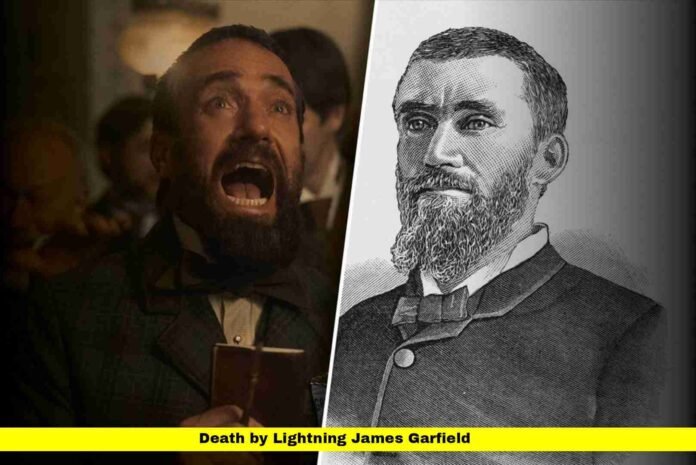

The shocking death by lightning James Garfield story is once again capturing attention after the release of the gripping series Death by Lightning, which chronicles the life, leadership, and untimely demise of America’s 20th president. This powerful retelling brings renewed focus to how James A. Garfield’s short-lived presidency changed U.S. history forever and how his assassination led to some of the most important reforms in American governance and medicine.
Key Points Summary
- James A. Garfield served as the 20th U.S. President and was assassinated in 1881.
- He was shot by Charles J. Guiteau, a disgruntled office-seeker.
- Garfield’s death resulted from poor medical practices rather than the initial gunshot.
- The assassination led to major civil service reform and advancements in medical hygiene.
- The new series Death by Lightning revisits his life and legacy for modern audiences.
James A. Garfield: From Humble Roots to the White House
James Abram Garfield’s rise to power was nothing short of extraordinary. Born in 1831 in a log cabin in Ohio, he grew up in poverty but worked his way through college and became a professor, lawyer, and later a Union general during the Civil War. His intelligence and leadership quickly earned him national recognition, leading to a political career that would culminate in his presidency.
By 1880, Garfield was unexpectedly nominated as the Republican candidate for president, a compromise choice amid fierce party divisions. His victory in the election marked a new era of hope and reform, with Garfield vowing to clean up corruption in the federal government and create opportunities based on merit rather than patronage.
Garfield’s story is one of determination, intellect, and moral conviction—traits that made his sudden assassination all the more tragic.
The Assassination: A Nation Shocked by Sudden Violence
On July 2, 1881, President Garfield arrived at the Baltimore and Potomac Railroad Station in Washington, D.C., planning to travel to New Jersey for a summer vacation. As he walked through the station with his secretary of state, Charles J. Guiteau approached him from behind and fired two bullets. One grazed Garfield’s arm; the other struck his back and lodged near his spine.
The president collapsed, and chaos erupted in the station. Witnesses described scenes of panic and disbelief as Garfield was carried to the White House for treatment. Guiteau, meanwhile, was immediately arrested and proudly declared, “I am a Stalwart and Arthur will be president!”—referring to Vice President Chester A. Arthur and the factional disputes within the Republican Party.
This shocking event paralyzed the nation. Americans anxiously followed daily updates on Garfield’s condition, praying for his recovery.
Medical Missteps: How Treatment, Not the Bullet, Killed Garfield
What followed was one of the most heartbreaking sagas in presidential history. Garfield’s wounds were not necessarily fatal; however, the lack of medical hygiene and modern surgical practices proved deadly.
Doctors repeatedly probed his wound with unsterilized fingers and instruments, searching for the bullet. Germ theory was still controversial in the United States, and most physicians ignored emerging knowledge about infection control. Over the following weeks, Garfield suffered from high fevers, infections, and extreme pain.
As his condition worsened, he was moved to a seaside cottage in Elberon, New Jersey, in hopes that fresh air would help his recovery. It was there, on September 19, 1881—79 days after the shooting—that Garfield finally succumbed to infection and internal bleeding.
The autopsy later revealed that the bullet had lodged harmlessly near his spine and that his death resulted primarily from medical malpractice. The phrase “death by lightning” that Garfield once used metaphorically—referring to the unpredictability of fate—became hauntingly prophetic.
Charles J. Guiteau: The Assassin’s Delusion
Charles J. Guiteau, Garfield’s killer, was a disgruntled lawyer and preacher who believed he was owed a government position. After being ignored by the administration, he convinced himself that killing the president would reunite the Republican Party and make him a hero.
Guiteau’s trial became one of the first major legal spectacles in American history. He acted erratically in court, claiming divine inspiration for his actions. Despite his pleas of insanity, he was found guilty and hanged on June 30, 1882.
The trial raised early questions about mental illness, legal responsibility, and the intersection between politics and violence—issues that remain relevant today.
The Phrase “Death by Lightning” and Its Deeper Meaning
The expression death by lightning has two meanings in this context. Literally, it was a phrase Garfield used to describe the unpredictability of assassination. Metaphorically, it captured the sudden and devastating end of his presidency.
The phrase resurfaced as the title of the acclaimed series Death by Lightning, which dramatizes the fateful events of 1881 and the aftermath. The show, featuring acclaimed performances by Michael Shannon as Garfield and Matthew Macfadyen as Guiteau, highlights both the human tragedy and the political consequences that followed.
Through this modern retelling, Garfield’s life is being rediscovered by a new generation of viewers who might otherwise have forgotten America’s 20th president.
How Garfield’s Death Changed America Forever
Garfield’s assassination had lasting consequences for the United States. The outcry over his death accelerated the passage of the Pendleton Civil Service Reform Act of 1883, which ended the corrupt “spoils system” and established a merit-based hiring process for federal employees.
His death also spurred progress in American medicine. The public was horrified to learn that the president’s death could have been prevented with cleaner surgical practices. The event pushed U.S. doctors to adopt sterilization techniques and modern medical hygiene that were already gaining ground in Europe.
Furthermore, Garfield’s ordeal led to greater awareness of the need for organized presidential security. Although the Secret Service existed at the time, it was not yet tasked with protecting the president—something that would change in later years.
Legacy of a Forgotten President
Though his presidency lasted only six months, James Garfield left a legacy of integrity, reform, and progress. He believed deeply in equality and education, once saying, “Next in importance to freedom and justice is popular education, without which neither freedom nor justice can be permanently maintained.”
Garfield’s ideas outlived him. The reforms sparked by his assassination reshaped the structure of the U.S. government and professionalized public service. His life became a testament to how even a brief presidency can leave an enduring mark.
Why the New Generation Is Rediscovering Garfield
In today’s era of political polarization, Garfield’s story offers a reminder of civility, intellect, and leadership guided by principle rather than ambition. The Death by Lightning series is introducing his story to younger audiences, bringing renewed discussion about accountability, mental health, and the dangers of extremism in politics.
Through a blend of historical accuracy and cinematic storytelling, the series rehumanizes figures often reduced to textbook names. It shows Garfield as a family man, reformer, and visionary—cut down by chaos and misfortune.
Final Thoughts
The story of death by lightning James Garfield is not just about an assassination—it’s a reflection on leadership, reform, and the fragility of progress. Garfield’s life was a symbol of hope in a nation emerging from division, and his death became a catalyst for change that reshaped America’s political and medical systems.
Even today, his legacy endures as a lesson in courage, integrity, and the unpredictable nature of history. Readers are invited to share their thoughts on how Garfield’s short presidency continues to influence modern governance and ethics.