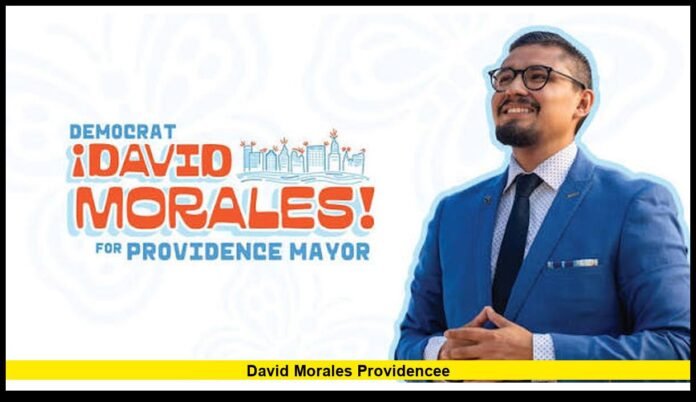

David Morales has become the central figure in Providence politics after defeating incumbent Mayor Brett Smiley in the Democratic primary, giving david morales providence voters a new choice for the city’s leadership heading into the November general election. Morales, a 27-year-old Rhode Island state representative and Democratic socialist, built his campaign around housing affordability, rent stabilization, public services, schools and a more progressive approach to city government.
His primary victory is one of the most significant political developments in Providence this year. Smiley had sought a second term after winning the mayor’s office in 2022, but Morales’ grassroots campaign ultimately overcame the advantages of incumbency and a substantially larger campaign operation.
The result now sets up a general election contest between Morales and Republican candidate Dave Talan on November 3, 2026. Because Providence is one of Rhode Island’s strongest Democratic strongholds, the primary victory puts Morales in a powerful position heading into the final stage of the campaign.
David Morales Defeats Incumbent Mayor Brett Smiley
Morales’ Democratic primary victory represents a major change in Providence’s political direction.
With most votes reported after the September 9 primary, Morales held a substantial lead over Smiley. The contest had attracted statewide and national attention because it reflected a broader debate inside the Democratic Party between establishment-oriented Democrats and a younger progressive movement focused on affordability, labor and stronger government intervention.
Smiley, 47, had campaigned on his record as mayor, pointing to housing construction, public safety initiatives and efforts to improve basic city services. Morales argued that Providence residents were still facing serious problems with rent, taxes, schools and infrastructure despite those efforts.
The primary became particularly focused on the city’s housing crisis.
Morales made rent stabilization one of the defining issues of his campaign, while Smiley argued that controlling rents could discourage developers from building the additional housing Providence needs.
That disagreement helped turn the election into a broader debate about how the city should respond to rising housing costs.
A Young Candidate With a Rapid Political Rise
Morales has had an unusually fast political career.
He was first elected to the Rhode Island House of Representatives in 2020 at age 22. He represents House District 7 in Providence and has built a reputation as a progressive lawmaker.
His political identity has been closely connected to housing, labor rights, immigrant communities and public investment.
Morales has described himself as the child of a single immigrant mother and a lifelong renter. His campaign biography says his family experienced housing insecurity before obtaining access to public housing.
Those experiences have shaped his political message.
Rather than presenting housing affordability simply as an economic issue, Morales has framed it as a question of whether working families can remain in Providence as rents and other household costs increase.
That message resonated strongly with renters during the mayoral campaign.
Housing Is at the Center of Morales’ Agenda
Housing affordability became the defining issue of the Providence Democratic primary.
Morales supports limiting annual rent increases to 4 percent. He has argued that renters need immediate protection while the city works on increasing the supply of affordable housing.
The proposal became particularly controversial after Smiley vetoed a rent stabilization ordinance approved by the Providence City Council. The legislation would have limited most annual rent increases to 4 percent while providing exemptions, including provisions affecting new construction.
Smiley maintained that Providence needs more housing and warned that rent control could make developers less willing to build.
Morales took the opposite position.
He argued that the city can protect existing renters while continuing to build new homes, particularly because new construction can receive exemptions under a rent stabilization framework.
His campaign has also proposed using vacant buildings and underused land for affordable housing.
A Public Development Strategy
One of Morales’ most notable housing proposals is the creation of a stronger public development model.
Instead of relying exclusively on private developers, Morales wants Providence to use publicly controlled land and buildings to create permanently affordable housing and community assets.
His platform calls for the Providence Redevelopment Agency to play a more active role in acquiring underused properties and transforming them into housing.
Morales has also supported requiring new housing projects to include affordable units.
The objective is to make affordable housing part of new development rather than treating it as a separate issue.
He has also proposed stronger enforcement of housing codes and greater accountability for landlords who allow unsafe conditions to continue.
Property Taxes and the Cost of Living
Housing affordability is not limited to rent in Morales’ campaign.
He has also criticized increases in property taxes and argued that Providence needs a tax structure that places less pressure on working families.
His platform calls for stabilizing property taxes for homes valued below $2 million while seeking additional revenue from other sources.
Morales has proposed making large corporate property owners and industrial polluters contribute more toward city services and infrastructure.
He has also called for stronger enforcement of Providence’s vacancy tax, arguing that empty storefronts and properties should be brought back into productive use.
Another proposal involves transaction fees targeting large corporate real estate companies involved in buying residential properties.
The broader goal is to increase city revenue without placing as much of the financial burden on ordinary homeowners and renters.
Providence Public Schools Are Another Major Priority
Education is another major component of Morales’ mayoral platform.
He has argued that Providence Public Schools require stronger city-level support, particularly as schools deal with staffing shortages and the continuing challenges associated with student services.
Morales wants the city budget to prioritize staffing and student support.
His proposals include working with teachers, students, families and the Providence School Board to identify gaps in services and improve academic and community outcomes.
Mental health services are also part of the approach.
Morales has argued that students need access to counselors and other support professionals, while schools need sufficient staff to provide a stable learning environment.
His background in education gives the issue particular importance within his campaign.
Before entering elected office, Morales worked in education and community-focused positions, including work with students in Providence.
Public Safety and the Police Debate
Public safety became one of the more contentious aspects of the mayoral campaign.
Morales faced criticism over comments he made earlier in his political career supporting the idea of defunding police departments during the national debate over policing in 2020 and 2021.
During the 2026 campaign, Morales rejected the idea that defunding the Providence Police Department represents his current position.
He said his views have changed and emphasized that his record as a state representative includes votes supporting fully funded public-safety budgets.
Morales has pledged to maintain stability within the city’s police and fire departments.
At the same time, he supports expanding the role of social-service professionals in situations where police may not be the most appropriate first response.
His approach would involve greater use of mental health professionals, case managers and other services for residents experiencing homelessness, behavioral health challenges or substance-use problems.
The campaign has presented that strategy as a way to maintain public safety while addressing the underlying problems that can contribute to repeated emergency calls.
Immigration Policy Would Be Another Major Difference
Immigration policy is another area where Morales has positioned himself firmly on the progressive side of Providence politics.
He supports the city’s sanctuary policies and has argued that local police should not become an extension of federal immigration enforcement.
Morales has proposed prohibiting Immigration and Customs Enforcement from using city property for enforcement operations.
He has also said city employees should not assist federal immigration authorities unless the requirements established by law and the city’s sanctuary policies are satisfied.
The issue has particular significance in Providence because of the city’s large immigrant population.
Morales has repeatedly argued that immigrant residents should be able to interact with city government, schools and public services without fear that routine interactions will lead to immigration enforcement.
Streets, Infrastructure and Basic City Services
While housing dominates Morales’ campaign, he has also focused heavily on everyday municipal services.
His platform includes greater attention to street sweeping, road repairs and stormwater infrastructure.
These issues can seem less politically dramatic than rent control, but they directly affect residents’ daily lives.
Morales has argued that Providence needs a city government capable of delivering basic services consistently while also addressing larger challenges such as housing affordability and climate resilience.
His campaign has also proposed greater investment in libraries, including expanded staffing and operating hours.
The emphasis reflects Morales’ broader argument that city government should be judged not only by major development projects but also by whether residents can see improvements in their neighborhoods.
Endorsements From Progressive Leaders
Morales entered the primary with support from prominent progressive figures and labor organizations.
U.S. Sen. Bernie Sanders endorsed him, helping raise Morales’ profile beyond Rhode Island.
Former Providence Mayor Jorge Elorza also backed Morales.
Those endorsements reinforced Morales’ argument that his campaign represented a broader political movement rather than simply an effort to replace one mayor with another.
The support also helped Morales build a coalition among progressive voters, organized labor and residents concerned about housing costs.
The Campaign Was a David-versus-Goliath Contest
One of the most notable aspects of the primary was the difference in campaign resources.
Smiley’s campaign significantly outspent Morales and benefited from the advantages that normally accompany incumbency.
Morales relied much more heavily on grassroots organizing, social media, volunteers and direct voter engagement.
His campaign demonstrated how a younger candidate with fewer financial resources can compete effectively in a modern urban Democratic primary when a strong issue-based message connects with voters.
Housing provided that central message.
Rather than presenting a long list of unrelated promises, Morales repeatedly returned to the question of whether ordinary Providence residents could afford to continue living in the city.
That message helped him distinguish himself from Smiley.
What Happens Next in the Providence Mayor’s Race?
Morales now moves from the Democratic primary to the November 3 general election.
His Republican opponent is Dave Talan, who has also criticized rent control but has offered a different approach to Providence’s housing shortage.
Talan has argued that the city’s colleges should increase dormitory capacity, potentially reducing pressure on the broader rental market.
Morales will therefore enter the general election with housing still likely to be one of the central issues.
The political environment, however, is different from the Democratic primary.
The general election will give Morales an opportunity to appeal beyond progressive Democratic voters and make the case that his agenda can work for the entire city.
Why Morales’ Victory Matters Beyond Providence
The result has significance beyond Rhode Island.
Providence is now another example of a major American city where housing affordability has become a central political issue.
Morales’ victory demonstrates the power of rent and housing costs as campaign issues, particularly among younger voters and renters.
It also highlights the growing influence of democratic socialist and progressive candidates within Democratic politics.
At the same time, Morales faces the challenge of turning campaign promises into workable municipal policies.
Rent stabilization, affordable housing construction, public development, taxation and public safety all involve complicated legal, financial and administrative questions.
If he wins in November, his ability to implement those policies will be closely watched.
What Voters Can Expect From a Morales Administration
The direction of a Morales administration would likely be defined by a greater role for city government in housing and affordability.
Rent stabilization would be an immediate priority.
Affordable housing development would also receive increased attention, particularly through the use of vacant and publicly controlled properties.
Morales would likely seek additional revenue from corporate property owners and other sources while attempting to reduce pressure on working families.
Public schools, libraries, infrastructure and neighborhood services would also be important parts of his governing agenda.
The administration would likely take a strong stance on immigration enforcement and seek to preserve Providence’s sanctuary-city policies.
Public safety would remain a major responsibility, but Morales has indicated that his approach would combine traditional police and fire services with expanded social programs.
The Political Future of Providence
The Democratic primary has already changed the political landscape in Providence.
Morales’ victory means the city is moving toward a November election centered on competing visions of what local government should do about affordability, development and public services.
For Morales, the challenge is now to turn a successful grassroots campaign into a citywide governing coalition.
His supporters see his age, background and progressive policies as strengths that can bring a new generation into Providence leadership.
His critics question whether some of his proposals could create financial or economic risks for the city.
Those disagreements will continue through the general election.
For residents searching for the latest david morales providence developments, the most important fact is now clear: Morales has won the Democratic nomination and is moving forward to the November election with the opportunity to reshape the city’s political direction.
If elected, his administration would place housing affordability, tenant protections, public investment and progressive municipal policy at the center of Providence government.
The November election will determine whether voters want that agenda to become the city’s next chapter.