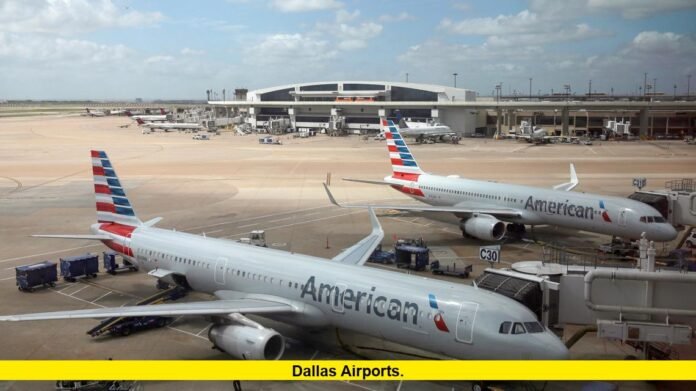

Dallas airports are once again in the spotlight as both DFW Airport and Dallas Love Field struggle with ongoing delays following a temporary ground stop earlier today. The pause in operations, which lasted about two hours in the afternoon, was triggered by a critical telecommunications outage at the Dallas TRACON, the radar and communication hub that directs flights across North Texas.
Although the ground stop has been lifted, the ripple effects continue to slow traffic, leaving thousands of passengers stranded in terminals or waiting on tarmacs.
What Caused the Ground Stop
The sudden halt in operations was not due to weather or equipment owned by the Federal Aviation Administration, but rather a malfunction with local telecommunications infrastructure that supports the TRACON. Air traffic controllers briefly lost both radar and phone communications, forcing the FAA to suspend incoming flights and sharply limit departures.
The outage disrupted flight coordination not only at Dallas airports but also at surrounding regional facilities including Addison, McKinney, Fort Worth Meacham, and Fort Worth Alliance.
Extent of Flight Disruptions
The impact has been staggering for passengers:
- At DFW International Airport, more than 600 flights experienced delays, and well over 100 were canceled by late afternoon. Some travelers reported sitting on planes for several hours waiting for clearance.
- At Dallas Love Field, delays affected close to 200 flights, though cancellations were far fewer compared to DFW. Average wait times stretched to 30 minutes or more, with some passengers facing extended rebookings.
- Some flights were delayed by as much as seven hours, straining airline crews and leading to missed connections for travelers headed across the country.
The backlog is expected to take the rest of the evening to untangle, and ripple effects could continue into tomorrow’s early departures.
Airlines Hit the Hardest
Two major carriers bore the brunt of the disruption:
- American Airlines, which operates its largest hub at DFW, issued a travel advisory allowing passengers to rebook flights without penalty.
- Southwest Airlines, the primary tenant at Love Field, worked to minimize cancellations but still saw widespread late departures and arrivals.
Both airlines deployed extra staff to assist stranded passengers, but long lines quickly built at customer service counters as delays compounded.
Passenger Experiences
For travelers on the ground, the situation has been frustrating:
- Families returning from vacations faced hours-long waits with little clarity on departure times.
- Business travelers reported missing critical meetings as connecting flights out of Dallas slipped further behind schedule.
- Some passengers were forced to rebook for flights leaving tomorrow, while others scrambled for rental cars to reach destinations within driving distance.
The sudden outage underscored just how dependent Dallas airports are on seamless communication systems, with even a short disruption throwing operations into chaos.
FAA and Local Efforts to Restore Service
FAA officials confirmed that the problem originated with telephone company equipment that supports radar and communication at Dallas TRACON. While not an FAA failure, the issue still crippled the ability to direct flights safely.
Technicians have been working with urgency to restore full service. Although some systems were back online when the ground stop ended, the FAA placed a ground delay program on DFW and Love Field to gradually manage the flow of aircraft until normal capacity could be restored.
Advice for Travelers
If you are traveling through Dallas airports today or tomorrow, here are some practical tips:
- Check flight status frequently using your airline’s website or app. Schedules may continue to shift by the minute.
- Arrive early, as security lines and boarding queues may be longer than normal due to rescheduled flights.
- Consider rebooking if your travel is not urgent. Airlines are offering more flexibility for changes given the scope of delays.
- Pack patience, as airport staff are managing high stress while working to help stranded passengers.
Broader Impact on Air Traffic
The temporary outage in Dallas had effects beyond Texas. Since DFW is one of the busiest hubs in the world, delays spread across the national air traffic system. Flights bound for Dallas from cities such as Chicago, Atlanta, Los Angeles, and New York were held at their origin points, creating a chain reaction of rescheduled departures across the country.
Smaller Texas airports also reported delays in handling inbound and outbound flights, highlighting how central Dallas remains to the state’s overall aviation network.
Looking Ahead
While the telecommunications issue is expected to be fully resolved soon, today’s incident highlights a vulnerability in the infrastructure supporting America’s busiest airports. Unlike weather disruptions, which can be anticipated, a sudden outage of communication equipment brings unpredictable and wide-reaching consequences.
For Dallas airports, resilience planning and redundancy in communication systems will likely become a renewed priority. Passengers, however, are left with the immediate challenge of navigating delays, rebookings, and uncertainty about when their travels will resume smoothly.
Conclusion
Dallas airports remain under strain tonight, even as operations gradually return to normal following the ground stop. The telecommunications outage may have been brief, but its effects are lingering, leaving travelers with long waits and airlines scrambling to recover schedules.
If you are flying through DFW or Love Field, expect continued delays and stay in close contact with your airline. Have you been affected by today’s disruptions? Share your experience below and let others know how you managed your travel.