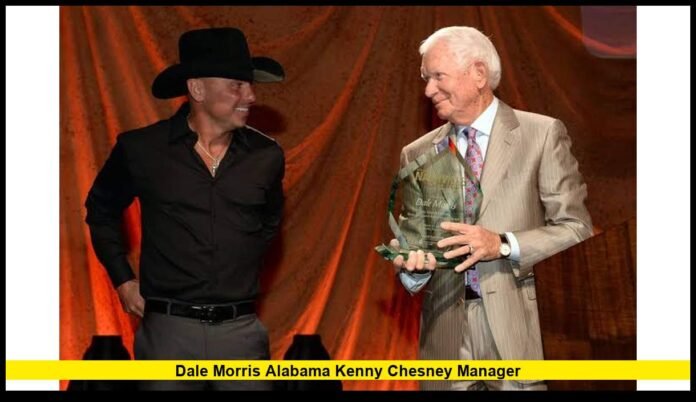

The story of dale morris alabama kenny chesney manager brings together two of the most important success stories in modern country music. Dale Morris was the Nashville manager and entertainment executive whose career helped transform Alabama from a promising Southern band into a country music institution and later helped Kenny Chesney develop into one of the genre’s most successful touring artists. Morris died peacefully in his sleep on August 21, 2026, at age 89, bringing an extraordinary career that stretched across nearly seven decades to a close.
Morris worked largely behind the scenes, but his influence could be seen in the scale of the artists he represented, the way country music concerts were produced and the careers of younger executives he mentored. His approach combined artist development, ambitious touring strategies, business creativity and a willingness to take risks when the conventional path was not enough.
Dale Morris Built a Career From the Ground Up
Before becoming one of Nashville’s most influential managers, Morris started in the music business as a songwriter.
One of his early breakthroughs came when Johnny Paycheck recorded one of Morris’ songs, giving the future manager an important foothold in the country music industry. Morris eventually realized that his greatest opportunity could come from working directly with artists and helping shape their careers rather than remaining solely on the creative side of the business.
That decision changed the direction of his life.
Morris established Dale Morris & Associates and developed a reputation for identifying artists with significant potential. He was known for thinking beyond an artist’s immediate record sales and considering the larger picture, including touring, production, branding, relationships and long-term audience development.
That philosophy became particularly important when he encountered Alabama.
The Alabama Connection Changed Everything
The band, made up of Randy Owen, Teddy Gentry and Jeff Cook, was still developing its identity and audience. Morris saw something bigger than the group’s existing profile. He believed Alabama could become a major national act, and he approached the band’s career with a level of ambition that was unusual for a country group at the time.
Morris became the band’s manager and began working toward opportunities that could take Alabama far beyond the regional circuit.
His strategy helped Alabama build momentum at a critical point in its development. The group eventually signed with a major label and began a remarkable run of chart success.
But Morris did not simply focus on records.
He understood that a country artist’s live show could become a major part of the business. His vision for Alabama’s concerts incorporated larger production values and staging techniques that were more commonly associated with major rock tours.
That helped change expectations for what a country concert could look like.
How Alabama Became a Country Music Giant
Alabama went on to become one of the most commercially successful groups in country music history.
The band accumulated an extraordinary run of No. 1 hits and developed a massive national audience. Its success helped establish the idea that a country group could operate at the same scale as major touring acts in other genres.
Morris played an important role in that transformation.
He pushed the organization around Alabama to think bigger, particularly when it came to touring and production. Instead of treating concerts simply as a way to support record releases, the live show became a major attraction in its own right.
That strategy proved highly influential.
Alabama’s success also helped open doors for other country artists who wanted to build careers around large-scale touring. Morris had effectively demonstrated that country music could support ambitious entertainment businesses without sacrificing its connection to the audience.
The band’s eventual induction into the Country Music Hall of Fame in 2005 became one of the major milestones in a career that had begun with Morris taking a chance on the group decades earlier.
The Second Major Chapter: Kenny Chesney
Morris’ next defining artist relationship came with Kenny Chesney.
In the early 1990s, Chesney was still a developing artist with ambitions of becoming a major country star. Producer Barry Beckett helped introduce Chesney to Morris, and the meeting would become one of the most consequential partnerships in the singer’s career.
Chesney was already determined to build a career, but Morris brought something different to the equation: an expansive vision of what that career could become.
Morris did not view Chesney merely as a recording artist. He saw the potential for Chesney to become a major live entertainer with an audience capable of filling increasingly larger venues.
That vision eventually became reality.
Dale Morris Helped Shape Kenny Chesney’s Touring Career
Kenny Chesney developed into one of country music’s biggest touring performers, with stadiums and major venues becoming central to his career.
The scale of Chesney’s touring success reflected many of the ideas Morris had developed during his work with Alabama.
Live entertainment was not treated as an afterthought. It became part of the artist’s identity.
Chesney’s concerts evolved into large productions designed to create a communal experience between the performer and thousands of fans. That approach helped make his tours some of the most commercially successful in country music.
Morris also encouraged Chesney to think beyond traditional industry boundaries. The relationship eventually became about more than booking shows or managing a recording career. It involved developing new opportunities and exploring different ways for an artist to connect with fans.
That willingness to experiment became a defining feature of Morris’ management style.
A Manager Who Thought Bigger Than Nashville
One reason Morris became so respected among industry insiders was his willingness to borrow ideas from outside traditional country music.
He recognized that the business was changing and that country artists did not need to remain confined to old models.
His work with Alabama helped introduce bigger production concepts to country touring. His later work with Chesney continued that evolution as the artist expanded into massive stadium performances and increasingly sophisticated live experiences.
Morris understood that successful management involved anticipating where the entertainment business was heading rather than simply reacting to where it had already been.
That mindset helped him remain relevant through multiple generations of country music.
The Importance of Clint Higham
Another major part of Morris’ legacy is Clint Higham.
Higham joined Dale Morris & Associates while he was a student at Belmont University. What began as an opportunity to learn the business eventually developed into a decades-long professional relationship.
Higham became a trusted colleague, business partner and eventually president of Morris Higham Management.
His career illustrates another part of Morris’ influence: mentorship.
Morris was known for identifying potential not only in performers but also in the people working around them. He gave younger professionals opportunities and encouraged them to think creatively about the business.
Higham eventually became an important figure in Kenny Chesney’s management and helped continue the management philosophy Morris had developed.
The relationship also demonstrates why Morris’ legacy cannot be measured solely through album sales or concert grosses. He helped shape people who would remain active in the music business long after his own career entered its later years.
Dale Morris Managed More Than Two Major Acts
Although Alabama and Kenny Chesney were his most recognizable clients, Morris’ career included many other notable names.
His management roster over the years included artists such as Martina McBride, Old Dominion, Jake Owen, Barbara Mandrell, Louise Mandrell, Big & Rich, Gretchen Wilson, Dailey & Vincent and others.
That range demonstrates the breadth of his influence.
Morris was not tied to one particular sound or generation. He worked with established stars, developing performers and artists at different stages of their careers.
His ability to identify commercial potential while maintaining a focus on the artist’s individual identity became one of his defining strengths.
Morris Light & Sound Expanded His Influence
Morris also understood that artist management and concert production were closely connected.
To support his artists’ ambitions, he became involved in staging, lighting and sound through Morris Light & Sound.
The company became known for providing high-level production capabilities and helped Morris pursue the type of ambitious touring environment he envisioned for his clients.
This was particularly significant during the era when country music was rapidly becoming a larger touring business.
Morris wanted his artists to have access to production capabilities that could compete with the biggest entertainment acts in the country. His involvement in this area gave him another way to influence the direction of live music.
It also reinforced his reputation as an executive who preferred to solve problems himself rather than accept limitations imposed by traditional industry structures.
A Broader Nashville Business Legacy
Morris’ activities eventually extended beyond artist management.
Over the years, his business interests included record labels, production operations and entertainment ventures. His career reflected the increasingly interconnected nature of the modern music industry.
He also remained involved in Nashville’s larger entertainment community and became an important relationship-builder within the business.
People who worked with Morris often remembered his ability to connect artists, executives, promoters and other influential figures.
That network became one of his greatest professional assets.
He understood that relationships could create opportunities that traditional business structures could not always provide.
Why His Management Style Mattered
Morris’ approach was built around several core ideas.
First, he believed artists should be allowed to dream beyond the opportunities immediately in front of them.
Second, he understood that careers should be built for the long term rather than around one successful album or single.
Third, he recognized the importance of live entertainment.
Finally, he believed that relationships mattered.
Those principles helped him remain influential through dramatic changes in the music business, from the era of physical records and traditional radio to the modern world of streaming, stadium tours and increasingly sophisticated entertainment brands.
His success with Alabama and Chesney offered two different examples of the same philosophy.
With Alabama, he helped a young band redefine what a country touring act could become.
With Chesney, he helped develop an individual performer into a stadium-level entertainment brand.
The Final Chapter of Dale Morris’ Career
Morris remained connected to the business for decades.
In 2018, the Dale Morris agency was sold to Paradigm, now known as The Team, while Morris’ management interests continued separately. The move reflected the changing nature of the talent business and Morris’ willingness to adapt his operations to a new era.
He also continued to be recognized for his contributions to the industry.
Morris was inducted into the International Entertainment Buyers Association Hall of Fame in 2010. Later, he received the Country Music Association’s Irving Waugh Award of Excellence, recognizing his broader contribution to the country music industry.
These honors highlighted something that his career had demonstrated repeatedly: Morris’ influence extended well beyond the success of any individual client.
Dale Morris Dies at 89
The latest development in Morris’ story came with his death on August 21, 2026.
He was 89 and died peacefully in his sleep, according to his family and representatives. Morris would have turned 90 in September.
News of his death brought tributes from across Nashville.
Kenny Chesney, Randy Owen of Alabama and Clint Higham were among those reflecting on the impact Morris had made during his lifetime. Their responses emphasized his role as a mentor, visionary and trusted friend as much as his accomplishments as a manager.
For those who worked with him, Morris was not simply a businessman who negotiated deals. He was someone who encouraged people to pursue possibilities that might initially have seemed unrealistic.
A Legacy That Lives Through Alabama and Kenny Chesney
The connection between Alabama and Kenny Chesney helps explain why Morris remains such an important figure in country music history.
The Alabama chapter showed what could happen when a manager believed a regional band could become a national superstar.
The Chesney chapter demonstrated how the same philosophy could work with a solo performer and eventually produce one of country music’s most powerful touring careers.
In both cases, Morris looked beyond the immediate moment.
That ability to see a larger future may be the most important part of his professional legacy.
For readers researching dale morris alabama kenny chesney manager, the central story is not simply that Morris represented two famous country acts. It is that he helped create a management model centered on ambition, innovation, live entertainment and long-term relationships.
Remembering a Nashville Original
Dale Morris occupied a rare position in the music business.
He was influential without becoming a household name. His work was visible through the success of his clients rather than through constant public attention.
Alabama’s historic career and Kenny Chesney’s rise to the top of country touring remain two of the clearest examples of what his vision could accomplish.
His influence will also continue through the professionals he mentored and the business practices he helped introduce to Nashville.
Morris’ death closes an important chapter in the history of country music management, but the careers he helped build ensure that his name will remain connected to some of the genre’s most important achievements.
His story is ultimately about believing in people before the rest of the world recognizes what they can become. That belief helped turn Alabama into a country music institution, helped Kenny Chesney reach unprecedented heights as a live performer and gave generations of Nashville professionals an example of how bold management can change an entire industry.
Dale Morris’ influence lives on through the artists, executives and country music fans who experienced the careers he helped shape—share your memories and stay with us for more stories from Nashville’s remarkable history.