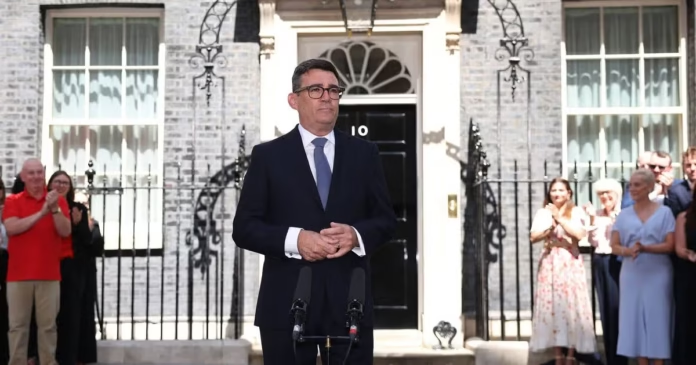

Britain’s new Prime Minister has moved quickly to order a cut in taxes on electricity, making it the first major policy announcement of his premiership. Just one day after taking office, Andy Burnham confirmed that his government will scrap the value-added tax (VAT) on domestic electricity bills starting October 1, a decision aimed squarely at easing the financial pressure that has weighed on British households for years. The announcement signals that the new administration wants to be judged on quick, visible action rather than long-term promises, and it has already become one of the most talked-about political stories in the UK this week.
Background: A New Prime Minister Steps In
Andy Burnham officially became the United Kingdom’s Prime Minister on July 20, 2026, succeeding Sir Keir Starmer, who resigned after a period marked by election setbacks, internal party tension, and sliding approval ratings. Burnham takes over as the UK’s seventh prime minister in a decade, a statistic that reflects just how unstable British politics has been in recent years. He was appointed unchallenged as Labour Party leader after Starmer stepped aside, with rival leadership contender Wes Streeting choosing to back him rather than run against him.
Burnham, 56, is not a newcomer to British politics. Born in a suburb of Liverpool, he joined the Labour Party as a teenager and studied at Cambridge University before working his way up through government. He held cabinet positions under former Prime Ministers Tony Blair and Gordon Brown and later took on shadow cabinet roles under Ed Miliband and Jeremy Corbyn. For nearly a decade, from 2017 until his return to Westminster in 2026, he served as Mayor of Greater Manchester, a role that earned him the nickname “King of the North” and built his reputation as a politician closely connected to working-class communities.
His path back to national leadership began after Labour suffered a heavy defeat in local and regional elections in May 2026. That defeat triggered a leadership crisis within the party, and Burnham won a special election to represent Makerfield in June 2026, positioning himself as the clear alternative to Starmer. Days later, Starmer announced his resignation, clearing the way for Burnham’s rise to the top job.
Main Policy: Cut in Taxes on Electricity Explained
The centerpiece of Burnham’s opening agenda as Prime Minister is the cut in taxes on electricity for ordinary households. Alongside newly appointed Chancellor John Healey, Burnham announced that VAT will be removed entirely from domestic electricity bills beginning October 1. According to the announcement, this change is expected to reduce the average annual household electricity bill by roughly £45, based on typical bills of around £1,862 per year.
Burnham framed the decision as an urgent response to years of financial strain on British families. “We’re taking immediate action to cut taxes on energy bills, put more money in people’s pockets and bring back hope,” he said in his statement announcing the measure. He also spoke of giving people more “breathing space” in their day-to-day lives, a phrase he has used repeatedly since taking office to describe his broader economic approach.
This tax cut is not an isolated gesture. Energy bills have been one of the central drivers of Britain’s cost-of-living crisis for several years, largely because wholesale gas prices, which strongly influence UK electricity costs, spiked dramatically following Russia’s full-scale invasion of Ukraine in 2022. That surge pushed household bills to levels that many families have struggled to manage ever since, making energy costs one of the most politically sensitive issues in the country.
Some key details of the announcement include:
- VAT will be removed from domestic electricity bills starting October 1, 2026.
- The change is expected to save the average household about £45 per year.
- The policy was announced on Burnham’s second full day in office, alongside new Chancellor John Healey.
- It follows years of public frustration over high energy costs tied to the broader cost-of-living crisis.
Political Reaction and Funding Questions
While the announcement was framed as a win for ordinary households, it has not gone without scrutiny. Notably, Burnham’s team has reportedly scrapped a previously proposed scheme that would have helped pay for the new tax cut, raising questions about how the policy will be financed. Darren Jones, an ally of former Prime Minister Keir Starmer, publicly questioned whether the new government has secured the funding needed to support the move, stating that the government will have to explain how it plans to pay for its new policies at the upcoming budget.
This tension reflects a broader challenge facing Burnham as he begins his premiership: balancing bold, headline-grabbing policy moves with the fiscal discipline that markets and political rivals expect. Investors in UK government bonds had previously shown some unease about the prospect of Burnham, seen as more left-leaning than Starmer, taking over as Prime Minister. His government will likely face continued pressure to demonstrate that popular measures like the electricity tax cut are financially sustainable rather than short-term political gestures.
Despite these funding questions, Burnham has used his first days in office to emphasize immediate action. In his first speech as Prime Minister, delivered outside 10 Downing Street, he described his approach as a “circuit breaker for Britain,” promising what he called the biggest changes to British politics in 40 years. He has spoken of building a new political and economic model for the country, one that puts more essential services, including energy, under stronger public influence.
Public Interest and Why This Matters
The cut in taxes on electricity speaks directly to one of the most persistent concerns among British voters: the rising cost of everyday essentials. Energy bills have remained a top-of-mind issue since the 2022 price spikes, and successive governments have faced criticism for failing to bring meaningful relief to households. By making this his first significant policy move, Burnham appears to be signaling that his government intends to prioritize cost-of-living relief above other items on the political agenda.
Public interest in the announcement has also been fueled by curiosity about Burnham himself. Many people outside the UK may not be familiar with him, but domestically he is a well-known figure with a reputation for connecting with working-class communities, partly due to his long tenure as Mayor of Greater Manchester and his role in passing the Hillsborough Law, legislation aimed at preventing state cover-ups following public disasters. His rise to Prime Minister without a formal leadership contest, and the speed with which he has moved on energy policy, has added to the sense that his government intends to act differently from his predecessor.
There is no official confirmation yet on how the government intends to fully fund the electricity tax cut beyond what has already been reported, and further budget details are expected to be addressed in the coming months. Households and businesses following this story will want to watch for updates from the Treasury on funding sources, as well as any additional measures aimed at energy affordability.
Latest Updates
As of this week, the electricity tax cut remains one of the most closely watched developments coming out of the new Burnham government. Alongside the energy announcement, Burnham has already made changes to his Cabinet, including appointing Ed Miliband as foreign minister in place of Yvette Cooper and confirming John Healey as Chancellor. Shabana Mahmood has been reappointed as interior minister, suggesting some continuity even as other roles are reshuffled.
Burnham has indicated that further measures aimed at easing living costs may be announced in the near future, though no additional specifics on electricity pricing or broader energy policy have been confirmed at this stage. As the October 1 implementation date approaches, more details are likely to emerge regarding how the VAT removal will be applied and how the government plans to address the funding concerns raised by critics within his own party.
Final Thoughts
The decision to order a cut in taxes on electricity marks a decisive opening move for Britain’s new Prime Minister, aimed at addressing one of the most pressing financial concerns facing households across the country. By removing VAT from domestic electricity bills starting in October, Andy Burnham has signaled that his government intends to prioritize immediate, tangible relief for families over more gradual policy approaches. At the same time, unresolved questions about funding highlight the challenges his administration may face as it works to balance ambitious promises with fiscal accountability.
As Britain enters this new political chapter, the coming months will reveal whether this early energy policy translates into lasting confidence from both the public and financial markets. For now, the announcement stands as a clear signal of the priorities Burnham intends to bring to 10 Downing Street.
Stay tuned for more updates on this developing story, and feel free to share your thoughts in the comments below.