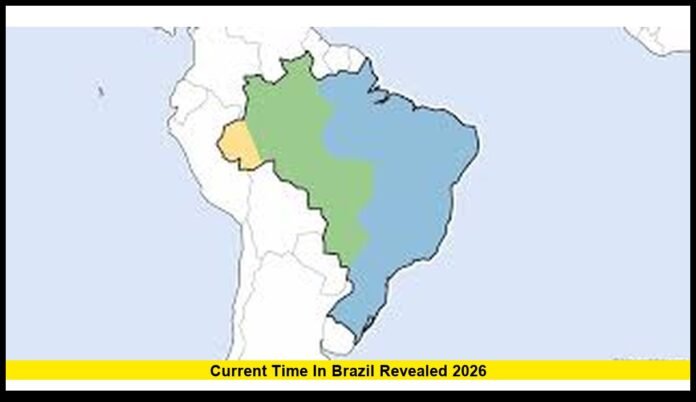

The current time in brazil varies depending on where you are in the country, and that single fact often surprises people in the United States. Brazil is not just one time zone—it spans multiple regions with different clocks, all operating without seasonal changes. As of today, most of the population, including major cities like São Paulo, Rio de Janeiro, and Brasília, follows Brasília Time (BRT), which is set at UTC−3 year-round.
For Americans managing business calls, travel plans, or remote work schedules, understanding Brazil’s time structure is more than a curiosity—it’s essential for staying on track and avoiding costly timing mistakes.
If you regularly coordinate with international partners or plan trips abroad, keeping track of global time differences can save hours of confusion and missed opportunities.
Brazil’s Time Zones: A Country That Runs on Multiple Clocks
Brazil is the largest country in South America, stretching across vast geographic distances. Because of this, it operates on four official time zones, each covering a specific region.
- UTC−2 (Fernando de Noronha Time) – Used by a small group of islands in the Atlantic
- UTC−3 (Brasília Time – BRT) – The primary time zone covering the majority of the population
- UTC−4 (Amazon Time – AMT) – Includes parts of western Brazil such as Manaus
- UTC−5 (Acre Time – ACT) – Covers the far western edge near Peru
While this may sound complex, the reality is simpler in practice. Nearly all national activity—government operations, financial markets, media broadcasts, and corporate business—runs on Brasília Time.
That means when people refer to “Brazil time,” they are almost always talking about BRT.
Why There’s No Daylight Saving Time in Brazil
One of the most important updates for anyone tracking Brazil’s time is the absence of daylight saving time.
In the past, Brazil used seasonal clock changes to extend daylight hours in certain regions. However, the country discontinued this system, and clocks now remain unchanged throughout the year.
This has several practical benefits:
- No need to adjust clocks twice a year
- Consistent time difference with other countries
- Easier scheduling for global communication
For U.S.-based readers, this is especially helpful. While American time zones shift forward and backward each year, Brazil’s time remains stable, reducing confusion during those transition periods.
How Brazil’s Time Aligns With U.S. Time Zones
Understanding how Brazil’s time compares to U.S. time zones is critical for communication and planning.
Here’s how Brasília Time (UTC−3) typically lines up:
- Eastern Time (ET): Brazil is usually 1 hour ahead
- Central Time (CT): Brazil is 2 hours ahead
- Mountain Time (MT): Brazil is 3 hours ahead
- Pacific Time (PT): Brazil is 4 hours ahead
For example, when it’s 9:00 AM in New York, it’s generally 10:00 AM in São Paulo.
Because the time gap is relatively small, Brazil remains closely connected to U.S. business hours, making it a strategic partner for companies operating across the Americas.
Major Cities and Their Current Time Zones
Brazil’s major cities are spread across different regions, but most fall within the same primary time zone.
- São Paulo: UTC−3 (BRT)
- Rio de Janeiro: UTC−3 (BRT)
- Brasília (capital): UTC−3 (BRT)
- Salvador: UTC−3 (BRT)
- Manaus: UTC−4 (AMT)
- Rio Branco: UTC−5 (ACT)
This means that while the eastern and central parts of the country are synchronized, western areas can be one to two hours behind.
For travelers or remote workers moving between regions, this difference can be significant.
Why Brazil’s Time System Matters for Americans
Brazil’s consistent and predictable time system plays a major role in global coordination.
Business and Trade
Brazil is one of the largest economies in the Western Hemisphere. Its close time alignment with the U.S. allows for real-time collaboration in industries such as finance, technology, and logistics.
Remote Work Opportunities
As companies expand globally, Brazil’s time compatibility makes it an attractive location for outsourcing and distributed teams.
Travel Planning
Tourists from the U.S. benefit from minimal jet lag when visiting Brazil, especially when traveling to cities in the BRT zone.
Financial Markets
Brazil’s stock exchange and banking hours overlap significantly with U.S. markets, enabling smoother international transactions.
Common Misunderstandings About Time in Brazil
Despite its importance, Brazil’s time system is often misunderstood. Here are a few common mistakes:
- Assuming the entire country uses one time zone
- Expecting daylight saving adjustments
- Overlooking regional differences when scheduling travel
These misconceptions can lead to missed calls, delayed flights, and scheduling conflicts.
How to Stay Updated on Brazil’s Time
Checking the current time in any part of Brazil is simple if you use the right approach:
- Use a reliable world clock app
- Search by city instead of country
- Default to Brasília Time for business purposes
Because Brazil’s time does not change seasonally, once you understand the difference, it remains consistent all year.
The Importance of Brasília Time (BRT)
Brasília Time is the backbone of Brazil’s timekeeping system.
It serves as the official standard for:
- Government operations
- National media broadcasts
- Financial institutions
- Corporate headquarters
Since it covers the majority of the population, it effectively acts as the country’s primary time reference.
Geography and Its Impact on Time Differences
Brazil’s size directly influences its time zones.
The country stretches across multiple longitudes, which means:
- Eastern regions experience earlier sunrises
- Western regions have later sunsets
- Daily routines can vary depending on location
Despite these differences, Brazil maintains strong national coordination through its dominant time zone.
Technology Keeps Brazil on Time
Modern technology ensures that time across Brazil remains accurate and synchronized.
Systems used include:
- Internet time servers
- Satellite-based synchronization
- Automated device updates
These tools help maintain precision across industries, from aviation to telecommunications.
Practical Tips for Scheduling With Brazil
If you regularly interact with people or businesses in Brazil, consider these tips:
- Always confirm the time zone when scheduling meetings
- Use digital calendars that adjust automatically
- Plan around Brasília Time unless otherwise specified
These steps can help avoid confusion and ensure smooth communication.
Will Brazil Change Its Time System Again?
At present, Brazil continues to operate without daylight saving time, and there are no active changes in place.
The current system is widely viewed as efficient and stable, particularly for international coordination and economic activity.
A Clear Takeaway for U.S. Readers
Understanding the current time in brazil is not just about knowing the hour—it’s about recognizing how a large, diverse country manages time across regions while staying connected to global markets.
With a stable system, minimal time difference from the United States, and a dominant national time zone, Brazil offers a predictable environment for business, travel, and communication.
Whether you’re planning your next trip, coordinating a meeting, or simply staying informed, knowing how Brazil’s clocks work gives you a clear advantage.
Stay informed, plan smarter, and check back for more updates that help you stay perfectly in sync with the world.