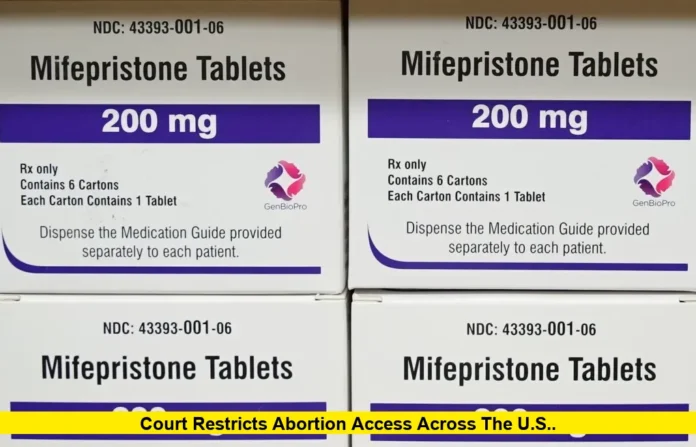

In a significant and rapidly evolving legal development, Court Restricts Abortion Access Across The U.S. has become a defining headline after a federal court ruling moved to block the mailing of the widely used abortion medication mifepristone. The decision has triggered nationwide debate, legal uncertainty, and immediate implications for reproductive healthcare access across multiple states.
What Happened: Key Court Decision Explained
A federal court ruling has effectively restricted access to medication abortion by targeting how one of the primary drugs—mifepristone—is distributed. The court’s decision focuses on halting or limiting the mailing of the drug, which has been a cornerstone of abortion access since regulatory changes allowed telehealth prescriptions and mail delivery.
According to reporting from major outlets such as Reuters and the Associated Press, the ruling challenges long-standing policies established by the U.S. Food and Drug Administration, which had previously approved mifepristone as safe and effective and allowed it to be dispensed through certified providers and mailed to patients.
As per legal experts cited in national coverage, this decision could drastically reduce access, especially in states where abortion services are already limited.
Why Mifepristone Matters
Mifepristone is one of two drugs commonly used in medication abortions, typically followed by misoprostol. It has been used safely for over two decades and accounts for a majority of abortions in the United States.
Medical authorities including the World Health Organization and the American College of Obstetricians and Gynecologists have consistently supported its safety profile.
According to public health data cited in recent reports, medication abortions now make up more than half of all abortions nationwide, making this ruling particularly impactful.
Nationwide Impact: Access and Legal Confusion
The decision does not affect all states equally, but its consequences are widespread:
- Restricted access in conservative states: States with strict abortion bans may enforce the ruling aggressively.
- Legal battles in liberal states: Some states are expected to challenge or bypass the ruling to maintain access.
- Telehealth disruption: Providers relying on mail delivery could face operational shutdowns.
According to analysis from major legal scholars, the ruling creates a patchwork system where access depends heavily on geography, increasing disparities in healthcare availability.
Federal vs State Authority Clash
This case highlights an ongoing power struggle between federal authority and state-level abortion laws following the landmark Dobbs v. Jackson Women’s Health Organization decision.
That ruling overturned Roe v. Wade and returned abortion regulation to the states. However, the current situation introduces a new layer—federal court intervention into drug regulation—raising questions about whether courts can override FDA authority.
As per constitutional experts quoted in national media, this could set a precedent affecting not just abortion drugs but other federally approved medications.
Political and Public Reaction
The ruling has drawn sharp responses across the political spectrum:
- Supporters of abortion restrictions argue it reinforces oversight and addresses legal concerns about drug approval processes.
- Opponents warn it undermines science-based regulation and restricts essential healthcare.
According to statements reported by AP News, advocacy groups on both sides are mobilizing legal teams, signaling that this issue is far from settled.
What Happens Next?
The legal battle is expected to escalate quickly. Possible next steps include:
- Appeals to higher courts, potentially reaching the Supreme Court of the United States
- Emergency stays that could temporarily restore access
- Additional lawsuits from states and healthcare providers
As per legal analysts, the timeline for resolution remains uncertain, but immediate disruptions are already being felt.
Broader Implications for U.S. Healthcare
This ruling may extend beyond abortion policy. Experts warn it could:
- Undermine confidence in FDA-approved medications
- Encourage legal challenges to other drugs
- Shift healthcare access toward state-controlled systems
According to healthcare policy specialists cited in Reuters, the decision represents a turning point in how medical authority is interpreted in the U.S.
Conclusion
The headline Court Restricts Abortion Access Across The U.S. reflects more than a single legal ruling—it signals a major shift in healthcare access, federal authority, and reproductive rights. With the blocking of mifepristone mailing, millions of Americans could face new barriers, while courts, lawmakers, and medical institutions prepare for an extended legal and political battle.