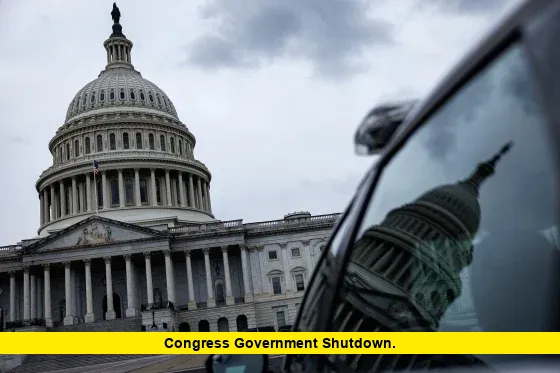

Congress is once again at the center of a high-stakes budget battle that could determine whether the U.S. federal government remains open or experiences another crippling funding lapse. With the deadline looming at the end of January and divisions deepening within and between the two major parties, the issue of averting a congress government shutdown has dominated political debate and shaped strategy on Capitol Hill.
Lawmakers in both chambers are negotiating to pass the remaining appropriations bills needed to fund federal agencies for the rest of the fiscal year. Without final action, large portions of the government could face a lapse in funding, leading to furloughs, service disruptions, and economic uncertainty for millions of Americans.
The Funding Deadline and Why It Matters
The federal government is currently operating under a temporary funding measure that expires at the end of January. This short-term extension was passed to give Congress more time to finalize the full set of annual spending bills.
If new legislation is not approved before the deadline, non-essential federal operations would be forced to halt. Agencies without funding would suspend many activities, and hundreds of thousands of federal workers could be furloughed or required to work without pay until funding is restored.
Key departments awaiting full-year funding include Homeland Security, Health and Human Services, Education, Transportation, and Housing and Urban Development. These agencies provide services that touch nearly every American household, from airport security and disaster response to student aid, public housing, and medical research.
Bipartisan Negotiations and the Emerging Spending Package
In recent days, congressional leaders from both parties have moved closer to a compromise by assembling a large, bipartisan spending package designed to fund most of the government for the remainder of the fiscal year.
The proposal combines several appropriations bills into one legislative vehicle to speed up the process and reduce the risk of a last-minute stalemate. The package sets overall spending levels for defense, labor, education, health programs, transportation, and housing, while also addressing key policy disputes that have slowed progress for months.
Supporters say the agreement reflects weeks of negotiations and represents a realistic path to avoiding a shutdown. It balances fiscal restraint with the need to maintain essential services and protect core domestic and national security priorities.
Defense and National Security Funding
National defense remains one of the least controversial components of the budget. The current proposal maintains previously agreed-upon funding levels for the military, ensuring continued support for troop readiness, weapons modernization, and overseas operations.
Lawmakers from both parties have emphasized the importance of providing stability for the armed forces and defense contractors, particularly at a time of heightened global tensions and ongoing international commitments.
Homeland Security and Immigration Enforcement
One of the most sensitive and closely watched sections of the budget involves the Department of Homeland Security.
Debates have centered on funding for immigration enforcement, border security operations, and oversight measures. Some lawmakers have pushed for stronger accountability provisions and limits on certain enforcement practices, while others have argued that agencies need flexibility and resources to manage border operations effectively.
The current compromise adjusts funding levels and includes additional reporting and oversight requirements. While not all members are fully satisfied, congressional leaders believe the agreement has enough support to advance.
Education, Healthcare, and Social Programs
The spending package largely preserves funding for education and healthcare programs, avoiding the steep reductions that had been proposed earlier in the budget process.
Education funding supports K-12 programs, special education, college affordability initiatives, and workforce training. Healthcare funding continues support for medical research, disease prevention, and public health infrastructure.
Housing and urban development programs, which assist low-income families, veterans, and the elderly, are also included in the agreement, with funding levels designed to maintain existing services and prevent large-scale cutbacks.
Progress in the Senate
The Senate has already passed several of the required appropriations bills with strong bipartisan support. These measures cover a range of departments, including agriculture, energy, justice, and environmental agencies.
Senate leaders have signaled that they are prepared to move quickly on the remaining bills once final agreements are reached with the House. The goal is to send a complete funding package to the president’s desk before the temporary funding extension expires.
The House Challenge
In the House of Representatives, narrower margins and internal party divisions have made negotiations more complex. Leadership must secure enough votes from both parties to pass the combined spending package.
Procedural strategies, such as bundling multiple bills together, are being used to streamline the process and limit opportunities for amendments that could derail the agreement. The approach is intended to present lawmakers with a clear choice: approve the compromise or risk a shutdown.
Economic and Public Impact of a Shutdown
Even the possibility of a shutdown can have real-world consequences.
Federal workers face uncertainty about paychecks and job security. Contractors and businesses that rely on government funding or approvals may delay projects and hiring. National parks, museums, and other public facilities could close, affecting tourism and local economies.
Delays in regulatory approvals can slow construction, energy projects, and financial transactions. Processing of loans, permits, and some benefit applications may also be interrupted.
While essential services such as air traffic control, law enforcement, and emergency response continue during a shutdown, they often operate with reduced staffing and resources, increasing strain on employees and systems.
Lessons From Past Shutdowns
Previous government shutdowns have demonstrated how quickly disruptions can spread across the economy and public services.
Extended shutdowns have led to backlogs in tax processing, delays in scientific research, postponed infrastructure projects, and financial hardship for federal employees who must wait for back pay.
These experiences have increased pressure on lawmakers to avoid another funding lapse and reinforced the political risks of allowing negotiations to collapse.
What Happens Next
Over the coming days, both chambers of Congress are expected to schedule votes on the remaining appropriations measures or on a comprehensive package that includes them.
If the legislation passes and is signed into law before the deadline, federal agencies will receive full-year funding and the immediate threat of a shutdown will be removed.
If talks break down or procedural delays prevent final action, a short-term extension could be considered as a fallback option. However, leaders from both parties have indicated a strong preference for completing full-year funding rather than relying on another temporary measure.
Why This Moment Is Critical
The outcome of these negotiations will determine whether the federal government can operate without interruption and whether millions of workers and families can avoid the uncertainty that comes with a funding lapse.
Avoiding a congress government shutdown is not only a matter of meeting a legislative deadline. It is about maintaining public trust, protecting essential services, and ensuring economic stability at a time when many Americans are already facing rising costs and financial pressure.
What do you think about how Congress is handling the budget fight and the risk of a shutdown? Share your thoughts and stay tuned for the latest developments.