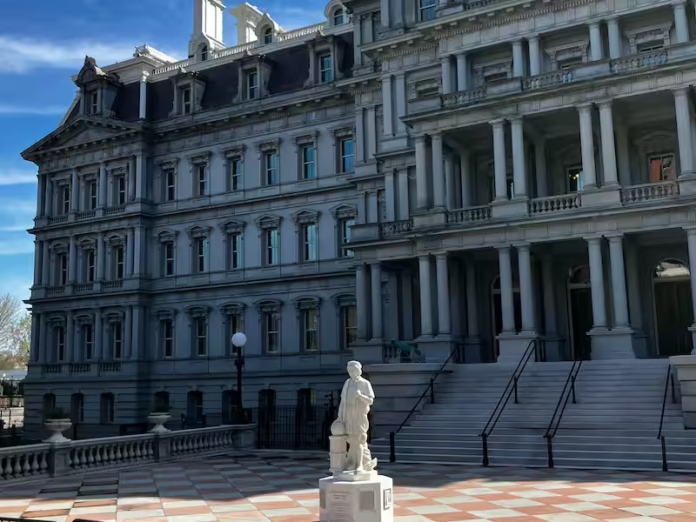

America has never fully resolved the Columbus Day debate, but in 2026 it is louder, more politically charged, and more personally felt than it has been in a generation. The question driving it — whether honoring Christopher Columbus celebrates the spirit of exploration or deliberately overlooks the catastrophic harm caused to Indigenous peoples — has now moved from city halls and university campuses directly to the front of the White House. When President Donald Trump installed a Christopher Columbus statue on White House grounds in March 2026, he did not simply make a statement about history. He made a declaration about identity, power, and which version of America he intends to represent.
This is the story behind that decision, the people it affects, and why the Columbus Day debate is nowhere near over.
This story is continuing to develop — bookmark this page and check back for the latest updates.
How a Federal Holiday Became a Cultural Flashpoint
Columbus Day has carried federal holiday status since 1937. Its establishment was not purely an act of historical admiration. It was, in large part, a political response to the discrimination that Italian immigrants faced in America during the late 19th and early 20th centuries. Italian Americans had endured violence, social exclusion, and deep-rooted prejudice. The recognition of Columbus — a Genoa-born explorer — as a national hero was a way of saying that Italian Americans belonged in this country and that their heritage deserved a place in the American story.
For most of the 20th century, that meaning held. Schools taught the 1492 voyage as an act of discovery. Communities held parades. The holiday passed largely without controversy.
The cracks began appearing in the 1970s, when Native American scholars, activists, and community leaders began making their case publicly and persistently. The argument was grounded in documented history. Columbus never reached the continental United States. He arrived in the Caribbean, and what followed his arrival — colonization, forced labor, enslavement, and the destruction of entire civilizations — was not a footnote. It was the defining consequence of his voyages for millions of people whose descendants are still alive today.
In 1992, Berkeley, California became the first city in the country to replace Columbus Day with Indigenous Peoples’ Day. It was a small decision in a single city, but it planted a seed that kept growing. Over the following three decades, more than 200 cities and nearly 20 states followed. The holiday map of America quietly but unmistakably shifted.
The Federal Government Takes Sides — Twice
For years, the White House avoided the Columbus Day debate by saying nothing definitive. That changed in 2021 when President Joe Biden issued the first-ever presidential proclamation formally recognizing Indigenous Peoples’ Day at the federal level. He did not eliminate Columbus Day. He issued both proclamations on the same day. But the act of putting Indigenous Peoples’ Day on equal footing with Columbus Day — even symbolically — was a seismic shift for many on both sides.
Italian American organizations pushed back hard. They argued that recognizing Indigenous Peoples’ Day as a counterpoint to Columbus Day diminished their community’s heritage and treated a beloved cultural symbol as something to be apologized for. Their frustration built steadily through the Biden years.
When Donald Trump returned to the White House in January 2025, he heard that frustration clearly and responded to it without hesitation.
Trump Draws a Hard Line
In October 2025, Trump signed a formal presidential proclamation restoring Columbus Day to its full federal standing with no competing recognition of Indigenous Peoples’ Day. The language in the proclamation was direct and forceful. It described Columbus as the original American hero, praised his 1492 voyage as one of the defining acts of Western civilization, and framed the defense of Columbus Day as an act of patriotism.
Trump did not mince words about the other side of the debate. The proclamation took direct aim at what it described as efforts to tear down Columbus’s legacy and erase history. At the Cabinet meeting where he signed the order, Trump told the room, “Columbus Day — we’re back, Italians.” The line drew applause from supporters and immediate criticism from Indigenous advocates and historians.
The message was unmistakable. Under this administration, the Columbus Day debate had an official answer — and it was not ambiguous.
A Statue With a Remarkable Story
Words were only the beginning. In March 2026, Trump went further by installing a 13-foot Christopher Columbus statue directly on White House grounds, making the abstract political debate suddenly, physically real.
The statue carries one of the most dramatic origin stories of any monument in recent American history. It began its life in Baltimore’s Little Italy neighborhood, where it was unveiled in 1984 during the Reagan administration. It stood there for 36 years as a symbol of Italian American pride in the city.
In July 2020, during nationwide protests that followed the police killing of George Floyd, demonstrators used ropes and chains to pull the statue from its base and throw it into Baltimore’s Inner Harbor. The moment was widely filmed and became one of the most striking images of that summer.
Rather than accept the loss, members of Baltimore’s Italian American community organized a recovery and restoration effort. A sculptor was brought in to reconstruct the piece using fragments pulled from the harbor and new marble sections. The base of the finished statue notes its original 1984 dedication, its 2020 destruction, and its 2022 resurrection.
The Italian American Organizations United, a Maryland-based advocacy group, loaned the restored statue to the federal government. It now stands adjacent to the Eisenhower Executive Office Building, visible from Pennsylvania Avenue, surrounded by security fencing but impossible to miss.
Trump praised the Italian American community for their generosity in bringing the monument to Washington and described the installation as an eternal tribute to courage and the American spirit. A White House spokesperson stated directly that Columbus is a hero in this administration and that his legacy will be honored for generations.
The Columbus Day Debate Through Indigenous Eyes
For Native American communities across the country, the statue installation and the proclamation represent something deeply painful. Indigenous advocates have been consistent and clear in their response.
The core argument from Native communities is not complicated. Columbus’s arrival in 1492 did not mark a discovery — it marked the beginning of a catastrophe for the peoples who were already here. The Taino people of the Caribbean, whom Columbus first encountered, were subjected to forced labor, violence, and enslavement under his direct governance of Hispaniola. Within decades of his arrival, their population had collapsed from hundreds of thousands to near extinction.
What followed across the broader Americas — over the next three to four centuries — included the deaths of tens of millions of Indigenous people through violence, disease, and deliberate destruction of cultures and communities. Native scholars and advocates argue that placing a statue honoring the man whose voyages set all of that in motion at the seat of American executive power sends a clear and painful message about whose suffering matters in this country.
Many Native communities have responded by simply continuing to celebrate Indigenous Peoples’ Day regardless of what federal proclamations say. Across the states and cities that have formally made the switch, October’s second Monday remains a day of ceremony, education, and recognition — presidential declarations notwithstanding.
Italian Americans: Heritage, Identity, and a Holiday That Means More Than History
Understanding the Columbus Day debate fully requires understanding what Columbus Day actually means to Italian American communities — and that meaning runs much deeper than admiration for a 15th-century explorer.
Italian immigrants who arrived in America in the late 1800s and early 1900s faced discrimination that was severe and sometimes deadly. The 1891 lynching of eleven Italian immigrants in New Orleans remains one of the largest mass lynchings in American history. Italian Americans were treated as racially suspect, socially inferior, and culturally unwelcome for decades.
Columbus Day emerged from that context as a statement of belonging. It said that an Italian-born man had played a foundational role in the story of the Western Hemisphere — and that Italian Americans, by extension, had a rightful place in the American story. The holiday was never just about Christopher Columbus the historical figure. It was about dignity, recognition, and survival.
That history explains why efforts to replace or diminish Columbus Day land so painfully in Italian American communities. For many families who have celebrated the holiday for four or five generations, removing Columbus feels like removing themselves from the national narrative.
A Nation Still Divided
As of March 2026, the Columbus Day debate has no resolution in sight. Federally, the holiday remains Columbus Day with no Indigenous recognition. In nearly 20 states and more than 200 cities, Indigenous Peoples’ Day is observed in some form. The two Americas on this issue are not separated by geography so much as by history — by whose ancestors suffered and whose ancestors were celebrated.
Legislation has been introduced in Congress that would withhold federal funding from state and local governments that choose to recognize Indigenous Peoples’ Day instead of Columbus Day. It has not passed. More states continue to move toward Indigenous recognition each year. The legal, cultural, and political battle over the second Monday of October is still very much alive.
The 13-foot marble figure now standing on White House grounds will be reviewed when the next administration takes office in January 2029. Whether it stays or goes will depend entirely on who wins the next presidential election — which means the Columbus Day debate has now become, in the most direct possible way, a question on every American ballot.
Where do you stand on the Columbus Day debate? Leave your thoughts in the comments below — and keep checking back as this story continues to unfold across the country.