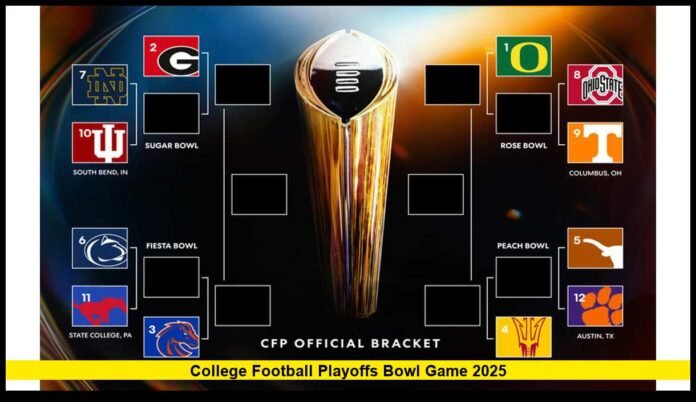

College football playoffs bowl games are officially set for the 2025 postseason, ushering in a new era of excitement and opportunity for programs across the nation. This season’s playoff is particularly historic—it marks the first year of the 12-team College Football Playoff format, replacing the four-team model that had defined college football’s postseason since 2014.
The final rankings, released on Sunday, December 8, 2025, have locked in the 12 teams that will compete for the national championship. Fans, players, and coaches are now gearing up for what promises to be the most competitive and wide-open playoff field in the sport’s modern history.
A Milestone Moment for College Football
The expanded playoff format is designed to include more teams from a wider range of conferences, giving programs that previously sat just outside the top four a legitimate shot at the title. It also enhances the importance of the major bowl games, integrating them directly into the playoff schedule while preserving the pageantry and tradition fans associate with college football’s postseason.
This season’s playoff field features six automatic bids for the highest-ranked conference champions and six at-large selections. The top four ranked conference champions receive first-round byes and will automatically advance to the quarterfinals.
The remaining eight teams will compete in on-campus first-round matchups, a new feature of the format that gives fans a taste of playoff football in a true college atmosphere.
2025 College Football Playoff Teams
Here is the final 12-team playoff field as confirmed by the College Football Playoff Selection Committee:
- Georgia Bulldogs (13-0) – SEC Champion
- Michigan Wolverines (12-1) – Big Ten Champion
- Texas Longhorns (12-1) – Big 12 Champion
- Oregon Ducks (12-1) – Pac-12 Champion
- Alabama Crimson Tide (11-2) – At-Large (SEC)
- Florida State Seminoles (12-1) – ACC Champion
- Ohio State Buckeyes (11-2) – At-Large (Big Ten)
- Penn State Nittany Lions (10-2) – At-Large (Big Ten)
- Missouri Tigers (10-2) – At-Large (SEC)
- Ole Miss Rebels (10-2) – At-Large (SEC)
- Boise State Broncos (11-2) – Group of Five (Mountain West Champion)
- Notre Dame Fighting Irish (9-3) – At-Large (Independent)
The selection committee’s final rankings reflect a balance between dominance in conference play and overall strength of schedule. The inclusion of multiple SEC and Big Ten teams underscores the continued strength of those leagues, while Boise State’s entry marks a milestone for Group of Five representation.
First-Round Games: Campus Showdowns
The playoff officially begins with four first-round games on December 20–21, 2025. These matchups will be hosted by the higher-seeded teams on their home fields, creating electric atmospheres and giving programs the chance to host postseason games on campus for the first time in the playoff era.
First-Round Schedule:
- (12) Notre Dame at (5) Alabama – Tuscaloosa, Alabama
- (11) Boise State at (6) Florida State – Tallahassee, Florida
- (10) Ole Miss at (7) Ohio State – Columbus, Ohio
- (9) Missouri at (8) Penn State – State College, Pennsylvania
Winners from these games will advance to the quarterfinal round, where they’ll face one of the top four seeds. The home-field advantage is expected to play a major role in determining outcomes, especially for northern programs like Penn State and Ohio State, where weather conditions could impact game play.
Quarterfinal Bowl Matchups
The winners of the first round will advance to the quarterfinal bowl games, which will take place on December 31, 2025, and January 1, 2026. Each quarterfinal game will be hosted by one of the major New Year’s Six bowls, which now rotate through playoff hosting duties.
Quarterfinal Schedule:
- Fiesta Bowl (Glendale, Arizona) – December 31
- Peach Bowl (Atlanta, Georgia) – December 31
- Rose Bowl (Pasadena, California) – January 1
- Sugar Bowl (New Orleans, Louisiana) – January 1
The exact matchups will be finalized after the completion of the first round, with the highest remaining seeds facing the lowest surviving seeds. The goal is to maintain competitive balance while minimizing travel for higher-ranked programs.
Each of these bowl games is expected to sell out, with fans from across the country traveling to support their teams and celebrate the new playoff era.
Semifinals and the National Championship
The playoff semifinals will take place at two iconic bowl sites — the Orange Bowl in Miami Gardens, Florida, and the Cotton Bowl in Arlington, Texas.
- Semifinal Dates: January 9 and 10, 2026
- National Championship: January 19, 2026 – Levi’s Stadium, Santa Clara, California
The two semifinal winners will advance to the College Football Playoff National Championship, where the first-ever 12-team playoff champion will be crowned.
Levi’s Stadium previously hosted the 2019 title game, and this year’s matchup is expected to draw more than 70,000 fans and record-breaking television ratings.
How the 12-Team Format Changes the Game
The introduction of the 12-team playoff system has transformed how teams approach the season. In the past, one loss could eliminate a contender from playoff consideration. Now, a broader field means teams can recover from early setbacks and still compete for a title if they perform well down the stretch.
This expansion also restores meaning to conference championships, as the six highest-ranked conference winners automatically qualify. It gives mid-major programs like Boise State a clear path to compete against national powerhouses.
Fans and analysts have praised the change for creating more high-stakes matchups and extending playoff excitement throughout December and January. The inclusion of on-campus playoff games has also been hailed as a return to college football’s roots, providing students and local fans with unforgettable postseason experiences.
Key Players to Watch
This postseason features some of the most talented rosters in recent memory, with elite quarterbacks, dominant defenses, and explosive offenses spread across the playoff field.
- Carson Beck (Georgia): The Bulldogs’ star quarterback has been nearly flawless this season, guiding Georgia to an undefeated record and a third consecutive SEC title.
- J.J. McCarthy (Michigan): Known for his leadership and accuracy, McCarthy leads one of the most balanced teams in the country.
- Quinn Ewers (Texas): The Longhorns’ strong-armed quarterback has elevated his program back into national contention.
- Bo Nix (Oregon): A veteran presence with exceptional mobility and poise under pressure.
- Keon Coleman (Florida State): The standout wide receiver is a game-changer in clutch moments and a top NFL prospect.
Defensively, Georgia, Michigan, and Alabama all boast top-five units nationally, making their matchups must-watch television for fans of high-level football.
Major Non-Playoff Bowl Games
While the expanded playoff dominates headlines, traditional bowl games continue to hold importance for programs just outside the playoff field.
Highlighted Non-Playoff Bowls for 2025:
- Citrus Bowl (Orlando, FL): LSU vs. Wisconsin
- Gator Bowl (Jacksonville, FL): Clemson vs. Oklahoma
- Alamo Bowl (San Antonio, TX): Utah vs. Kansas State
- Holiday Bowl (San Diego, CA): North Carolina vs. Arizona
These games remain vital showcases for rising programs, NFL prospects, and coaching staffs building toward future playoff runs.
Economic and Cultural Impact
The expansion of the college football playoffs bowl games has created major financial and cultural benefits. Host cities are reporting record hotel bookings and visitor spending for December and January.
Television networks are also poised for a ratings surge. ESPN, which broadcasts the entire playoff, has reported unprecedented advertising interest for the inaugural 12-team postseason.
For fans, the expanded format extends the season’s excitement by nearly a month, delivering more meaningful games and creating opportunities for more fan bases to participate in championship-level football.
Looking Ahead to 2026 and Beyond
The success of the first expanded playoff will likely shape the future of college football for years to come. Conference realignment, media deals, and fan engagement strategies will all evolve based on how the 12-team model performs this postseason.
The College Football Playoff Management Committee has already begun discussions about hosting future playoff rounds at neutral sites or rotating championship games between major stadiums nationwide. The goal is to balance tradition, accessibility, and fairness while keeping the excitement of college football alive across every region.
As for the current season, fans are preparing for what could be the most thrilling postseason in college football history. With elite matchups, star power, and unpredictable outcomes, the 2025 playoffs will set the benchmark for this new era of the sport.
The 2025 college football playoffs bowl games mark a historic turning point—combining tradition, competition, and expansion into a format that promises unforgettable matchups and a true test of championship caliber.