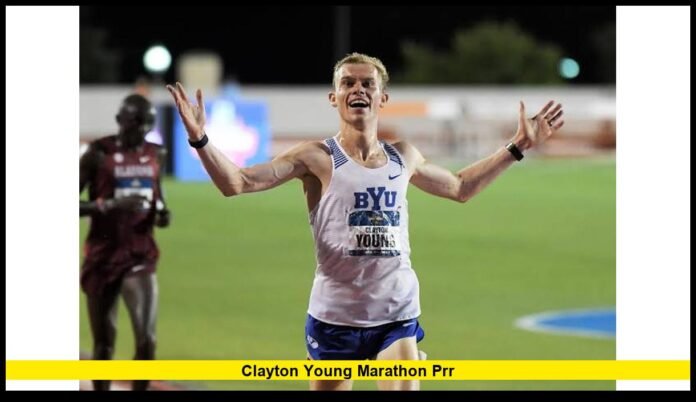

Clayton Young marathon PR news has drawn attention from American distance-running fans after the U.S. marathoner delivered a personal-best performance at the 2026 Chicago Marathon. Young clocked 2:05:23 on October 11, 2026, finishing seventh overall in the men’s race and leading the American men across the finish line. The result improved his previous marathon best of 2:05:41, recorded at the Boston Marathon earlier in the year, and brought him closer to the American men’s marathon record.
Young’s latest performance is another important milestone in a career that has included collegiate success, Olympic qualification and strong results at major international races. His Chicago finish also highlights the growing competitiveness of American marathon running, where athletes are increasingly challenging established performance standards and pursuing faster times on the world stage.
Clayton Young Sets a New Marathon Personal Best in Chicago
The 2026 Bank of America Chicago Marathon provided Young with another opportunity to test himself against an elite international field. The annual race attracts some of the world’s strongest distance runners and is particularly popular among athletes pursuing personal records because of its generally flat course.
Young finished the 26.2-mile race in 2 hours, 5 minutes and 23 seconds. That performance represented an 18-second improvement over his previous best, demonstrating progress at a distance where even small gains require substantial preparation and precise race execution.
His seventh-place overall finish was particularly notable because Chicago’s men’s field included accomplished international marathoners capable of running at an exceptionally fast pace. Young remained competitive in that environment and emerged as the leading American finisher.
For U.S. distance running, his result provides another example of the country’s growing depth in the marathon. American athletes have increasingly demonstrated that they can compete with international leaders at major road races, and Young’s latest performance adds to that momentum.
How Young’s Chicago Result Compares With His Previous Best
Young entered the Chicago race after recording a 2:05:41 marathon at the Boston Marathon in April 2026. He lowered that mark by 18 seconds in Chicago.
| Performance | Time |
|---|---|
| Chicago Marathon, October 2026 | 2:05:23 |
| Boston Marathon, April 2026 | 2:05:41 |
| Improvement | 18 seconds |
The difference between these performances is meaningful at the elite level. Top marathoners frequently compete within narrow time margins, and a few seconds can determine whether a runner finishes among the leading contenders.
Course conditions also matter when comparing marathon results. Boston’s point-to-point route features significant elevation changes and does not meet the standard course-eligibility requirements for national records. Chicago’s relatively flat layout is more suitable for record attempts, although weather, pacing and competition still influence the outcome.
Young’s Chicago time therefore represents both a personal milestone and a performance that can be assessed against record-eligible marathon standards.
Aiming for the American Marathon Record
One of the major storylines surrounding Young’s Chicago campaign was his ambition to challenge the American men’s marathon record.
The national record stands at 2:04:43, set by Conner Mantz at the 2025 Chicago Marathon. Young’s 2:05:23 finish was 40 seconds outside that mark.
Although he did not achieve his record goal, his performance demonstrated that he is operating at a level that puts the national benchmark within a realistic range of future competition. Closing a 40-second gap over 26.2 miles remains a substantial challenge, but his progression during 2026 provides a reason to follow his next marathon campaign closely.
The distinction between a personal record and a national record is important. A runner can achieve a faster personal best without breaking a national record, and performances on certain courses may not qualify for official record recognition. Chicago’s course is widely used for record attempts because it generally satisfies the relevant eligibility requirements.
Young’s result places him among the fastest American marathoners on a record-eligible course. His performance also illustrates the increasingly competitive environment among U.S. men seeking to establish themselves internationally.
Why the Record Remains a Major Benchmark
The marathon demands a combination of endurance, speed, strength and tactical discipline. Maintaining a pace near the American record standard requires athletes to cover every mile with remarkable consistency while managing fatigue that builds throughout the race.
A runner targeting a national record must also respond to conditions that cannot be controlled entirely, including temperature, wind, humidity and the pace established by competitors.
Even when training indicates that a record attempt is possible, the final result depends on how an athlete feels on race day and whether the race develops as expected. Young’s Chicago performance demonstrates his ability to run at a high level, but another attempt at the record will require its own preparation and execution.
Clayton Young’s Journey From College Running to the Marathon
Young’s development into an elite marathoner began with success at Brigham Young University. During his collegiate career, he established himself as a leading distance runner and won the NCAA Division I outdoor 10,000-meter championship in 2019.
The 10,000 meters is a demanding track event that rewards aerobic fitness, efficient movement and tactical awareness. Success at that distance can provide an important foundation for marathon running, although moving to the roads requires athletes to develop additional endurance and refine their approach to pacing and fueling.
Young’s transition from collegiate competition to the marathon demonstrated his ability to adapt to the demands of longer races. The marathon places sustained pressure on muscles and energy reserves, making training volume, recovery and nutrition essential parts of an athlete’s preparation.
His progression has also reflected the importance of experience. Elite marathoners often improve by learning how to distribute effort over the full distance, respond to changing race conditions and maintain concentration when fatigue becomes severe in the final miles.
Young’s achievements since college have helped establish him as one of the leading figures in American distance running.
Olympic Success Strengthened Young’s Reputation
A major milestone in Young’s career came at the 2024 U.S. Olympic Marathon Trials in Orlando, Florida. He finished second in 2:09:06, earning a place on the U.S. Olympic team for the Paris Games.
The Olympic Trials are among the most consequential races in American distance running because athletes compete for a limited number of places on the national team. The event requires competitors to balance ambitious pacing with the tactical demands of a high-pressure championship race.
Young’s second-place finish demonstrated that he could perform when Olympic qualification was at stake.
At the Paris 2024 Olympic Games, he finished ninth in the men’s marathon with a time of 2:08:44. Reaching the top 10 at the Olympics placed him among the leading marathon runners in a field featuring the strongest athletes from around the world.
The Olympic experience also gave Young an opportunity to compete in a championship environment where positioning, course management and responding to competitors can be just as important as achieving a fast finishing time.
His subsequent improvement to 2:05:23 in Chicago represents a significant development from his Olympic performance.
What Makes Young’s 2:05:23 Performance Special?
A marathon covers 26.2 miles, or approximately 42.195 kilometers. Finishing in 2:05:23 requires an average pace of about 4 minutes and 47 seconds per mile, equivalent to approximately 2 minutes and 58 seconds per kilometer.
That pace must be sustained for the entire distance, leaving little room for significant slowdowns. Elite runners train extensively to develop the aerobic capacity, muscular endurance and running economy necessary to maintain such speed.
Marathon performance also depends on preparation outside the race itself. Training plans typically combine long runs, threshold sessions, faster workouts and recovery periods. Athletes must build endurance without accumulating excessive fatigue or increasing their risk of injury.
Nutrition and hydration are equally important. Runners need to manage carbohydrate intake and fluid consumption to support performance over more than two hours of intense exercise. Small mistakes in fueling or pacing can become increasingly costly late in the race.
Chicago’s course can support fast performances, but the setting alone does not guarantee a personal best. Young still needed to execute his race plan and sustain a demanding pace against world-class competition.
His latest result shows that he was able to put together the necessary elements on race day.
Chicago Marathon Results Highlight International Competition
The 2026 men’s race featured a strong international field, with Kenyan and Ethiopian runners occupying the leading positions.
Kenya’s Amos Kipruto won in 2:01:09. Ethiopia’s Tadese Bikila finished second in 2:02:56, followed by compatriot Milkesha Mengesha in 2:03:46.
Young finished seventh in 2:05:23, while American Charles Hicks placed eighth in 2:05:35.
These results demonstrate the depth of the field and the standard required to contend for the leading positions at a major marathon. Young’s finish placed him among the top seven athletes in a race dominated by some of the world’s fastest distance runners.
The American results also provide an encouraging indication of the country’s competitiveness at the marathon distance. Strong performances from multiple U.S. athletes help build depth within the national program and create additional competition for future championship selections.
For Young, finishing as the top American adds another important accomplishment to a career that already includes an Olympic appearance and success at major road races.
What Could Be Next for Clayton Young?
Young’s new personal best gives him a strong platform for future marathon competition. His next objectives could include another attempt at the American record, improved finishes at major international races and continued development ahead of future championship opportunities.
However, a faster result is never guaranteed. Marathoners must balance the desire to compete frequently with the need for recovery after demanding races. Training schedules, injury prevention and decisions about when to return to competition can all influence future performances.
Young will also need to consider which courses and conditions best suit his goals. A relatively flat course may offer a stronger opportunity for a personal record, while a championship event may reward tactical experience and the ability to respond to other runners rather than an exceptionally fast pace.
His latest performance makes the next stage of his career particularly interesting. The gap between his personal best and the American record is measurable, and his continued development will be worth monitoring as the U.S. marathon scene evolves.
For now, his 2:05:23 performance stands as his latest marathon personal best and a clear milestone in his progression as an elite American runner.
Frequently Asked Questions
What is Clayton Young’s marathon personal best?
Clayton Young’s latest reported marathon personal best is 2:05:23, achieved at the 2026 Chicago Marathon on October 11, 2026.
How much did Clayton Young improve his marathon time?
He improved his previous best of 2:05:41 by 18 seconds.
Where did Clayton Young finish at the 2026 Chicago Marathon?
He finished seventh overall in the men’s race and was the first American man to cross the finish line.
What is the American men’s marathon record?
The American record is 2:04:43, set by Conner Mantz at the 2025 Chicago Marathon.
Did Clayton Young compete at the Olympics?
Yes. Young represented the United States at the Paris 2024 Olympic Games, finishing ninth in the men’s marathon in 2:08:44.
What pace did Clayton Young maintain for his latest personal best?
His 2:05:23 finish corresponds to an average pace of approximately 4:47 per mile, or 2:58 per kilometer.
Final Thoughts
Clayton Young’s Chicago performance marks another important step in his development as an elite marathoner. His 2:05:23 personal best, seventh-place overall finish and status as the top American in the men’s race demonstrate his continued competitiveness at the highest level of the sport.
Although the American record remains 40 seconds faster, Young has established a new benchmark for his own career and strengthened his position among the country’s leading distance runners. His collegiate achievements, Olympic experience and improving marathon times provide a compelling foundation for future competition.
What do you think Clayton Young will achieve in his next marathon? Leave a comment with your prediction and follow the latest updates from the world of American distance running