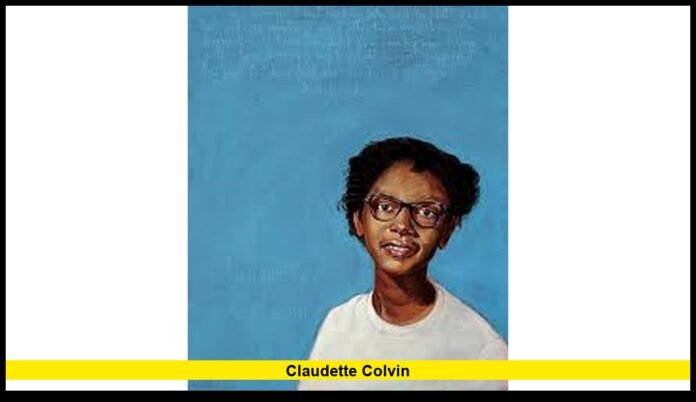

Claudette Colvin became a symbol of courage in the fight for civil rights when, at just 15 years old, she refused to surrender her seat on a segregated Montgomery bus, an act that would help dismantle Jim Crow laws and reshape the course of U.S. history.
Born on September 5, 1939, in Birmingham, Alabama, Claudette Colvin grew up during one of the most rigidly segregated eras in the nation’s past. She spent most of her childhood in Montgomery, a city where racial separation was enforced not only by social custom but by law. Black residents were required to attend separate schools, use separate facilities, and sit in designated sections on public transportation. From an early age, Colvin became aware of these injustices and questioned why basic rights and dignity were denied to people who looked like her.
She was raised by her aunt and uncle, Mary Ann and Q.P. Colvin, who worked hard to provide stability in a society that offered limited opportunities to Black families. At school, Claudette showed a strong interest in history and government. She studied the Constitution and learned about figures such as Harriet Tubman and Sojourner Truth, women who resisted oppression and fought for freedom. These lessons left a deep impression on her and shaped her belief that injustice should never be accepted as normal.
In early March 1955, Montgomery’s bus system still operated under strict segregation rules. Black passengers were required to sit in the rear and give up their seats if the white section became full. On March 2 of that year, after finishing classes at Booker T. Washington High School, Claudette Colvin boarded a city bus to head home. She sat in the section reserved for Black riders, close to the dividing line that separated white and Black seating.
When the bus filled and a white woman was left standing, the driver ordered Colvin and several other Black passengers to move. While the others complied, Claudette remained seated. She later explained that she felt a powerful sense of duty, as if the lessons of history and the words of the Constitution were telling her to stand her ground. She believed that she had a right to remain where she was and that giving up her seat would mean accepting an unjust system.
Police officers were called to the scene. They pulled her from the bus, handcuffed her, and took her to jail. She was charged with violating segregation laws and with disorderly conduct. At only 15 years old, she was treated as a criminal for refusing to accept discrimination. The experience was frightening and humiliating, and it placed a heavy burden on her family, who feared retaliation and social backlash.
Although her arrest occurred months before Rosa Parks’ more widely known protest, Colvin did not become the public face of the movement at the time. Civil rights leaders were concerned that her youth and the circumstances of her case might make it harder to gain broad public support. Still, her act of defiance did not go unnoticed within legal and activist circles. It helped demonstrate that segregation could be challenged not only through protest but through the courts.
In 1956, Claudette Colvin became one of the plaintiffs in a federal lawsuit that would prove historic. The case, known as Browder v. Gayle, directly challenged the constitutionality of segregated seating on Montgomery buses. Colvin, along with three other Black women, testified that the city’s policies violated their rights under the Fourteenth Amendment, which guarantees equal protection under the law.
The federal court ruled in their favor, declaring that bus segregation was unconstitutional. The decision was later upheld by the U.S. Supreme Court, forcing Montgomery and other cities to end the practice. This ruling marked a turning point in the civil rights movement and provided a legal foundation for dismantling segregation across the South. Claudette Colvin’s testimony played a key role in achieving that outcome, even though her name was not widely known to the public at the time.
After the case, life in Montgomery became increasingly difficult for her. Job opportunities were limited, and the social pressure of being associated with a legal challenge to segregation made everyday life uncomfortable. In 1958, she moved to New York City in search of a fresh start. There, she built a quiet life away from the spotlight, working for decades as a nurse’s aide and raising her family.
For many years, her contribution to civil rights remained largely unrecognized outside academic and activist circles. History books and public narratives often focused on more visible leaders and events, leaving little room for the story of a teenager whose courage had helped set legal change in motion. Yet those who studied the movement understood that her actions had been crucial.
In the decades that followed, educators and historians began to bring her story to a wider audience. Her role in the struggle against segregation became a powerful example of how young people, armed with knowledge and conviction, can influence the direction of a nation. She was invited to speak at schools and community events, where she encouraged students to learn their rights and to stand up against injustice.
A significant moment of recognition came when her juvenile arrest record was formally cleared, acknowledging that she had been punished for defying laws that were themselves unjust. This step carried symbolic weight, affirming that her stand on the bus was not an act of wrongdoing but an act of conscience.
Claudette Colvin’s life illustrates that the fight for civil rights was not driven only by well-known leaders but also by ordinary individuals who made extraordinary choices. Her refusal to move from her seat was a personal decision, yet it carried national consequences. It showed that the Constitution’s promises applied to everyone and that those promises could be defended, even by a teenager in a segregated city.
Today, her name is increasingly included in discussions of the civil rights era, ensuring that her role is no longer overlooked. Her story adds depth to the understanding of how legal challenges, community action, and individual bravery combined to dismantle segregation in the United States.
Her legacy continues to resonate, especially among young people who see in her example the power of standing firm in the face of injustice. She did not set out to become a historical figure. She simply believed that what was happening to her was wrong and that remaining seated was the right thing to do.
Claudette Colvin’s courage reminds us that lasting change often begins with a single voice refusing to be silenced, and her story continues to inspire those who believe in justice and equality.