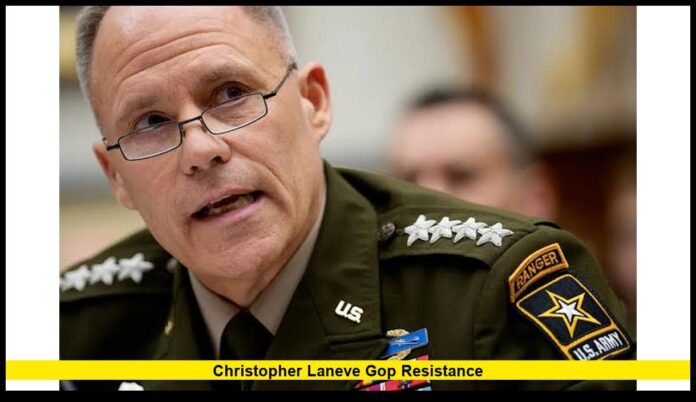

Christopher LaNeve GOP resistance has quickly become one of the biggest political and military stories in Washington after several Republican senators questioned Defense Secretary Pete Hegseth’s preferred choice to permanently lead the U.S. Army. Rather than facing opposition from Democrats, Gen. Christopher LaNeve’s potential nomination has encountered skepticism from members of the president’s own party, creating an unexpected challenge for one of the Pentagon’s most important leadership appointments.
The debate has drawn national attention because it involves military readiness, Senate oversight, Pentagon leadership, and Republican divisions over how senior military officers should be selected. As of today, LaNeve continues serving as the Army’s acting Chief of Staff while the administration has not formally advanced his nomination for Senate confirmation amid concerns that sufficient Republican support is lacking.
Who Is Gen. Christopher LaNeve?
Gen. Christopher C. LaNeve is a veteran U.S. Army officer whose military career spans decades of operational and leadership experience. Throughout his service, he has commanded combat units, led major Army formations, and held several senior positions responsible for planning and executing military operations.
Before assuming his current responsibilities, LaNeve served in several high-profile assignments, including:
- Commander of the 82nd Airborne Division
- Commander of the Eighth Army in South Korea
- Vice Chief of Staff of the U.S. Army
- Acting Chief of Staff of the U.S. Army
His experience in both operational commands and strategic leadership positions made him one of the Pentagon’s most recognizable senior officers before becoming acting Army chief.
How the Controversy Began
The current debate emerged after Defense Secretary Pete Hegseth selected LaNeve to serve as acting Chief of Staff following the departure of Gen. Randy George earlier this year.
Normally, an acting appointment is followed by a formal presidential nomination and Senate confirmation process. Instead, reports indicate the administration has delayed submitting LaNeve’s nomination because several Republican senators have questioned whether he has the level of senior experience traditionally expected for the Army’s highest uniformed position.
That hesitation has transformed what would typically be a routine personnel decision into a major political story inside Washington.
Why Republican Senators Are Objecting
Unlike many controversial nominations, the concerns surrounding LaNeve are not related to ethics, misconduct, or disciplinary matters.
Instead, Republican lawmakers have focused on whether his military career has included enough time at the four-star level before assuming responsibility for leading the entire Army.
Among the concerns raised are:
- His relatively recent promotion to four-star general.
- The traditional career path followed by previous Army Chiefs of Staff.
- Whether confirmation standards should remain consistent regardless of administration.
- The precedent that could be established for future military appointments.
Several senators reportedly believe that the position requires a longer period of service at the highest rank before confirmation.
Why Sen. Joni Ernst Has Become a Central Figure
Iowa Republican Sen. Joni Ernst has become one of the most closely watched lawmakers in the debate.
As both a military veteran and a member of the Senate Armed Services Committee, Ernst’s views carry significant influence during confirmation proceedings.
Reports indicate she has questioned whether LaNeve’s comparatively short tenure as a four-star general satisfies the traditional expectations for Army Chief of Staff.
Because Republicans hold only a narrow committee majority, even a small number of dissenting votes could prevent the nomination from advancing.
Pete Hegseth Continues Supporting LaNeve
Defense Secretary Pete Hegseth has continued backing LaNeve despite the political headwinds.
Since taking office, Hegseth has promoted a defense agenda centered on military readiness, operational effectiveness, and changes to senior Pentagon leadership.
LaNeve has become one of the most visible military leaders associated with those priorities.
Supporters argue his operational experience makes him well suited for the Army’s highest leadership role, while critics maintain that longstanding confirmation standards should not be relaxed.
Why Experience Has Become the Main Issue
The debate is largely focused on timing rather than capability.
Previous Army Chiefs of Staff typically accumulated longer service as four-star generals before receiving the Army’s top assignment.
Republican senators questioning the nomination argue that maintaining those traditions protects the credibility of future military promotions.
Supporters respond that battlefield leadership, command experience, and demonstrated performance should outweigh the length of time spent at a particular rank.
This difference in philosophy has become the central issue surrounding the nomination.
LaNeve’s Military Career
Throughout his career, LaNeve has served in a variety of leadership positions across the Army.
His assignments have included combat formations, international commands, and senior Pentagon responsibilities.
Highlights include:
| Position | Responsibility |
|---|---|
| Commander, 82nd Airborne Division | Led one of the Army’s premier rapid-response units |
| Commander, Eighth Army | Oversaw U.S. Army forces in South Korea |
| Vice Chief of Staff | Assisted in managing Army-wide operations |
| Acting Chief of Staff | Currently leads the Army while serving in an acting capacity |
His experience in both operational and strategic roles has made him one of the Army’s most senior active officers.
What an Acting Army Chief Can Do
An acting Chief of Staff performs many of the same day-to-day duties as a Senate-confirmed chief.
These responsibilities include:
- Supervising Army operations.
- Managing readiness initiatives.
- Working with defense officials.
- Supporting military modernization.
- Advising civilian leadership.
However, a confirmed Army Chief generally provides greater long-term stability for planning and policy implementation.
That is why administrations usually seek Senate confirmation rather than relying indefinitely on acting leadership.
How Senate Confirmation Works
Senior military appointments require Senate approval before becoming permanent.
The process typically includes:
- Presidential nomination.
- Review by the Senate Armed Services Committee.
- Committee vote.
- Full Senate confirmation.
If sufficient committee support is unavailable, a nomination may never proceed to the Senate floor.
Current reports suggest that concern over Republican votes has delayed LaNeve’s formal nomination.
Why This Story Is Politically Significant
Presidential nominees often face criticism from the opposing political party.
The LaNeve situation differs because the strongest resistance has emerged from Republican senators rather than Democrats.
That dynamic illustrates broader debates within the Republican Party over military leadership, confirmation standards, and the direction of Pentagon policy.
It also highlights the Senate’s independent role in reviewing senior military appointments.
Trump Administration Priorities
President Donald Trump’s administration has placed considerable emphasis on reshaping senior military leadership.
Several high-ranking defense positions have changed during the administration’s effort to implement new strategic priorities.
Within that broader effort, LaNeve has become one of the administration’s most prominent military selections.
His confirmation process has therefore attracted greater attention than many previous Army leadership nominations.
The Importance of Army Leadership
The Army Chief of Staff serves as the senior uniformed officer responsible for organizing, training, and equipping the United States Army.
Although the Secretary of the Army and Secretary of Defense oversee civilian leadership, the Chief of Staff plays a critical role in translating national defense priorities into military readiness.
Responsibilities include:
- Personnel management.
- Force modernization.
- Budget planning.
- Operational readiness.
- Strategic planning.
- Advising national defense leaders.
Because of these responsibilities, Senate scrutiny of the position is typically extensive.
What Happens Next?
Several possible paths remain available.
The administration could:
- Continue discussions with Republican senators.
- Submit LaNeve’s nomination despite existing concerns.
- Delay action while building additional support.
- Select another candidate for permanent appointment.
At this stage, no official announcement has been made regarding the next step.
LaNeve remains acting Chief of Staff while discussions continue.
What the Debate Means for the Army
The Army continues carrying out its missions worldwide regardless of the confirmation process.
Training, overseas deployments, modernization efforts, and operational planning continue under existing leadership.
Nevertheless, permanent leadership often provides additional certainty for long-term initiatives involving force structure, procurement, recruiting, and strategic planning.
That explains why confirmation of the Army’s senior officer is closely watched by lawmakers, military leaders, and defense analysts.
Looking Ahead
The discussion surrounding Gen. Christopher LaNeve has become one of the most closely followed military leadership stories in Washington. Republican concerns over his qualifications for the Army’s highest uniformed position have delayed progress toward a formal Senate confirmation process, even as Defense Secretary Pete Hegseth continues to support him.
Whether the administration ultimately proceeds with LaNeve’s nomination or chooses another path remains to be seen. Until then, the Army continues operating under his acting leadership while lawmakers weigh one of the Pentagon’s most significant personnel decisions of the year.
What are your thoughts on the debate surrounding Gen. Christopher LaNeve’s potential nomination? Share your perspective in the comments and stay tuned for the latest verified developments.