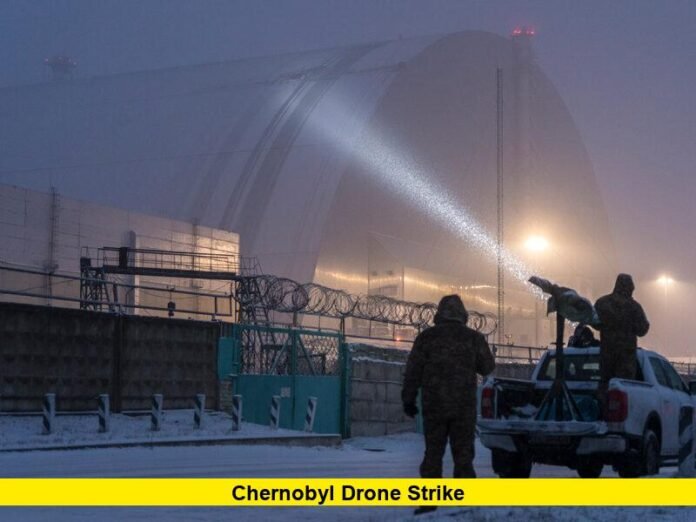

The protective dome shielding the ruined reactor at the Chernobyl Nuclear Power Plant has suffered major degradation, and experts warn it may no longer effectively contain radioactive materials — a stark reminder of how vulnerable nuclear sites remain in war. In a December 2025 report, inspectors declared that the outer shelter over Reactor 4 lost its primary safety functions, triggering urgent concerns about containment, long-term decommissioning, and environmental security in and beyond Ukraine.
The 2025 Drone Strike: What We Know
In the early hours of February 14, 2025, an unmanned aerial vehicle struck the roof of the massive containment structure built over the exploded Reactor 4 at Chernobyl. The shelter — a massive steel and concrete dome assembled years ago to restrict the spread of radiation and enable safe dismantling of the reactor — was carrying out a critical long-term safety mission.
The drone reportedly carried a high-explosive warhead. The strike punctured the outer shell, damaging cladding and insulation layers designed to keep radioactive dust and debris contained. A fire erupted inside the protective layers; emergency crews managed to extinguish the blaze, but thermal imaging later revealed lingering hot spots, indicating the insulation continued smoldering weeks afterward. At the time, radiation monitoring equipment inside registered no spike in ambient radioactivity, and the central containment structure held — offering a temporary sigh of relief that the disaster was contained.
The December 2025 Inspection: Containment Compromised
When a team of nuclear safety experts returned to the site in late November 2025 to assess structural integrity, their findings were alarming. The outer “New Safe Confinement” dome now carries damage severe enough to remove its ability to guarantee confinement. Inspectors concluded the shelter “no longer provides reliable containment,” meaning the shield can no longer be trusted to prevent spread of radioactive particles under stress or aging.
Despite the outer shield’s failure, investigators confirmed that the inner supporting structure remains intact. Load-bearing beams have not buckled, and internal monitoring systems — including radiation sensors — continue to operate. Radiation readings at the site remain within previously recorded safe bounds, and no detectable leak or environmental contamination has emerged so far.
Nonetheless, specialists emphasize that temporary repairs done soon after the strike are far from adequate. The damage goes beyond superficial harm: the breach undermines the very function for which the shelter was built. Without thorough, large-scale restoration, the dome risks progressive deterioration — potentially allowing pathways for radioactive dust escape, especially under new environmental stress or further conflict.
Why This Situation Matters — Decades After the Disaster
Legacy of 1986 Still at Stake
The reactor within the shelter exploded in 1986, releasing massive quantities of radioactive material into the atmosphere. In the aftermath, authorities erected this vast containment dome to seal in the danger, with the goal of storing waste and safely dismantling the reactor over many decades. That mission depended upon a sturdy, long-lasting shelter capable of sealing off radiation indefinitely.
Now, nearly four decades later, that mission is suddenly threatened — not by the original tragedy, but by new damage from war. The loss of containment capacity delivers a sobering lesson: nuclear disasters don’t end when reactors shut down, and decommissioned sites remain extremely vulnerable, especially in conflict zones.
Environmental and Public Safety Risks
The shelter sits near the exclusion zone around the power plant, a zone once considered permanently uninhabitable. If the containment fails completely — whether through further damage, wear and tear, or inadequate repairs — radioactive dust or particles could find their way out into the surrounding environment. That contamination could affect soil, water, flora, fauna, and even reach populated regions if wind or water flows carry contamination beyond the exclusion zone.
Because the compromised shield lies just north of the Ukrainian capital and within a region that saw renewed conflict, any new leak would not only threaten public health but could also trigger fresh evacuations. Ecosystems would suffer long-term harm, and land once considered unusable might become dangerously radioactive again.
Threat to Long-Term Cleanup and Decommissioning
The initial objective for the shelter was to allow for the gradual dismantling of Reactor 4 and safe handling of radioactive waste over many decades. With the containment compromised, those plans now face serious delays or derailment. Engineers can’t risk exposing workers or the environment during dismantling if they cannot guarantee the site remains sealed.
Furthermore, restoration efforts will likely be extremely complex and expensive. Repairs must account for radiation safety, structural integrity, and possible future threats from warfare or sabotage. Mobilizing the required technical expertise under unstable conditions adds yet another layer of challenge.
What’s Next: Remedies and Risks
The experts’ December report demands comprehensive restoration to re-establish the shelter’s confinement capability. Temporary patches or minor repairs won’t suffice — engineers now face the task of rebuilding damaged cladding or insulation layers, reinforcing seals, and ensuring structural integrity under potential future threats.
Such an overhaul will come with steep financial costs. Given the complexity of the shelter and the radiation hazards inside, the restoration effort will require heavy investment, skilled labor, and strict safety protocols. Notably, the required funds likely far exceed the contingencies previously allocated for emergencies at the site.
Moreover, the stability of any repair effort remains uncertain, given ongoing conflict around the region. Additional damage — whether from new strikes or from neglect due to power outages or disruptions — could further undermine containment. Even routine maintenance becomes hazardous in a war environment.
Implications for Global Nuclear Safety in Conflict Zones
The events at Chernobyl highlight a deeply troubling reality: nuclear and radioactive sites remain vulnerable long after reactors shut down — especially in times of war. This isn’t just about one site; it’s a warning for countries worldwide that host decommissioned reactors, radioactive waste storage facilities, or nuclear remnants.
Modern conflict doesn’t always follow traditional battlefields. Drones and long-range weapons increasingly threaten critical infrastructure. As a result, nuclear sites — even old ones — must now be considered high-risk assets. International protocols and safety agreements may need updates to reflect evolving risks.
Governments and global organizations should review which legacy nuclear sites need enhanced physical protection, redundant containment measures, and robust maintenance plans — particularly in volatile regions. Without such proactive efforts, decades-old disasters remain capable of reigniting.
Current Reality at Chernobyl — What We Know Right Now
- The February 14, 2025 strike damaged outer cladding and insulation on the containment dome over Reactor 4. A fire followed; initial radiation readings showed no leak.
- The latest inspection reveals the shelter’s outer shell can no longer guarantee containment. Confinement capability is effectively lost.
- Inner structural supports and radiation sensors remain operational, but outer containment loss undermines long-term safety.
- Radiation levels remain within previously safe bounds, but the risk persists: widespread deterioration or environmental impact could occur under future stress.
- Full restoration will be costly, complicated, and risky — complicated further by the ongoing war, power instability, and volatility in logistics.
Broader Lessons — Why This Matters for the World
For the global community, the situation at Chernobyl shouldn’t be treated as a remote Ukrainian issue — it’s a wake-up call. Nuclear disaster legacy sites are living hazards. They demand ongoing attention, safeguards, and protection — especially when geopolitical instability comes into play.
Countries that host nuclear sites, even if long-shut, must assess their vulnerability to conflict, sabotage, or neglect. International bodies must support plans to reinforce containment, guarantee monitoring and maintenance, and ensure emergency repair funding. Otherwise, old disasters can become new crises.
The case also raises moral and ethical questions about peace and war. Targeting — or simply damaging — nuclear infrastructure carries a unique and long-lasting threat. Civilized societies and global institutions must recognize that nuclear safety transcends borders, politics, and conflict cycles.
What Comes Next — Key Watchpoints
Going forward, all eyes will focus on how restoration efforts at the Chernobyl site progress. Key questions include:
- Will funding be committed quickly and robustly to rebuild containment?
- Can skilled engineers operate safely under current war conditions to perform complex repairs?
- Will monitoring and security systems be upgraded to withstand future threats?
- Might this incident spur broader international reforms to protect legacy nuclear facilities globally?
The answers will shape not only Chernobyl’s fate but also set precedents for nuclear safety under conflict — affecting many nations and vulnerable sites worldwide.
Nuclear disasters don’t always stay in the past. The damaged shelter at Chernobyl reminds us that radioactive risk can linger — and even grow — decades after reactors shut down. The coming months will be crucial: timely, well-executed repairs could secure safety; delays or neglect could reopen a chapter best left closed.
I encourage readers to follow developments closely and share your thoughts — because protecting our shared environment means we all stay vigilant together.