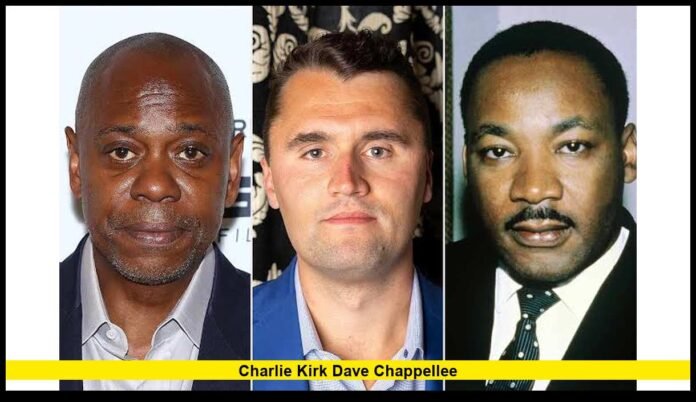

The Charlie Kirk Dave Chappelle controversy has intensified following a stand-up performance in New York that brought political grief, celebrity speech, and the boundaries of comedy into the national conversation. A clip circulating online from Dave Chappelle’s November 7, 2026, appearance at Madison Square Garden shows the comedian joking that he had felt better since conservative activist Charlie Kirk was murdered. The remarks prompted criticism from Kirk’s widow, Erika Kirk, and prominent commentators, including Elon Musk.
The incident has renewed questions about how comedians approach politically charged tragedies and whether a joke can cross a moral line even when the performer intends to provoke an audience. It has also revived interest in Chappelle’s previous comments about Kirk, whose killing in September 2025 became a major national story.
As of November 9, the immediate controversy centers on the remarks captured in the circulating recording, the public reaction, and the absence of a confirmed public apology from Chappelle. The complete routine has not been established through the short clip alone, making it important to distinguish the recorded words from assumptions about the comedian’s wider intentions.
What Happened at Dave Chappelle’s Madison Square Garden Show?
Chappelle addressed the dangers of public speaking during his New York performance before turning to Kirk’s death. In the recording circulating online, he said he felt uncomfortable admitting his reaction publicly, then remarked that he had felt better since Kirk was murdered.
He continued by describing moments when he wondered why he was in such a good mood before remembering the killing. The audience response appeared mixed, with laughter and audible reactions following the joke.
The clip spread rapidly across social media despite restrictions intended to prevent audience members from recording the show. The performance was part of Chappelle’s Karmageddon tour, which included appearances at Madison Square Garden on November 6 and 7.
The short recording became the main focus of public criticism. Viewers debated whether the joke was an example of intentionally provocative comedy or an insensitive response to a fatal act of political violence.
The available footage captures the disputed remark, but it does not provide a complete record of the surrounding routine. That distinction matters when assessing the broader performance. It does not, however, change the wording that viewers can hear in the recording.
Chappelle has developed a reputation for addressing subjects that generate strong reactions. His material often challenges social conventions, political assumptions, and expectations about what comedians should discuss onstage. The latest incident places that approach under renewed scrutiny because it involves the murder of a public figure and the grief of a surviving family.
Erika Kirk Responds to the Remarks
Erika Kirk publicly condemned the treatment of political assassination as entertainment in a statement posted on November 8. Although she did not name Chappelle directly, her comments came amid the growing reaction to jokes about her husband’s death.
She described the use of assassination as a punchline as deeply offensive and emphasized that her family would continue to live with the consequences of the killing.
Erika also referred to the effect on her and the couple’s two children. Her message focused on the principle that people should recognize the value of human life even when they strongly disagree with someone’s political beliefs.
Her statement argued that a culture that laughs at assassination risks weakening the values that support democratic society. She also said political violence should never be tolerated, excused, or celebrated.
The response gave a personal dimension to a debate that had quickly become dominated by political commentary. For Kirk’s supporters, her words reinforced the view that public entertainment should not minimize the consequences of a murder.
Others interpreted the controversy as an example of the tension between a comedian’s freedom to provoke and the public’s freedom to criticize material they consider cruel.
Erika did not identify Chappelle by name in the statement. It is therefore more precise to describe her remarks as a condemnation of jokes about political assassination made amid the backlash, rather than claim that she issued a direct statement naming him.
Elon Musk and Other Commentators Criticize Chappelle
Elon Musk joined the public reaction with a brief post condemning Chappelle. His response helped bring the dispute to an even wider online audience.
Other commentators also criticized the comedian. Some described the joke as insensitive to Kirk’s family, while others argued that expressing relief about a person’s murder crosses a line that political disagreement should not erase.
British broadcaster Piers Morgan also criticized the remarks and pointed to Chappelle’s own experience with violence during a live performance in 2022.
These reactions illustrate how quickly a joke at a comedy show can become a national debate. Social media allows short clips to reach millions of people, including viewers who were not present and may never hear the complete performance.
Criticism of the remark does not necessarily mean that every critic supports Kirk’s politics. People can oppose Kirk’s views while still objecting to jokes that appear to celebrate his death. Similarly, defending a comedian’s legal right to perform controversial material does not require an audience member to find the material acceptable.
That distinction has become central to the public discussion. The dispute involves not only political divisions but also different expectations about empathy, satire, and the responsibilities of people with large audiences.
Who Was Charlie Kirk?
Charlie Kirk was a conservative activist who co-founded Turning Point USA, an organization that became influential in conservative youth politics. He built a national profile through campus events, political debates, speeches, podcasts, and online videos.
His public commentary frequently covered immigration, education, religion, abortion, government policy, and cultural disputes. Kirk became known for a direct debating style that attracted supporters and critics in large numbers.
Supporters considered him an effective advocate for conservative values and an important figure in mobilizing younger voters. Critics challenged his rhetoric and many of his political positions. His visibility made him a regular subject of debate across American political media.
On September 10, 2025, Kirk was fatally shot while speaking at a Turning Point USA event at Utah Valley University in Orem, Utah. He was 31 years old.
His death generated widespread condemnation of political violence and prompted a national discussion about security at public events. It also produced disagreements over how his political legacy should be understood.
Those debates have continued after his death, but criticism of his political record remains separate from the circumstances of his killing. The current dispute over Chappelle’s remarks concerns how the murder is discussed publicly, not whether Americans must agree about Kirk’s politics.
Why the Joke Has Provoked Such a Strong Reaction
The reaction to Chappelle’s remarks reflects a broader disagreement about the role of comedy in American public life.
Stand-up comedians often use exaggeration, irony, shock, and uncomfortable observations to challenge audiences. Political humor can expose hypocrisy, question powerful institutions, and make difficult subjects easier to discuss. It can also offend people who believe a particular subject deserves a more serious treatment.
Chappelle has frequently chosen controversial material, and his performances have generated arguments about whether provocation serves a meaningful purpose or simply alienates audiences.
The latest dispute is especially sensitive because the subject is not merely a political disagreement. Kirk was murdered, leaving behind a wife and children. For many critics, that fact makes a joke suggesting improved happiness after his death fundamentally different from satire about his public statements.
Some defenders of Chappelle’s broader approach argue that comedy should not be restricted to subjects that audiences find comfortable. They believe performers need room to explore even disturbing thoughts and social contradictions.
Critics respond that freedom of expression does not eliminate personal responsibility. They argue that a comedian can legally make a joke while still facing justified public disapproval for its message.
These positions can coexist. The right to speak does not guarantee praise, and criticism of a joke does not automatically amount to a demand for censorship.
The central question is whether the remark offers meaningful commentary or simply treats a person’s violent death as a source of amusement. People who hear the same words can reach different conclusions depending on their expectations of comedy, their political outlook, and their views about the treatment of grieving families.
Chappelle’s Previous Comments About Kirk
The new controversy has also brought renewed attention to Chappelle’s Netflix special The Unstoppable, released in December 2025.
In that performance, Chappelle discussed Kirk’s killing and described being shaken by the news. He connected the incident to the dangers of speaking publicly, particularly for people who regularly express controversial opinions before large audiences.
Chappelle also challenged comparisons between Kirk and civil rights leader Martin Luther King Jr. He argued that the two men had different public roles, communication styles, and approaches to influencing audiences.
The comparison generated debate because it involved both the seriousness of Kirk’s death and the question of how his historical significance should be assessed.
Chappelle’s earlier discussion was not identical to the remarks now circulating from Madison Square Garden. In the Netflix special, he described feeling shaken by the killing and examined its implications for public speakers. In the newer clip, he joked that he had felt better since Kirk was murdered.
The contrast helps explain why the latest comments have drawn particular attention. Some viewers see a sharp difference between acknowledging a disturbing event and joking about a positive emotional response to it.
Nevertheless, the two performances should be evaluated on their own terms. Neither establishes a private relationship between Chappelle and Kirk, and neither proves that the comedian’s public remarks reveal every aspect of his personal views.
Dave Chappelle’s Own Experience With Stage Violence
Critics have also referred to an incident at the Hollywood Bowl in Los Angeles on May 3, 2022, when a man rushed the stage during Chappelle’s performance.
Security personnel restrained the attacker. Authorities said the man carried a replica handgun containing a knife blade. Chappelle was not killed, and the incident prompted questions about security at live entertainment events.
The episode resurfaced during the current controversy because critics argue that someone who has faced a physical threat onstage should understand the seriousness of violence directed at public figures.
That argument is a criticism of Chappelle’s judgment rather than proof of his intentions. Experiencing an attack does not determine what a person will say years later, nor does it settle the ethical question of how comedians should discuss another person’s death.
Still, the comparison has become part of the public debate. For those who have condemned the joke, Chappelle’s experience makes the apparent levity surrounding Kirk’s killing more difficult to understand.
Others argue that an entertainer’s personal history should not determine whether a particular routine is permissible. They believe the material should be evaluated by its actual words, context, and effect rather than by assumptions about what the performer ought to feel.
The Role of Social Media in the Backlash
The speed of the reaction shows how social media has changed the relationship between live comedy and public opinion.
A performance once reached its audience primarily through the people inside the venue. Today, a short recording can circulate nationally within hours, prompting responses from politicians, entertainers, commentators, and ordinary users.
That process can make a single joke the defining moment of a much longer show. People who have not watched the full performance may form an opinion based on a few seconds of footage.
In this case, the recording captures Chappelle’s disputed words, but the full surrounding routine has not been established by the clip alone. That leaves room for disagreement over the material’s broader structure while allowing viewers to respond to the statement itself.
Social media also encourages rapid reactions. A prominent figure’s criticism can generate thousands of additional posts, each of which may introduce new interpretations or repeat claims that have not been independently verified.
Readers should therefore distinguish between the recording, statements made by identifiable people, and speculation about Chappelle’s motivations or future career. The public backlash is documented, but claims about private conversations, professional consequences, or planned changes to his performances require separate confirmation.
The Legal Case Is Separate From the Comedy Controversy
The public discussion surrounding Chappelle’s joke should not be confused with the criminal case involving Kirk’s death.
Tyler Robinson has been charged in connection with the fatal shooting and has pleaded not guilty. The case must proceed through the legal system, and the allegations remain subject to the court process.
The prosecution concerns evidence, criminal responsibility, and the legal determination of guilt. Chappelle’s remarks concern public speech and the response to a political tragedy. The two issues intersect only because they involve the same death.
A comedian’s comments do not determine the outcome of a criminal case. Likewise, the legal proceedings do not establish whether a joke is ethical or appropriate.
Keeping those matters separate helps prevent political commentary from being mistaken for legal evidence. It also allows the public to discuss free expression and the consequences of violence without treating online arguments as substitutes for judicial findings.
What the Controversy Says About Political Division in America
The dispute highlights how deeply political identity can shape reactions to public figures.
Kirk’s supporters often viewed him as a defender of conservative values. His critics frequently challenged his positions and public style. Following his death, those differences continued to influence how people discussed his life and legacy.
Yet the reaction to Chappelle’s remarks shows that political disagreement does not always determine a person’s response. Some people who opposed Kirk’s views still consider jokes about his assassination inappropriate. Others believe that controversial public figures remain legitimate subjects of satire, even after death.
The debate also reflects a wider concern about political violence becoming normalized in public conversation. When violent acts are discussed primarily through partisan loyalty, people can lose sight of the human consequences for victims, families, and communities.
Erika Kirk’s statement sought to emphasize that concern. Her message called for recognizing the value of life regardless of political differences.
Whether audiences accept that argument does not depend on agreeing with Kirk’s political agenda. It depends on how they distinguish between criticizing a person’s beliefs and treating a fatal attack as a source of celebration.
Will Dave Chappelle Respond to the Backlash?
As of November 9, 2026, a public apology or formal response from Chappelle addressing this specific controversy has not been confirmed in the available reporting.
It also remains unclear whether he will discuss the remarks at another performance or whether the controversy will have any lasting impact on his career.
Predictions about cancelled appearances, lost professional relationships, or changes to his material should not be presented as established developments without confirmation. Public criticism can affect a performer’s reputation, but its long-term consequences cannot be determined from the initial reaction alone.
Further context may emerge if Chappelle or his representatives comment publicly. Additional footage could also help establish how the disputed remarks fit into the wider routine, although it would not necessarily end the disagreement over their meaning.
For now, the established facts are that a clip of the remarks circulated online, prominent figures criticized the joke, and Erika Kirk condemned the use of political assassination as entertainment without naming Chappelle directly.
The next stage of the story will depend on verified developments rather than speculation about what the comedian might do.
Frequently Asked Questions
What did Dave Chappelle say about Charlie Kirk?
In a clip circulating from his November 7, 2026, Madison Square Garden performance, Chappelle joked that he had felt better since Kirk was murdered. He also described wondering why he was in a good mood before remembering the killing.
Why did Erika Kirk criticize the remarks?
Erika Kirk condemned jokes that treat political assassination as entertainment. She emphasized the continuing impact of her husband’s death on her family and argued that people should respect human life regardless of political differences.
Did Dave Chappelle apologize?
As of November 9, 2026, a public apology from Chappelle concerning the specific remarks has not been confirmed in the available reporting.
What was Chappelle’s previous public discussion of Kirk about?
In his December 2025 Netflix special The Unstoppable, Chappelle discussed being shaken by Kirk’s killing and challenged comparisons between Kirk and Martin Luther King Jr.
Who was Charlie Kirk?
Kirk was the co-founder of Turning Point USA and a prominent conservative activist known for campus appearances, political debates, and online commentary. He was fatally shot at Utah Valley University on September 10, 2025, at age 31.
Why has the joke generated so much criticism?
Critics argue that expressing happiness following a person’s murder treats political violence too lightly and disregards the suffering of the victim’s family. Others emphasize a comedian’s right to address uncomfortable subjects, while acknowledging that audiences can criticize the material.
Conclusion
The controversy surrounding Chappelle’s comments has become more than a disagreement about one stand-up routine. It has raised questions about comedy, political identity, public responsibility, and the way Americans respond to violence against people with whom they may strongly disagree. The recorded remarks and public backlash are clear, but the full context of the routine and any further response from Chappelle remain unresolved.
Share your perspective in the comments: where should comedians draw the line when discussing political violence and personal tragedy?