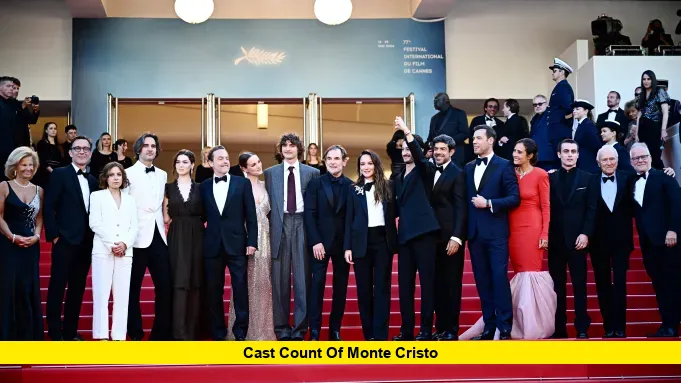

Alexandre Dumas wrote his sweeping epic of betrayal, imprisonment, and revenge nearly 180 years ago. Yet in 2025 and 2026, the story of Edmond Dantès has never felt more alive — and the cast of Count of Monte Cristo adaptations landing on American screens almost simultaneously has given viewers something genuinely spectacular to talk about.
Whether you’ve already watched both versions or you’re just now diving into the legend of the man who became the Count of Monte Cristo, now is the perfect time to get caught up. Keep reading — there is a lot to unpack.
Two Adaptations, One Unstoppable Story
In a rare cultural moment, the world received not one but two major adaptations of Dumas’ beloved novel within a short span of each other. The first arrived as a sweeping big-budget French film. The second came as a lushly produced, eight-episode English-language miniseries now airing on PBS. Together, they represent the most significant on-screen reckoning with the Monte Cristo story in decades — and American audiences are now fully immersed in both.
The French film, directed by Matthieu Delaporte and Alexandre de La Patellière, made its world debut at the 77th Cannes Film Festival in May 2024, where it earned a nearly 11-minute standing ovation. That kind of reception at Cannes signals something extraordinary has arrived. Critics who saw it early called it a genuine triumph — a rare description at a festival not known for easy praise.
The film went on to sell over 9 million tickets in France alone, finishing 2024 as the second-highest-grossing film in French cinemas for the year and grossing $100 million worldwide. With an estimated production budget of €42.9 million, it stood as the most expensive French film produced in 2024. Every euro is visible on screen, from sweeping Mediterranean landscapes to ornate 19th-century Parisian salons.
Pierre Niney and a Powerhouse Ensemble in the French Film
Pierre Niney leads the French production in the role of Edmond Dantès, and his performance has become the talking point of the film. He navigates the full emotional spectrum of the character — from the wide-eyed innocence of a young sailor wrongly condemned to the cold, calculating brilliance of the Count — with precision and ferocity that few actors could manage over a nearly three-hour runtime.
The supporting cast is equally formidable. Anaïs Demoustier brings nuance and heartbreak to the role of Mercédès, Edmond’s devoted fiancée who is forced to move on after his imprisonment. Laurent Lafitte portrays Villefort, the corrupt prosecutor who condemns Edmond to protect his own secrets, with an icy menace that makes every scene he occupies feel genuinely threatening. Bastien Bouillon’s Danglars channels petty jealousy into something far darker and more destructive.
Italian actor Pierfrancesco Favino rounds out the principal cast as Abbé Faria, the imprisoned scholar who becomes Edmond’s teacher, mentor, and the man who fundamentally changes the course of his destiny. His warmth and gravity in the role give the entire film its emotional backbone. When Faria speaks, the audience understands immediately why Edmond would trust him completely — and why losing him would shatter a man already broken by injustice.
The film also features Anamaria Vartolomei, Patrick Mille, Vassili Schneider, and Julien de Saint Jean in key supporting roles. Together, this ensemble transforms what could have been a simple action spectacle into a rich, layered character study.
The critical reception in the United States matched the enthusiasm overseas. The film currently holds a 96% critics score on Rotten Tomatoes, with reviewers praising its pace, visual grandeur, and commitment to the emotional core of Dumas’ original work. It was shortlisted by France’s Oscar committee for consideration as the country’s submission for Best International Feature Film at the 97th Academy Awards and made the longlist for Best Film Not in the English Language at the 2025 BAFTA Awards.
Sam Claflin, Jeremy Irons, and the PBS Miniseries Taking America by Storm
While the French film made its mark theatrically, the English-language miniseries has carved out its own passionate audience — particularly in the United States, where it is now airing on PBS as a MASTERPIECE presentation.
Sam Claflin stars as Edmond Dantès, a nineteen-year-old sailor who is falsely accused of treason and imprisoned without trial in the Château d’If, a grim island fortress off the coast of Marseille, France. After years of captivity, he escapes, discovers an enormous buried treasure, and reinvents himself entirely as the mysterious and powerful Count of Monte Cristo. From that new identity, he sets in motion an elaborate, methodical plan of revenge against every person who destroyed his life.
Claflin is best known to American audiences from Daisy Jones and the Six, and this performance represents a significant new chapter in his career. He brings both the physical presence and the emotional complexity the role demands. His Edmond is patient and cunning — a man who has learned to channel decades of rage into something far more dangerous than anger: strategy.
Jeremy Irons plays Abbé Faria, Edmond’s imprisoned mentor, and his performance has drawn some of the most passionate praise of the entire series. Irons, an EGOT winner with one of the most distinguished careers in contemporary acting, brings wisdom, warmth, and quiet authority to every scene. His chemistry with Claflin in the prison sequences gives the series an emotional weight that anchors everything that follows.
Ana Girardot stars as Mercédès, and Blake Ritson — known to American viewers from The Gilded Age and The Crown — plays Danglars, the scheming shipmate whose jealousy sets the entire tragedy in motion.
The series is directed by Bille August, a two-time Palme d’Or and Oscar-winning filmmaker whose instinct for literary adaptation is unmatched in contemporary cinema. His involvement elevates the production beyond typical prestige television. Every episode carries the weight and texture of something made for the big screen.
Where to Watch Right Now
American audiences have clear and immediate paths to both productions.
The PBS miniseries starring Sam Claflin and Jeremy Irons premiered via streaming on March 1, 2026, for PBS Passport subscribers, with the weekly broadcast debut beginning March 22, 2026, airing Sundays at 10/9c on PBS. The series is also available to stream on PBS MASTERPIECE on Prime Video.
The French film starring Pierre Niney is available to rent or purchase digitally on major platforms including Amazon Video, Apple TV, and Fandango at Home. It was released on Blu-ray and DVD earlier in 2025, and is also part of the MGM+ streaming lineup, giving cable subscribers another easy way to access it.
The Story That Never Stops Landing
What makes the Count of Monte Cristo so enduring that filmmakers keep returning to it generation after generation? The novel, published in serial form between 1844 and 1846, taps into something universal. A good man, betrayed by people he trusted. A system that punishes the innocent to protect the guilty. A long, patient road toward something that looks like justice but feels like vengeance. These themes land in every era — they simply land differently depending on the moment.
The plot follows Edmond Dantès, a young French sailor arrested on his own wedding day, framed by three men who feared his happiness, his connections, and his future. He spends 14 years in the island prison of Château d’If before engineering a daring escape. He finds a vast hidden treasure on the island of Monte Cristo, transforms himself into a figure of mystery and enormous power, and returns to Paris to dismantle the lives of every man who destroyed his.
The two adaptations approach this shared material from different angles. The French film compresses the enormous novel into a three-hour action spectacular that prioritizes pace and visual splendor. The miniseries, at eight episodes, takes time to breathe — letting relationships develop slowly, betrayals sink in deeply, and the revenge play out with a measured, intensely satisfying burn. Both choices are valid. Both work beautifully.
The International Reception
Before arriving in America, the PBS miniseries had already made a major impact in Europe. It drew a 26% average primetime share on Italy’s state broadcaster RAI — a performance that would be remarkable in any television landscape. The series also aired across Switzerland, Sweden, and other European broadcasters before being acquired by PBS MASTERPIECE for its American debut.
The series originally premiered at the 19th Rome Film Festival in October 2024, where the production team and cast presented it to an enthusiastic international audience. The prestige of that premiere, combined with the European broadcast numbers, gave PBS the confidence to schedule it as a flagship MASTERPIECE presentation.
The French film’s international journey was equally impressive, traveling to 54 territories and selling 3.3 million tickets outside France. For a subtitled, three-hour French-language historical adventure film — a category not typically associated with broad international crossover — those numbers are extraordinary. They speak to the film’s quality and to the enduring global appetite for this particular story.
Why the Cast Makes All the Difference
Both productions succeed largely because of the caliber and depth of their casts. The story of Edmond Dantès demands actors who can operate on multiple emotional registers at once. The Count must be charming and terrifying. His enemies must be believable in their cruelty and recognizable in their weakness. His allies must make the audience root for a plan that sometimes crosses uncomfortable moral lines.
In the French film, Pierre Niney carries that weight with remarkable control. He makes the Count’s transformation feel earned — not just cosmetic, but fundamental. Laurent Lafitte makes Villefort’s corruption feel genuinely tragic rather than simply villainous. Bastien Bouillon’s Danglars is petty in the most recognizable way, the kind of bitterness that curdles slowly into something monstrous.
In the miniseries, Jeremy Irons delivers the kind of performance that stays with you long after the credits roll. His Abbé Faria is not merely a plot device who reveals a treasure map — he is the moral center of the story, the voice that asks Edmond whether revenge will truly bring peace. Sam Claflin makes that question feel genuinely unanswered until the very end.
The supporting players in both productions rise to the occasion as well. From Ana Girardot’s heartbroken Mercédès to Blake Ritson’s calculating Danglars to Pierfrancesco Favino’s wise and wounded Faria — every role feels inhabited, not performed.
A Golden Moment for Classic Literature on Screen
The arrival of these two adaptations is more than coincidence. It reflects a broader appetite for stories with moral weight, historical grandeur, and genuine human complexity. In an era dominated by sequels and franchise properties, the Count of Monte Cristo stands apart. It is a story that demands patience, rewards attention, and leaves audiences thinking long after it ends.
American viewers have responded warmly to both productions. The prestige of the PBS broadcast, combined with the digital availability of the French film, means that the count of Monte Cristo — as both a character and a cultural phenomenon — is reaching a new generation of American fans right now.
The story is nearly 200 years old. It has never felt more current.
Which version captured your heart — Pierre Niney’s cinematic powerhouse or Sam Claflin’s gripping eight-episode journey? Tell us in the comments below and let the debate begin.