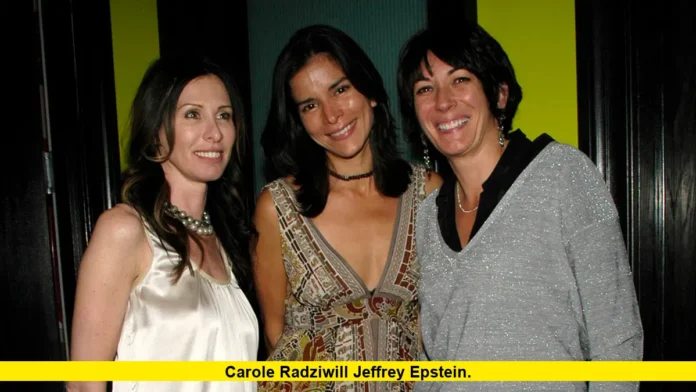

The Carole Radziwill Jeffrey Epstein story has drawn renewed attention following Carole Radziwill’s recent comments on The Real Housewives of New York City and her public response to questions about her past association with Ghislaine Maxwell. In October 2026, Radziwill addressed the controversy surrounding her name in Epstein-related records, clarified that she never met Jeffrey Epstein, and explained the limited nature of her relationship with Maxwell. Her remarks have renewed interest in what the publicly discussed documents actually establish and what remains unproven.
Radziwill, a journalist, author, and former reality television personality, has faced questions about her social connections from the early 2000s. Her name has surfaced in discussions of documents connected to the investigation of Epstein, the convicted sex offender who died in federal custody in 2019.
However, a person’s name appearing in Epstein-related records does not establish involvement in criminal activity. Understanding Radziwill’s situation requires separating documented references, her own statements, and online speculation.
The latest developments center on her explanation of her acquaintance with Maxwell, her denial of any personal relationship with Epstein, and the broader debate about how investigators and the public interpret names found in large collections of records.
Who Is Carole Radziwill?
Carole Radziwill is an American journalist, author, and television personality best known for her work on The Real Housewives of New York City. Before becoming a familiar face on reality television, she built a career in journalism and worked as a correspondent and producer.
Her professional background differs from that of many reality television personalities. Radziwill has written about politics, international affairs, and personal loss, and she has maintained a public identity as both a journalist and an author.
Her connection to the Epstein controversy stems primarily from her past acquaintance with Ghislaine Maxwell and the subsequent appearance of her name in Epstein-related materials.
That connection became a subject of renewed public discussion after cast members questioned her about the records during the current season of The Real Housewives of New York City.
The renewed attention has placed Radziwill in an uncomfortable position: explaining a past social relationship while responding to public assumptions about a notorious criminal case.
Why Is Carole Radziwill Being Linked to Jeffrey Epstein?
The central reason Radziwill’s name has attracted attention is her documented association with Maxwell, who was a longtime associate of Epstein and was later convicted of helping him sexually abuse underage girls.
Publicly discussed records include references to Radziwill and communications associated with her past interactions with Maxwell. These references have prompted questions about the nature of their relationship and whether Radziwill knew anything about Epstein’s criminal activities.
Radziwill has rejected the suggestion that she had a personal relationship with Epstein. She has said that she never met him and was not aware of his crimes through her acquaintance with Maxwell.
The distinction matters because the Epstein files contain many different kinds of material. They include correspondence, contact information, investigative records, and references to people who appeared in the same social circles.
A mention in a contact list or an email exchange does not automatically establish that someone was a participant in a crime. Investigators and readers must examine the context of each record before drawing conclusions.
In Radziwill’s case, the publicly reported material has focused on her social connection with Maxwell rather than a substantiated allegation that Radziwill participated in Epstein’s criminal conduct.
What Has Carole Radziwill Said About Ghislaine Maxwell?
Radziwill has acknowledged knowing Maxwell during the early 2000s. However, she has pushed back against characterizations of their relationship as an especially close friendship.
During her recent television appearances, Radziwill described their connection as a social acquaintance that developed through mutual friends and overlapping circles in New York.
She has also explained that Maxwell did not discuss Epstein’s criminal activities with her. Radziwill has maintained that she did not know about the abuse that later became central to the criminal investigation.
Her comments highlight an important distinction between knowing someone socially and knowing about that person’s criminal conduct.
Maxwell moved within wealthy and influential social circles before her conviction. Her connections included people in entertainment, business, politics, and other prominent communities.
The existence of those relationships has since attracted scrutiny. Yet each person’s connection to Maxwell must be assessed on its own evidence rather than through assumptions based on association.
Radziwill’s position is that her past acquaintance with Maxwell did not involve knowledge of Epstein’s crimes or participation in them.
What Do the Epstein-Related Documents Say About Carole Radziwill?
The question of what the records actually establish is central to understanding the controversy.
Public reporting has described references to Radziwill in documents associated with the Epstein investigation, including communications connected to Maxwell. Some of the reported material concerns ordinary social interactions and correspondence.
These references have become a subject of online discussion because Epstein-related document releases have attracted widespread interest in the identities of people who appeared in the records.
However, the documents should not be treated as a single, uniform list of suspects. Different records serve different purposes, and a name may appear for many reasons.
For example, an individual might appear in correspondence because of a social invitation, a professional interaction, a delivery, or a mutual acquaintance. Such a reference does not independently establish knowledge of abuse or participation in illegal conduct.
In Radziwill’s situation, the publicly discussed references have fueled questions about her connection to Maxwell. They have not, by themselves, established that she took part in Epstein’s criminal activities.
Readers should also distinguish between an original document, a journalist’s interpretation of it, and claims circulating on social media. Those are not interchangeable forms of evidence.
The most responsible assessment focuses on what the records demonstrate, what Radziwill has said, and whether any verified evidence supports additional allegations.
Did Carole Radziwill Ever Meet Jeffrey Epstein?
Radziwill has repeatedly stated that she never met Jeffrey Epstein.
That denial is a central part of her public response to the controversy. She has separated her acquaintance with Maxwell from any suggestion that she personally knew Epstein.
As of the latest developments discussed in October 2026, the public reporting reviewed for this article has not established that Radziwill met Epstein.
It is important to describe this carefully. Her statement is a direct denial, while the absence of a verified public account establishing a meeting is a separate matter.
Neither a past social relationship with Maxwell nor a reference in Epstein-related documents proves that Radziwill had direct contact with Epstein.
Claims that go beyond those established facts should not be presented as confirmed information.
What Happened During the Recent RHONY Discussion?
Radziwill’s connection to the Epstein files became a major topic during the current season of The Real Housewives of New York City.
In an episode that aired in October 2026, cast members questioned her about her past relationship with Maxwell and the attention surrounding her name in the records.
The discussion placed Radziwill in the position of explaining a history that she said had been misunderstood and exaggerated.
She pushed back against suggestions that her acquaintance with Maxwell demonstrated a connection to Epstein’s criminal activities. She also challenged the tendency to treat online claims as established facts.
The exchange attracted attention because it brought a complicated criminal investigation into a reality television setting. Instead of discussing the documents only as a matter of public record, cast members debated what Radziwill’s past associations might mean.
Radziwill argued that the focus should remain on the people responsible for the abuse and the broader questions surrounding accountability.
The episode generated renewed interest in the relationship between Radziwill and Maxwell, particularly among viewers searching for an explanation of why her name appears in Epstein-related discussions.
However, a televised disagreement does not resolve factual questions about a criminal investigation. The underlying records and verified evidence remain more important than the reactions of reality television cast members.
Carole Radziwill’s Account of Her Encounter With Prince Andrew
Another detail from Radziwill’s recent comments has drawn attention: a dinner with Prince Andrew, now known as Andrew Mountbatten-Windsor.
During a recent episode of The Real Housewives of New York City, Radziwill recalled an encounter arranged by Maxwell following the death of her husband, Anthony Radziwill, in 1999.
Radziwill described Maxwell as someone who offered to introduce her to people in her social circle during a difficult period in her life. The introduction eventually led to a dinner with Andrew.
She characterized the dinner as unmemorable and said there was no romantic relationship.
The account has attracted interest because Andrew’s association with Epstein and Maxwell has been the subject of extensive scrutiny. Andrew previously faced a civil sexual assault lawsuit brought by Virginia Giuffre, which he settled in 2022 without admitting liability. He has denied the allegations against him.
Radziwill’s account of the dinner does not establish that she knew about Epstein’s criminal activities. Nor does a social encounter arranged by Maxwell prove involvement in wrongdoing.
The episode is relevant to understanding how Maxwell operated within prominent social circles, but it should not be confused with evidence of criminal conduct by Radziwill.
Why Radziwill Has Criticized Online Speculation
Radziwill has expressed frustration with the public reaction to her name appearing in Epstein-related records.
Her concern centers on the difference between being mentioned in documents and being accused of, or implicated in, a crime. She has objected to the way online discussions can turn limited information into sweeping conclusions.
The controversy also raises a broader problem associated with large document releases. When thousands of records become publicly available, individual names can attract attention without the surrounding context necessary to understand their significance.
Social media can amplify that problem. A short excerpt or an isolated reference may circulate widely, while the details that explain the original context receive much less attention.
Radziwill has used her public comments to challenge this pattern and defend her account of her past relationship with Maxwell.
Her response does not mean that every question about the records is unreasonable. Public scrutiny of the Epstein case remains important, particularly because the investigation involved serious crimes and powerful social connections.
The distinction is that scrutiny should be evidence-based. Questions about a person’s past associations are not proof of criminal involvement.
What Is the Difference Between Being Named in the Epstein Files and Being Accused of a Crime?
Understanding this distinction is essential for anyone researching Carole Radziwill and Jeffrey Epstein.
The term Epstein files broadly describes records associated with Epstein, Maxwell, related investigations, and legal proceedings. It does not refer to one definitive document that identifies every person who committed a crime.
A name can appear in the records without the person being a suspect, defendant, or witness to criminal activity. The significance depends on the specific document and the circumstances surrounding the reference.
There are several important distinctions:
- A name in a record: Establishes that the document contains a reference to the person, but not necessarily why the reference exists.
- An email or social interaction: May demonstrate communication or an acquaintance, but does not independently prove criminal knowledge.
- An allegation: Represents a claim that must be evaluated against available evidence.
- A criminal charge: Is a formal legal accusation and is not the same as a conviction.
- A conviction: Reflects a criminal finding established through the legal process.
These distinctions are especially important when discussing people who knew Maxwell socially before her crimes became widely known.
For Radziwill, the available public discussion centers on her past acquaintance with Maxwell and her name’s appearance in related records. Those facts should not be expanded into allegations that the evidence does not support.
What Is the Latest Update on Carole Radziwill and Jeffrey Epstein?
The latest significant development is Radziwill’s renewed public response in October 2026.
Her comments on The Real Housewives of New York City brought renewed attention to her past association with Maxwell. She has also addressed the controversy in a personal essay, explaining her position and criticizing the spread of unsupported claims.
Her account remains consistent on the central points: she knew Maxwell socially, she says she never met Epstein, and she denies knowing about Epstein’s criminal conduct.
The renewed discussion has not changed the basic evidentiary distinction at the heart of the story. Being mentioned in Epstein-related records does not establish criminal wrongdoing.
No verified information reviewed for this article establishes that Radziwill participated in Epstein’s crimes. Claims suggesting otherwise should not be treated as fact without reliable supporting evidence.
For readers following the story, the most meaningful future developments would be newly authenticated documents, official statements, or credible reporting that materially changes what is known about her connection to Maxwell or Epstein.
Until such evidence emerges, Radziwill’s documented social association with Maxwell and her public denial of knowing Epstein remain the central facts of the story.
Conclusion
The Carole Radziwill and Jeffrey Epstein story illustrates why context matters when interpreting documents associated with a major criminal investigation. Radziwill has acknowledged knowing Ghislaine Maxwell socially while maintaining that she never met Epstein or knew about his crimes. Her recent television comments and public response have brought those distinctions back into focus. The key question is not simply whose names appear in the records, but what the evidence actually demonstrates about each person’s actions and knowledge.
What do you think about the distinction between being mentioned in the Epstein files and being implicated in wrongdoing? Share your thoughts in the comments and stay updated as verified information emerges.