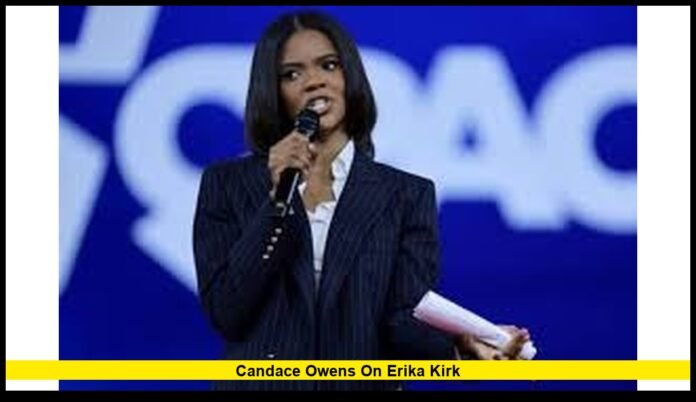

The ongoing saga of Candace Owens on Erika Kirk has quickly evolved from a series of pointed social media posts into one of the most intense internal disputes the conservative movement has witnessed in recent years. What began as Owens questioning Erika Kirk’s handling of her husband Charlie Kirk’s assassination has spiraled into a broader power struggle involving public accusations, ideological divisions, and mounting pressure on Turning Point USA (TPUSA).
This feud isn’t just about personal animosity—it reflects the ideological fractures, media dynamics, and leadership tensions shaping the future of a major conservative institution in the United States.
Who Are the Key Players: Candace Owens and Erika Kirk
Before diving into the timeline and implications, it’s essential to understand who the two central figures are.
Candace Owens rose to prominence as a conservative commentator known for her fiery rhetoric, willingness to confront establishment narratives, and massive online following. She has been a fixture in right-wing media since the late 2010s, becoming a household name through viral videos, debates on mainstream platforms, and her alignment with figures like Donald Trump. Her blunt style and conspiratorial leanings have earned her both loyal supporters and fierce critics.
Erika Kirk, meanwhile, stepped into the national spotlight in a different way. Initially known within conservative and religious circles, she became more publicly prominent after marrying Charlie Kirk, founder of TPUSA. Erika was known for her involvement in Christian advocacy, women’s conferences, and faith-based initiatives. Her public image has often contrasted with Owens’—more reserved, focused on leadership roles behind the scenes, and less combative on social media.
That changed dramatically after Charlie Kirk’s assassination on September 10, an event that shocked the nation and sent TPUSA into mourning. In the immediate aftermath, Erika assumed leadership of TPUSA, taking on the roles of CEO and chair—a position many close to the couple say Charlie had long prepared her for.
Within weeks, however, Candace Owens would thrust Erika into the center of a media storm.
Candace Owens’ Accusations Against Erika Kirk
The feud erupted when Owens began making a series of pointed claims and insinuations online. She suggested that Erika Kirk was not sufficiently invested in uncovering the truth behind her husband’s death.
She claimed to have obtained private messages from Charlie Kirk that, according to her, revealed deep tensions between Kirk and unnamed “powerful groups” who were upset with his refusal to distance himself from Tucker Carlson. Owens argued that these alleged messages indicated possible motives for a cover-up, and she implied Erika was not being transparent about what she knew.
Owens’ rhetoric became increasingly personal. She asked publicly, “What kind of widow doesn’t want the truth about her husband’s murder to come out?” She then criticized Erika for participating in photoshoots and media appearances shortly after the tragedy, calling it “unbecoming” behavior for someone in mourning.
Erika Kirk responded in measured terms, saying that “there’s no linear blueprint for grief” and that outsiders had no right to judge her personal process. Her statement struck a chord with many who saw Owens’ remarks as crossing a line between political commentary and personal attack.
Conservative Figures Push Back Against Owens
Owens’ accusations were met with swift backlash from several corners of the conservative movement. Prominent figures—including Laura Loomer—publicly denounced Owens’ insinuations, calling them “demented,” “vile,” and “deeply disrespectful.” Loomer, typically aligned with Owens on many political issues, broke ranks to defend Erika Kirk, highlighting the seriousness of attacking a widow without evidence.
Inside TPUSA, staff members reportedly expressed concern that Owens’ allegations were destabilizing an already fragile organization. While many chose to speak only off the record, the sentiment was clear: Owens’ personal crusade was being viewed as a distraction from the group’s mission and a potential threat to its unity.
Interestingly, Erika and TPUSA have so far chosen not to confront Owens directly through legal or public channels. Observers believe this is a strategic move, allowing Owens to take center stage while Erika maintains the image of a steady, grieving leader focused on her late husband’s legacy rather than engaging in public feuds.
TPUSA at a Crossroads
This dispute comes at a time when TPUSA is navigating perhaps its most difficult chapter. The assassination of Charlie Kirk not only left a leadership vacuum but also thrust Erika into a position that requires balancing emotional recovery with organizational stability.
Under Erika’s leadership, TPUSA has tried to project continuity—emphasizing its core mission, hosting events, and keeping its donor base engaged. But the Owens controversy threatens to overshadow these efforts.
Internal sources indicate that senior leadership has advised staff to stay silent on social media to avoid feeding the controversy. There are concerns that Owens’ continued allegations could fracture donor confidence or push influential voices to take sides, creating factions within the movement.
For Erika, the stakes are high. She is not only defending her personal reputation but also the direction of TPUSA at a critical juncture.
The Personal History Between Candace Owens and Charlie Kirk
To fully grasp the current feud, it’s important to revisit the personal and professional history between Candace Owens and Charlie Kirk.
The two were once close allies, working side by side to build TPUSA’s influence among young conservatives. Their partnership helped shape TPUSA into a powerhouse organization. However, tensions reportedly began to surface in recent years as Owens embraced increasingly conspiratorial narratives that some within TPUSA viewed as politically risky.
Sources close to Kirk claim that he began distancing himself from Owens well before his death, describing it as a “break-up” between two once-powerful figures in the movement. Owens, for her part, seemed to harbor lingering resentment toward TPUSA’s leadership and Kirk himself for sidelining her influence.
This personal history has likely fueled the sharp tone of Owens’ current accusations against Erika. Many observers believe that Owens’ campaign is as much about settling old scores as it is about questioning Erika’s leadership.
What’s Really at Stake
The feud between Candace Owens and Erika Kirk has implications that stretch far beyond their personal animosity.
- Control of Charlie Kirk’s Legacy: Erika Kirk represents continuity and stewardship of Charlie’s vision, while Owens appears to be challenging that narrative by positioning herself as a truth-teller.
- Unity of the Conservative Movement: If prominent voices are forced to choose sides, it could create lasting divisions within the right-wing ecosystem.
- Media Power vs. Organizational Leadership: Owens wields enormous media influence through her platforms. Erika commands institutional power as TPUSA’s leader. Their clash is, in many ways, a battle between media celebrity and organizational authority.
- Legal and Ethical Boundaries: Owens’ accusations have raised questions about defamation, moral responsibility, and the limits of political speech when personal tragedies are involved.
For TPUSA, how this situation unfolds may determine whether it emerges united or fragmented. For Erika Kirk, it could define her entire leadership tenure.
The Road Ahead
Looking forward, several potential scenarios could shape the trajectory of this feud:
- Legal Action: If Owens continues making personal accusations without evidence, Erika Kirk or TPUSA could pursue defamation claims.
- Public Showdown: Erika may eventually issue a strong public statement or participate in a media appearance directly addressing Owens’ claims.
- Further Escalation: Owens might release more alleged private communications, deepening the controversy.
- Movement Response: Influential conservative figures may eventually intervene, urging unity and trying to mediate the conflict.
What’s clear is that this is not a passing spat. The narrative of Candace Owens on Erika Kirk is shaping public perceptions of both women, testing TPUSA’s resilience, and revealing fault lines within the American conservative movement.
A Defining Moment
The conflict between Owens and Erika is emblematic of broader tensions between media-driven personalities and institutional leaders. It’s a test of how much sway a single influencer can have over the direction of an organization, and how leaders navigate public attacks during personal crises.
Erika Kirk now faces the dual task of safeguarding her late husband’s legacy and defending her leadership against one of the movement’s most outspoken figures. Candace Owens, meanwhile, continues to push her narrative with characteristic boldness, seemingly undeterred by backlash.
The coming weeks will likely determine whether this feud remains a loud media storm or escalates into a lasting divide that reshapes conservative politics in the U.S.
This feud between Candace Owens on Erika Kirk is more than just a clash of personalities—it’s a defining moment for the conservative movement. What’s your take on Erika’s next move? Share your thoughts and keep following this evolving story.