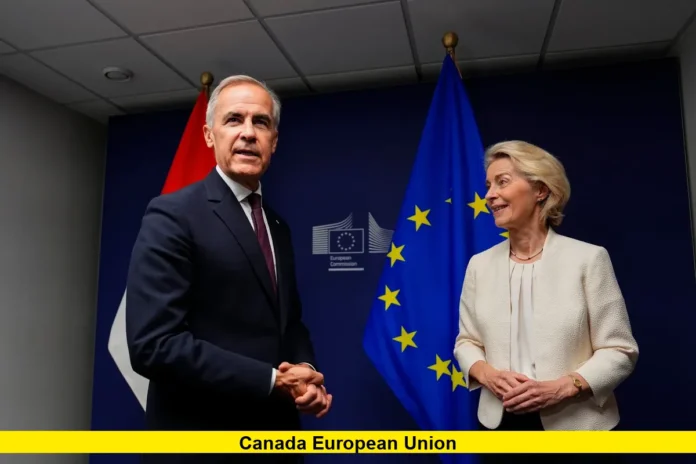

Canada European Union relations reached a pivotal moment this week after President Donald Trump warned that granting Canada associate membership in the EU could amount to a “hostile act.” The comment came just before Canadian Prime Minister Mark Carney addressed the European Parliament in Strasbourg, France, on Thursday, capping a whirlwind two-day visit that has thrust Ottawa’s pivot toward Europe into the international spotlight.
The timing could hardly be more charged. On Wednesday, European Commission President Ursula von der Leyen used her annual State of the Union address to propose making Canada the European Union’s very first “associate member,” a status that does not currently exist anywhere in the bloc’s treaties. Trump responded within hours, calling the idea “laughable” and threatening new tariffs on the EU depending on the “intention” behind the move.
What Trump Said, and Why It Matters
Speaking at an event in Charlotte, North Carolina, Trump escalated his rhetoric against both Canada and Europe. He dismissed the associate membership proposal outright and described Canada as a “terrible trade partner,” a line that landed just hours after von der Leyen’s proposal drew a standing ovation inside the European Parliament chamber.
Trump’s warning was conditional but pointed. He said any move toward closer EU-Canada integration would need to reflect “good intention” from European leaders. “If it’s a good intention, that’s fine,” he said. “If it’s a bad intention, we’ll put very heavy tariffs on Europe.” He also raised the possibility of cutting off trade with the bloc in certain sectors altogether.
This is not the first time Trump has targeted Canada’s sovereignty rhetorically. He has repeatedly floated the idea of Canada becoming the 51st U.S. state and has questioned the legitimacy of the Canada-U.S. border. Those comments have become a recurring backdrop to Carney’s efforts to diversify Canada’s economic and security relationships away from near-total reliance on Washington.
Carney’s Historic Address to the European Parliament
Carney’s speech to roughly 720 members of the European Parliament, delivered at the invitation of Parliament President Roberta Metsola, is only the latest step in a deliberate strategy. Canadian officials have spent months signaling that this address would not produce a dramatic new agreement on the spot. Instead, it was billed as a statement of political direction, one meant to build on the momentum from Carney’s closely watched speech at the World Economic Forum in Davos back in January.
At Davos, Carney warned that when smaller and mid-sized economies negotiate one-on-one with a dominant power, “we negotiate from weakness. We accept what is offered.” That framing, widely interpreted as a rebuke of U.S. trade tactics, drew a public response from Trump the following day. Analysts expected Thursday’s Strasbourg speech to carry a similar undertone, even if Carney avoided naming Trump directly.
Daniel Béland, a political-science professor at McGill University, said Carney is likely to leave little doubt about who his broader argument targets, even without naming names. “He knows that, beyond Europe, the world will be watching, including the White House,” Béland said.
Carney arrived in Strasbourg after attending von der Leyen’s State of the Union address on Wednesday, where he sat as a guest of honor in the front row of the chamber. When von der Leyen unveiled the associate membership proposal, Carney rose to embrace her as lawmakers applauded.
Why Canada Is Turning Toward Europe
For decades, Canada’s economy has been built around deep integration with the United States, with roughly 70% of Canadian exports going south of the border. That dependence has become a liability under the current trade dispute. Washington has imposed tariffs of up to 50% on tens of billions of dollars in Canadian goods, and Ottawa has responded with its own retaliatory measures rather than accepting the terms on offer.
Europe, by contrast, took a different route with Washington, largely shelving retaliation and accepting tariffs of up to 15% on most exports to the U.S. That contrast has shaped how each side is now approaching the idea of a closer transatlantic relationship with Canada.
Jonathan Wilkinson, Canada’s ambassador-designate to the EU, made clear this week that full EU membership is not on the table, since that would require Canada to give up elements of its sovereignty. Instead, he said Ottawa wants to “get as close as we possibly can” to Europe while simultaneously reducing reliance on the United States.
Key facts driving the Canada-EU push:
- Canada became the first non-European country to join the EU’s SAFE defense procurement program, worth 150 billion euros (about $173 billion).
- Talks are underway on cooperation involving energy, critical minerals, artificial intelligence, and digital trade.
- A Canada-EU summit is scheduled for Montreal on October 29-30, where leaders are expected to flesh out details of the proposed “Alliance for the Future.”
- Associate membership, as proposed by von der Leyen, does not yet exist in EU treaties and would require new legal groundwork before it could take effect.
The “Alliance for the Future” Concept
Von der Leyen’s proposal goes beyond simply expanding Canada’s existing free trade agreement with the EU. She described the goal as building an “Alliance for the Future,” a framework meant to create what she called a “common prosperity and economic security space” between Canada and the 27-member bloc.
Exactly what that would mean in practice is still being worked out. EU officials briefed on the discussions have cautioned that no broad new partnership has been finalized and that talks remain in an early stage. Ideas reportedly under consideration include Canadian participation in the EU’s Erasmus student exchange program, closer coordination on Arctic security, and expanded defense-industrial cooperation.
Sven Simon, who chairs the European Parliament’s committee on constitutional affairs, said European lawmakers have watched Carney’s handling of the trade dispute with the U.S. closely. “He nailed it,” Simon said of the Davos speech. “I think in those uncertain times, we, both the Europeans and Canadians, have a huge interest in closer co-operation.”
Nelson Wiseman, a professor emeritus at the University of Toronto, echoed that sentiment, saying Carney’s willingness to push back against Washington rather than quickly cave to its demands has increased Europe’s interest in Canada as a partner. Europeans have long viewed Canada as uniquely positioned to understand the United States because of decades of close economic and political ties, he noted.
Domestic Reaction in Canada
Not everyone in Canada has embraced the European outreach without criticism. Conservative deputy leader Melissa Lantsman argued that Carney should be focused on Canada’s own Parliament rather than courting European lawmakers, given the ongoing trade dispute with Washington. She pointed out the apparent contradiction of a prime minister describing the country as being “at war” economically while traveling abroad instead of recalling Parliament.
Carney’s office has pushed back on the idea that the Strasbourg trip represents a shift away from managing the U.S. relationship. Officials have framed the visit as complementary to, not a substitute for, ongoing efforts to stabilize trade with Washington.
A Rare Honor at the European Parliament
Addressing the full European Parliament is not something offered lightly. In past years, Brussels has typically reserved the honor of guest speaker for civil society figures or leaders connected to the war in Ukraine, rather than heads of government from outside Europe. Carney’s invitation, extended personally by Metsola, was widely read as a deliberate political signal rather than a routine courtesy.
Metsola described the visit as “an important visit” that would help “deepen EU-Canada ties and strengthen our bond.” That framing lines up with the broader mood in Brussels, where officials have grown increasingly interested in diversifying alliances beyond the traditional transatlantic relationship centered on Washington.
Carney has told reporters, including in an interview with Bloomberg News, that he expects “great things” from the deepening relationship, while cautioning that this particular trip is not meant to be the “grand finale of a grand bargain.” That cautious framing reflects the incremental approach both sides appear to be taking, even as public displays of warmth, like the standing ovation for von der Leyen’s proposal, suggest genuine momentum behind the effort.
What Comes Next
Thursday’s speech is widely viewed as a preview rather than a conclusion. The real substance of any new Canada-EU arrangement is expected to take shape at the Montreal summit in late October, when Carney is set to host von der Leyen and European Council President António Costa. Officials on both sides describe the current phase as one of signaling political intent and identifying priority areas, rather than finalizing legal commitments.
Trump’s warning about a possible “hostile act,” paired with his renewed tariff threats against Europe, adds a layer of uncertainty to how quickly and how far Canada and the EU can move. Whether Washington’s objections shape the substance of the eventual agreement, or simply generate more headlines, is likely to become clearer in the weeks leading up to the October summit.
This story is still developing, so check back for the latest updates and share your thoughts on what this shift means for North America and Europe.