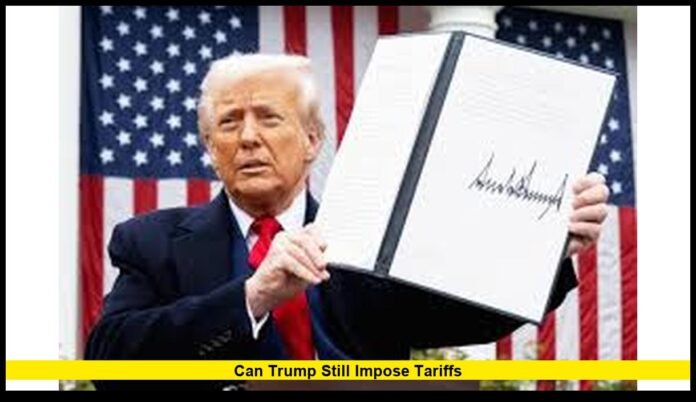

Can Trump still impose tariffs? As of February 21, 2026, the sitting president of the United States, Donald Trump, retains the legal authority to impose tariffs under existing federal trade statutes that Congress has not repealed or amended.
Trade policy remains one of the most powerful economic tools available to the White House. While the Constitution gives Congress authority over foreign commerce, lawmakers have delegated significant tariff powers to the executive branch through laws that are still active today. Because those statutes remain in force, presidential tariff authority continues to exist in 2026.
Here is a clear explanation of how that authority works and what limits apply.
The Constitutional Foundation of Tariff Power
The starting point is Article I of the U.S. Constitution.
Congress holds the power to:
- Lay and collect taxes, duties, and imposts
- Regulate commerce with foreign nations
Tariffs fall under both categories. They are duties imposed on imported goods and serve as tools of foreign commerce regulation.
The Constitution does not grant independent tariff authority to the president. Instead, it allows Congress to create laws governing trade. Congress can also delegate certain responsibilities to the executive branch.
That delegation forms the legal basis for modern presidential tariff actions.
The Key Statutes That Authorize Presidential Tariffs
Several federal laws give the president authority to impose tariffs under specific conditions. These statutes remain valid and enforceable in 2026.
Section 232 of the Trade Expansion Act of 1962
Section 232 allows the president to restrict imports if they threaten national security.
The process requires:
- An investigation by the Department of Commerce.
- A formal national security determination.
- A presidential decision on appropriate action.
Actions may include tariffs, quotas, or other trade adjustments.
Section 232 was used during Trump’s first term to impose tariffs on steel and aluminum. The statute remains active today.
Section 301 of the Trade Act of 1974
Section 301 allows the United States to respond to unfair trade practices by foreign governments.
The law requires:
- An investigation by the Office of the U.S. Trade Representative.
- Public comment procedures.
- Findings regarding unfair or discriminatory trade practices.
If violations are confirmed, the president may impose tariffs or other restrictions.
Section 301 served as the legal basis for tariffs on a large volume of Chinese imports beginning in 2018. The law has not been repealed.
Other Trade Authorities
In limited circumstances, other statutes may also apply.
The International Emergency Economic Powers Act (IEEPA) allows the president to regulate certain economic transactions during declared national emergencies involving foreign threats.
IEEPA is not a general tariff statute, but it provides economic authority in specific emergency contexts.
All of these laws remain part of federal trade policy as of February 2026.
Trump’s Current Legal Authority in 2026
Donald Trump began his second presidential term on January 20, 2025.
As president, he exercises the same statutory powers available to any occupant of the office. Congress has not withdrawn or significantly narrowed Section 232 or Section 301 authority.
Federal courts have not struck down these laws.
Therefore, when Americans ask can trump still impose tariffs, the legal answer is yes—provided he follows the procedures required by the relevant statute.
Judicial Review of Presidential Tariffs
Courts play an important oversight role.
Businesses have challenged tariff actions in the U.S. Court of International Trade. These cases typically examine whether the executive branch complied with statutory requirements.
Judges review:
- Whether investigations followed required timelines
- Whether agencies provided public notice and opportunity for comment
- Whether actions stayed within the scope of congressional authorization
Courts have upheld the constitutionality of Section 232 and Section 301. No Supreme Court decision as of 2026 has invalidated these statutes.
Judicial review focuses on compliance, not elimination of presidential authority.
Limits on Presidential Tariff Power
Although the president holds delegated authority, several limits apply.
Under Section 232:
- The Department of Commerce must conduct a formal investigation.
- The president must act within statutory deadlines.
- National security findings must support the decision.
Under Section 301:
- The U.S. Trade Representative must complete an investigation.
- A public process must occur.
- The action must address specific trade practices.
Congress can revise these laws at any time. Courts can block actions that violate statutory procedures.
These checks ensure that tariff authority remains structured rather than unlimited.
How Tariffs Are Enforced
Once the president announces tariffs under statutory authority, federal agencies implement them.
The process includes:
- Publication of the action in the Federal Register.
- Customs classification updates.
- Collection of duties by U.S. Customs and Border Protection.
- Deposit of revenue into the U.S. Treasury.
Tariffs operate as taxes on imported goods. Importers pay the duties when products enter the country.
Revenue does not go to the president personally. It becomes federal income.
Congress Retains Ultimate Control
Congress remains the primary constitutional authority over trade.
Lawmakers can:
- Amend tariff statutes
- Reclaim delegated authority
- Set new restrictions
- Repeal existing trade laws
In recent years, members of both parties introduced legislation aimed at increasing congressional oversight of tariff actions. As of February 2026, no major reform has eliminated executive authority under Sections 232 or 301.
The balance of power remains unchanged.
Supreme Court and Delegation Doctrine
The Supreme Court has historically allowed Congress to delegate authority if it provides guiding standards.
This principle is known as the nondelegation doctrine. Courts require an “intelligible principle” to guide executive action.
Federal courts reviewing tariff statutes have determined that Section 232 and Section 301 contain sufficient standards and procedures.
Because of these rulings, the statutory framework supporting presidential tariffs remains intact in 2026.
Economic Impact and Policy Debate
Tariffs influence multiple sectors of the U.S. economy.
Industries affected by past tariff actions include:
- Steel and aluminum manufacturing
- Automotive production
- Agriculture
- Consumer electronics
- Industrial machinery
Supporters argue tariffs protect domestic industries and address unfair trade practices.
Critics argue tariffs increase costs for businesses and consumers.
These policy debates do not change the underlying legal authority. The statutes continue to grant the president power to act.
Key Legal Facts at a Glance
| Issue | Status in 2026 |
|---|---|
| Constitutional tariff authority | Granted to Congress |
| Delegation to president allowed | Yes |
| Section 232 active | Yes |
| Section 301 active | Yes |
| Supreme Court invalidation | None |
| Presidential tariff authority today | Valid under statute |
This summary reflects the current legal landscape.
Why This Question Remains Relevant
Trade policy directly affects American businesses and consumers.
Presidential tariff authority allows rapid response to international trade disputes without requiring new legislation for every action.
At the same time, congressional oversight and judicial review provide checks.
Understanding this structure helps clarify how trade decisions occur and who holds responsibility.
The answer to can trump still impose tariffs depends entirely on existing law—and that law remains in force.
The Bottom Line in 2026
Donald Trump, as the current president, possesses the legal authority to impose tariffs under statutes enacted by Congress. Those statutes remain active. Courts have upheld them. Congress has not revoked them.
Any new tariffs must follow statutory procedures and withstand potential judicial review.
The constitutional framework remains stable, and presidential trade authority continues within its established limits.
What are your thoughts on presidential tariff authority in 2026? Share your perspective and stay engaged as U.S. trade policy continues to shape the national economy.