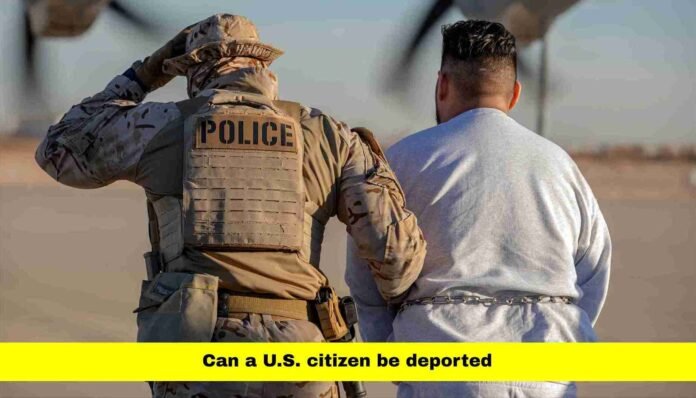

The question Can a U.S. citizen be deported has garnered intense public attention amid heightened immigration enforcement activities and several high-profile cases of U.S. citizens being detained or mistakenly placed into removal proceedings. As the debate grows online and in courts, public understanding of legal definitions and enforcement practices remains mixed. Federal law establishes clear protections for U.S. citizens, yet recent developments show that citizens can be detained or mistakenly identified, raising complex legal and civil rights concerns.
This comprehensive news article explains the current legal framework, clarifies what is legally possible and impossible, and outlines verified recent examples where U.S. citizens were wrongfully detained or placed into deportation-like situations. It also explores official statements, court rulings, and immigration enforcement trends shaping how this question is understood in 2026.
Understanding Deportation Under U.S. Law
At its core, deportation is a legal process defined under federal immigration law that applies to non-citizens. United States citizens — whether natural-born or naturalized — have constitutional rights and protections that prevent their removal from the country.
By law:
- Only people who are not U.S. citizens can be ordered removed (deported) from the United States through immigration proceedings.
- Citizens have the right to remain in the United States and cannot be expelled solely for immigration status violations.
- Deportation proceedings are part of the federal immigration court system, which only has jurisdiction over non-citizens.
This basic legal protection means that, under federal statute, U.S. citizens cannot be deported as part of immigration enforcement actions.
Recent Enforcement Actions and Reporting
While citizens cannot legally be deported, numerous confirmed reporting and federal comments show cases where citizens have been detained or erroneously processed by immigration agents, sometimes for days.
For instance:
- Advocacy reports and data show more than 170 U.S. citizens have been held by immigration agents in some circumstances. These incidents included serious civil liberties concerns and sparked calls for accountability.
- In recent months, multiple U.S. citizens were detained by immigration officials because of identification or verification errors, even though they later presented valid proof of citizenship and were released after extended confinement.
- A Maryland woman with clear U.S. citizenship documentation was held in immigration custody for several weeks before lawyers secured her release after she provided official proof of birthright citizenship.
These documented incidents confirm that while legal deportation of citizens does not occur, erroneous detentions do happen and have become part of the broader public conversation.
Court Rulings and Legal Safeguards
Judges in the United States have frequently intervened to prevent wrongful removal actions.
Recent decisions include rulings that block re-detention or deportation efforts when a person’s citizenship status is contested or mistreated. Courts have emphasized that removal actions without firm evidence of non-citizen status violate legal protections.
Beyond individual cases, long-standing legal precedents confirm that immigration enforcement officers must respect citizenship status and due process rights. When government agencies fail to verify identity or misread records, courts have ordered corrective action or prevented further detentions.
Misidentification and Administrative Errors
One reason U.S. citizens have been pulled into deportation proceedings is administrative misidentification.
In several documented situations:
- Government databases or intake forms have incorrectly flagged a person as an “alien” or non-citizen.
- Errors in paperwork or data entry have led immigration enforcement agents to treat U.S. citizens as removable individuals.
- Individuals with foreign-sounding names or complex documentation histories have been mistakenly profiled in enforcement actions.
These administrative issues have resulted in extended detentions and legal battles, even though the underlying law is clear that citizens cannot be legally removed from the country for immigration violations.
Federal Agency Position on Citizen Deportation
Federal agencies such as the Department of Homeland Security have repeatedly clarified that they do not deport U.S. citizens.
Official statements have directly debunked misleading reports claiming otherwise. Agencies emphasize that their removal actions are directed at non-citizens, and any detention of a U.S. citizen is an error to be corrected once citizenship is verified.
Despite misunderstandings and mistaken detentions, federal policy is clear: the government does not deport U.S. citizens.
Mistaken Deportation Claims and Reporting Challenges
Public discussions sometimes suggest that citizens have been deported, but verified data does not support confirmed cases of lawful deportation of U.S. citizens in recent years.
Independent research indicates that while there have been claims and anecdotal reports, there is no current verified evidence of immigration authorities removing an individual who was conclusively determined to be a U.S. citizen between early 2025 and early 2026.
This distinction is critical:
- Mistakes involving detention and removal procedures are documented.
- Verified deportations of citizens, as defined by lawful removal resulting in expulsion from the United States based on immigration status, have not been confirmed in public records for the period in question.
High-Profile Cases Highlight Enforcement Risks
Several incidents have drawn notable public and legal scrutiny:
- A case involving a U.S. citizen held in immigration custody for many days despite providing proof of citizenship highlighted gaps in verification and processing procedures.
- Instances of immigration officers entering private homes, detaining individuals, or initiating removal proceedings without clear evidence underscored tensions between enforcement measures and constitutional protections.
- Civil rights advocates have pointed to these situations as evidence that better oversight and training are needed to prevent wrongful detentions.
While these events involve serious rights violations, they do not equate to lawful deportations of U.S. citizens. Cases involving fine-tuning of procedure, documentation review, and corrective legal action are ongoing.
Historical Precedents and Longstanding Protections
The legal principle that U.S. citizens cannot be deported has deep roots in American jurisprudence.
Historic cases involving wrongful deportations of citizens — such as deportation due to administrative error or misclassification — have shaped legal safeguards and reinforced the constitutional protections afforded to citizens.
Over decades, courts have held that:
- Citizenship is a fundamental status that cannot be extinguished without due process.
- Deportation proceedings apply only to individuals lacking citizenship status.
- Government agencies must establish clear, legal authority before removing anyone.
These legal principles remain central to understanding why the answer to the question Can a U.S. citizen be deported is a firm no under current law.
Detention vs. Deportation: Important Legal Distinction
A crucial part of the national conversation revolves around understanding the difference between detention and deportation.
Detention:
- Can occur when law enforcement or immigration agents hold a person temporarily to verify identity or investigate potential violations.
- May happen even when citizenship status is unclear or incorrectly recorded.
- Must be followed by release once citizenship is verified.
Deportation:
- Involves a formal, legal removal proceeding specifically for non-citizens.
- Results in a person being expelled from the United States based on immigration law.
- Cannot legally apply to citizens.
This distinction explains how someone can be temporarily held by immigration officials without it being a lawful deportation.
Impacts on Families and Communities
Cases of mistaken detentions have had real effects on families and communities across the country.
Individuals held for days or weeks may miss work, lose income, and face emotional distress. Family members often face uncertainty while legal counsel works to secure release based on verified citizenship.
Advocates argue that such incidents erode trust between communities and law enforcement, especially when errors occur repeatedly.
Calls for Policy and Procedural Reforms
In light of these enforcement challenges, some lawmakers, legal experts, and advocacy groups are pushing for reforms to ensure:
- Better training for immigration and enforcement agents on recognizing citizenship documentation.
- Clearer procedures for rapid verification of citizenship status.
- Accountability measures for agencies that detain citizens in error.
- Enhanced oversight of immigration enforcement practices to protect civil rights.
Policy proposals under discussion aim to reduce frequency of wrongful detentions and ensure due process rights are upheld.
What This Means for Americans
For individuals in the United States, the bottom line remains:
- Under federal law, U.S. citizens cannot be deported.
- Any detention or enforcement action involving a citizen should be challenged and corrected.
- Citizenship documentation — such as a valid U.S. passport or birth certificate — is key to resolving wrongful detentions.
- Understanding legal rights and due process protections is essential when encountering immigration enforcement.
As the national conversation continues, clarity about these distinctions remains vital.
Conclusion
When people ask Can a U.S. citizen be deported, the answer under U.S. law is clear: no. However, verified evidence shows that lawful deportations do not include citizens, even though administrative errors have resulted in wrongful detention or processing. Understanding this difference helps protect civil rights and reinforces the legal protections that define citizenship.
Share your questions or experiences about this topic below and stay informed as this issue continues to unfold.