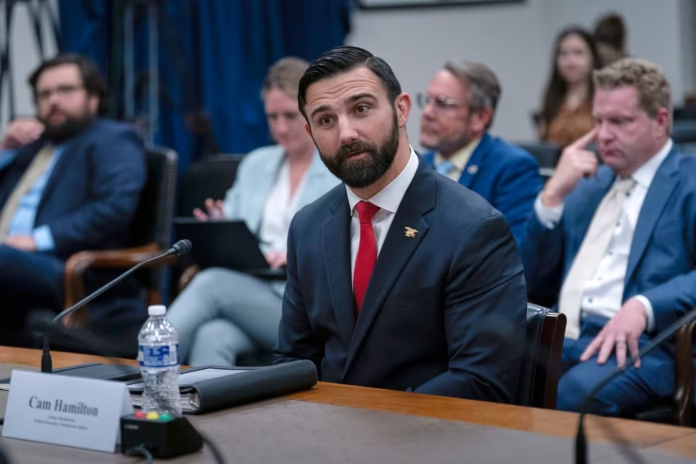

President Donald Trump is expected to nominate Cameron Hamilton to lead FEMA as its permanent administrator — a striking political reversal that brings back the very man the administration dismissed just one year ago for publicly refusing to support the idea of dismantling the agency. The move has quickly become one of the most talked-about developments in federal emergency management in recent memory.
This is not a quiet bureaucratic appointment. It is the story of a fired government official, a fractured federal agency, and a president who appears ready to give a second chance to someone who stood his ground under intense political pressure.
👉 If you work in emergency management, disaster response, or public policy — this nomination directly affects how the federal government will respond to the next major disaster on American soil. Read on to understand exactly what is at stake.
Who Is Cameron Hamilton?
Cameron Hamilton is a 1986-born American business executive and government official with a career that spans combat deployments, emergency management, and federal service. Before stepping into FEMA’s acting administrator role, he worked as director of business strategy for a defense contractor in Virginia — a position that followed nearly a decade of distinguished military service.
Hamilton enlisted in the U.S. Navy in 2005 and served as a Navy SEAL on SEAL Team Eight, completing four overseas deployments before receiving an honorable discharge in 2015. That combat background gave him a discipline and operational mindset that he would carry into every government role that followed.
After leaving the military, he transitioned into emergency management at the federal level. He served as a supervisory emergency management specialist at the U.S. Department of State from 2015 to 2020. He then moved to the Department of Homeland Security, where he served as director of emergency medical services, overseeing approximately 4,000 emergency medical technicians working along the southern border.
His career arc is unusual — a combat veteran turned emergency management professional turned political figure. Hamilton ran for Congress in Virginia’s 7th district in 2024 but lost in the Republican primary. Despite that setback, he remained connected to the Trump administration’s orbit and never entirely faded from Washington’s policy conversations.
The Day He Was Fired — And What He Said Before It Happened
The events surrounding Hamilton’s dismissal last year are central to understanding why this nomination carries such weight.
Hamilton served as FEMA’s acting administrator from January to May 2025. His tenure lasted just a few months before it ended in a very public and very consequential way. On May 7, 2025, he appeared before a U.S. House Appropriations subcommittee on Homeland Security — and what he said that day changed everything.
When the question of dismantling FEMA came before him, Hamilton did not hedge. He did not deflect. He told Congress directly: “I do not believe it is in the best interest of the American people to eliminate the Federal Emergency Management Agency.”
He was fired the next day.
That single sentence — delivered under oath before members of Congress — effectively ended his acting tenure. The administration had repeatedly floated the idea of dismantling FEMA and shifting disaster response responsibilities to individual states. Hamilton publicly pushed back on that idea at the worst possible moment for his career and paid for it immediately.
Yet it may have also set the stage for his return. He chose the American public’s safety over political convenience, and now, roughly a year later, the president who fired him appears ready to bring him back in a permanent capacity.
A Fragmented Agency in Need of Stable Leadership
Part of what makes this nomination so significant is the condition FEMA finds itself in today.
Throughout Trump’s second term, FEMA has operated without a permanent administrator. By the time this nomination surfaced, the agency was on its third temporary leader — a revolving door that critics across both parties have pointed to as a fundamental problem undermining the agency’s effectiveness and institutional memory.
Three acting administrators in the span of one presidential term is not a sign of a stable institution. It reflects the kind of leadership vacuum that can have real consequences when a hurricane, wildfire, or earthquake demands a coordinated, fast-moving federal response. Emergency management requires continuity, established relationships with state directors, and a clear chain of command. None of that thrives under constant leadership turnover.
Trump has also made clear that he wants to restructure how disaster response works in America. He has expressed interest in shifting more responsibility for disasters to individual states rather than relying heavily on a centralized federal response. To support that vision, he created a FEMA Review Council, which is expected to propose sweeping reforms to how the agency supports disaster-impacted communities.
The current Homeland Security Secretary, Markwayne Mullin, has taken a notably different tone from his predecessor Kristi Noem. While Noem famously vowed to eliminate FEMA as it existed, Mullin has expressed support for keeping the agency operational while pushing for meaningful reforms. That shift in posture at the top of DHS may have helped create the political space needed for Hamilton’s return.
Hamilton’s Own Vision for FEMA
Hamilton has never been shy about articulating what he wanted to accomplish at the agency — and equally important, what he was unwilling to do.
During a September 2025 episode of the podcast “Disaster Tough,” Hamilton spoke candidly about his short tenure. He described his relationship with DHS officials during that period as having become “very hostile.” He said he wanted to cut wasteful spending and downsize the agency — but he drew a hard line at dismantling it altogether.
That distinction is not a minor one. There is a meaningful difference between reforming a federal agency and eliminating it. Hamilton positioned himself firmly on the reform side of that debate, and his willingness to defend that position publicly — even when it cost him his job — speaks to a consistency that even his political opponents have acknowledged.
Earlier in April 2026, on the occasion of FEMA’s 47th anniversary, Hamilton took to LinkedIn to reflect on his time with the agency. He expressed gratitude for having served under Trump and alongside his FEMA colleagues, and added that he wished his tenure had been longer because there was still important reform work left to do.
That post, in hindsight, reads less like nostalgia and more like a preview.
What the Nomination Process Looks Like From Here
Trump extended the offer to Hamilton on Wednesday, according to a person familiar with the matter. The White House had not officially announced the nomination at the time the news broke, and an official announcement has not yet been made public. As of now, Trump could still change his mind before submitting a formal nomination to the Senate.
If the nomination does move forward, Hamilton will face a confirmation process that is unlikely to be smooth. One significant potential obstacle is that he has never served as a state emergency management director — a credential that has historically carried considerable weight in evaluating FEMA administrator candidates.
Federal law sets specific requirements for the role. The FEMA administrator must demonstrate a proven ability in emergency management and homeland security, along with no fewer than five years of executive leadership and management experience. Hamilton’s supporters will point to his State Department work, his DHS role managing thousands of emergency medical personnel, and his time as acting FEMA administrator as proof he meets that bar. His critics will push back.
There is also a broader historical context worth noting. After Hurricane Katrina exposed catastrophic failures in FEMA’s response, a strong precedent was established that the agency’s administrator should have direct experience in state or local emergency management. Hamilton’s background, while extensive, does not fit that traditional mold. That will be a point of debate during any Senate confirmation hearings.
If Hamilton is ultimately confirmed, he would become the principal advisor to both the president and the Homeland Security secretary on all matters related to emergency management in the United States — one of the most consequential positions in domestic policy when disaster strikes.
Why This Nomination Is Bigger Than One Person
The broader context here is a federal emergency management system undergoing a period of intense scrutiny and proposed transformation.
The FEMA Review Council is actively working on reform proposals that could fundamentally reshape how federal disaster assistance reaches Americans. In that environment, the question of who leads FEMA is also a question about what FEMA ultimately becomes.
A permanent administrator with a clearly defined philosophy — even one who openly disagreed with his own president last year — brings more institutional direction than a rotating cast of acting leaders. Hamilton, whatever one thinks of his qualifications, knows FEMA from the inside. He understands its culture, its bureaucratic challenges, and the political pressures that now surround it.
He would also take over at a time when climate-driven disasters continue to test the limits of what the agency can accomplish. Wildfires, flooding, severe storms, and extreme heat events are placing growing demands on federal disaster response infrastructure. A permanent, Senate-confirmed FEMA administrator carries more weight in budget negotiations, interagency coordination, and state partnerships than an acting official ever can.
The central question Hamilton would face — if confirmed — is the same one that defines FEMA’s identity right now: Does the agency remain a strong federal backstop for overwhelmed state and local governments, or does it evolve into something more limited, with states absorbing a much greater share of disaster response responsibility? His answer to that question, and the authority the White House grants him to act on it, will shape American disaster policy for years to come.
The Comeback Story Washington Didn’t See Coming
There is an undeniably striking narrative at the heart of this story. A man gets fired for telling Congress the truth. He spends nearly a year outside of government, speaks openly about what went wrong, expresses no public bitterness, and then finds himself invited back by the same administration that removed him.
Whether this reflects a genuine shift in the White House’s thinking about FEMA’s future, a strategic calculation about Senate confirmability, or simply the reality that experienced emergency management professionals with strong federal résumés are harder to find than politicians might assume — the result is the same. Cameron Hamilton is back at the center of one of Washington’s most consequential ongoing debates.
This time, however, the role on the table is not temporary.
👉 This story is still developing. The official nomination has not yet been formally announced by the White House, and the Senate confirmation process — if it moves forward — will draw significant scrutiny from lawmakers on both sides of the aisle. Check back for updates as this story continues to unfold.
The return of Cameron Hamilton to FEMA’s leadership raises questions that go far beyond one man’s career — it forces a real conversation about what Americans need from their federal disaster agency, and whether Washington is finally ready to provide it. Drop your thoughts in the comments and let us know where you stand.