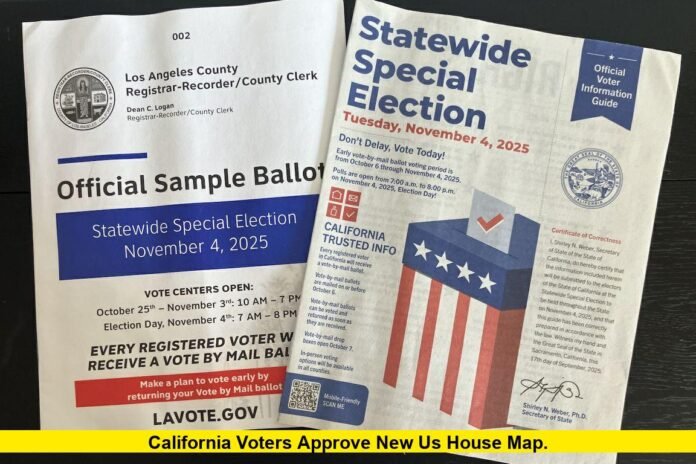

Historic Vote Reshapes California’s Political Landscape
In a major political development, California voters approve new US House map after passing Proposition 50 during the November 4, 2025, statewide special election. The decision, backed by a strong majority, grants the California Legislature temporary authority to redraw the state’s congressional boundaries, replacing the independent citizens’ commission until the next redistricting cycle in 2031.
Early vote counts show over 63% of Californians supported the measure, reflecting broad enthusiasm among Democratic voters and moderate independents who saw the change as a way to counterbalance redistricting moves in other states. The new congressional map will officially take effect for the 2026 election cycle and remain in use through the 2030 elections.
What Proposition 50 Does
Proposition 50 amends state law to allow lawmakers to draft and implement a new congressional map immediately, instead of waiting until after the 2030 census. The measure temporarily suspends the authority of the state’s independent redistricting commission, which traditionally oversees the drawing of electoral boundaries.
Key points of the measure include:
- Legislative Control: The California Legislature will take full responsibility for drawing new congressional districts for the 2026, 2028, and 2030 election cycles.
- Independent Oversight Restored in 2031: The commission will regain its powers following the 2030 census, ensuring the change is temporary.
- Updated Representation: The new map aims to reflect population shifts and demographic growth in major urban areas such as Los Angeles County, the Inland Empire, and the Bay Area.
- Defensive Move: State leaders describe Proposition 50 as a “protective adjustment” to ensure fair representation amid partisan redistricting activity in other parts of the country.
Political Reactions
Governor Gavin Newsom praised the outcome, calling it a “victory for representation and fairness” in the nation’s most populous state. He emphasized that California’s action ensures residents’ voices will be heard and that the new districts will better reflect population growth and demographic diversity.
Democratic leaders in the legislature celebrated the result, noting that the state’s outdated map no longer represented California’s evolving political and social landscape. They argued that the new boundaries will strengthen voter equality and ensure competitive elections.
Republican officials, however, voiced strong opposition. Party leaders have argued that Proposition 50 grants excessive power to the Democratic-controlled Legislature, warning that it could lead to partisan gerrymandering that weakens conservative representation in several key districts.
What the New Map Means for Voters
The newly approved U.S. House map could shift the political balance of California’s congressional delegation. With 52 seats in the U.S. House, California remains the largest and most influential state in Congress. Under the current map, Democrats hold 40 seats while Republicans control 12.
Preliminary analyses suggest that the redrawn boundaries could make as many as five Republican-held districts more competitive, especially in suburban and Central Valley regions where demographic changes have gradually favored Democrats.
In contrast, heavily rural districts in Northern California and along the southeastern border are expected to remain safely Republican. The new lines also aim to strengthen representation for Latino and Asian-American communities, two groups that have seen significant growth over the past decade.
Legal Challenges Expected
Despite the decisive public approval, several Republican organizations and nonpartisan watchdog groups have already announced plans to challenge Proposition 50 in federal court. They claim the measure violates California’s voter-approved constitutional safeguards that protect the independence of redistricting.
Legal experts expect the courts to hear initial arguments in early 2026. However, because voters approved the measure through a constitutional amendment, analysts believe it is unlikely to be overturned before the 2026 election cycle.
The California Supreme Court is also expected to weigh in if disputes arise over whether lawmakers adhere to transparency and fairness standards in drawing the new map.
Impact on the 2026 Elections
The new U.S. House map will shape the political battlefield heading into the 2026 midterm elections. Nationally, Democrats hope the redistricting will help them reclaim control of the House of Representatives after several tight races in 2024 left the chamber nearly evenly divided.
In California, the following regions are expected to be most affected:
- Central Valley: Several competitive districts could shift toward Democrats due to reconfigured boundaries emphasizing population centers over rural areas.
- Orange County: Once a Republican stronghold, the area may see new boundaries that consolidate suburban communities with similar political leanings.
- Inland Empire: Population growth and demographic changes in Riverside and San Bernardino counties may lead to the creation of more majority-minority districts.
- Bay Area & Los Angeles: While these regions remain Democratic strongholds, slight adjustments could redistribute some population centers to ensure compliance with federal population requirements.
California’s Role in National Politics
California’s redistricting decision reverberates far beyond its borders. As the largest state delegation in the U.S. House, changes to its map can significantly influence national power dynamics.
By approving Proposition 50, voters have effectively given California Democrats an opportunity to expand their influence in Washington while reinforcing the state’s commitment to diversity and fair representation.
Analysts suggest that if the new districts perform as expected, Democrats could gain between three and five seats — a margin large enough to affect which party controls the U.S. House in 2026.
Looking Ahead
Over the next several months, the Legislature will begin drafting and debating proposed district lines. Public hearings and community feedback sessions are expected to take place statewide to ensure voter engagement and transparency throughout the process.
Once finalized, the map will need certification by the Secretary of State before the 2026 primary election filing deadline. Lawmakers are under pressure to complete this process by spring 2026 to give candidates adequate time to prepare for the new political landscape.
If legal challenges delay implementation, courts could issue temporary orders — but state officials say they are confident the new map will be ready for use by the 2026 elections.
A New Chapter in California’s Political Evolution
The approval of Proposition 50 underscores California’s evolving identity and its willingness to take bold steps in the face of national political turbulence. While debate continues over the fairness and long-term implications of this move, one thing is clear: California voters have spoken decisively in favor of change.
The coming years will reveal whether this redistricting shift truly enhances representation or deepens partisan divides. Either way, it marks a turning point in how the Golden State defines political fairness and voter power.
California voters have set a new precedent — one that could reshape the nation’s political map for years to come.
Stay informed and share your thoughts below on how this change might influence California’s future elections.