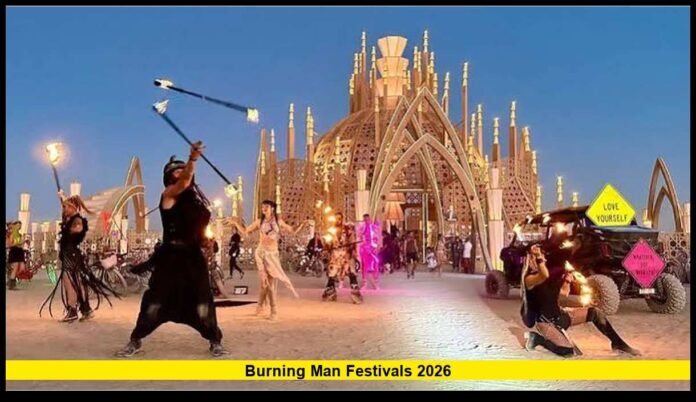

The burning man festival 2026 brought tens of thousands of people together in Nevada’s Black Rock Desert for another temporary experiment in art, creativity, community and radical self-expression. The 2026 gathering marked an important milestone for the Burning Man community, while also becoming one of the more eventful editions in recent years because of severe weather, transportation disruptions, medical emergencies and three participant deaths.
Black Rock City once again appeared in the desert as a massive temporary settlement before eventually disappearing after the event. Participants arrived with elaborate camps, art projects, costumes, mutant vehicles and supplies, creating an environment that looks dramatically different from the surrounding Nevada landscape.
This year’s event also placed renewed attention on the changing character of Burning Man, its aging participant base, the influence of wealthy technology figures and the question of how the community can preserve its original countercultural identity while continuing to attract tens of thousands of people.
When Was Burning Man 2026 Held?
The 2026 Burning Man event took place from August 31 through September 7, 2026, in Nevada’s Black Rock Desert.
The gathering traditionally takes place around the Labor Day weekend period, when Black Rock City becomes home to participants from across the United States and around the world.
Although visitors may describe it as a festival, Burning Man operates differently from a conventional music festival. Participants are not simply spectators. They are expected to contribute to the temporary community through art, performances, camps, workshops, volunteering and other forms of participation.
The result is a city that exists for only a short period before being dismantled.
What Was the 2026 Burning Man Theme?
The central artistic theme for 2026 was Axis Mundi.
The concept focuses on the idea of a central connection between different worlds and explores the relationship between people, nature, society and larger forces beyond everyday life.
The theme gave artists and builders a broad creative framework for developing installations across the playa. Rather than functioning as a strict storyline, it encouraged participants to interpret the idea in their own ways.
The theme was particularly visible in the design of the Man Pavilion, one of the most recognizable structures at Black Rock City.
The 2026 Man Pavilion
The Man Pavilion was known as Cryptomeria and was designed by artist and innovator Alexander Rose.
Its design drew inspiration from Japan’s ancient Jōmon Sugi cedar tree. The structure was created around the idea of a central connection between different realms, reflecting the broader Axis Mundi concept.
The pavilion incorporated multiple levels and root-like pathways, while a double spiral staircase provided a distinctive architectural feature.
For Burning Man participants, the Man is much more than a large sculpture. It represents one of the event’s most important traditions and becomes the center of attention during the famous Man burn.
The Temple of the Moon
Another major artistic feature was the Temple of the Moon, designed by James Gwertzman.
The Temple has a different role from many of the playful or interactive installations found throughout Black Rock City. It traditionally provides participants with a place for reflection, remembrance and contemplation.
The 2026 design took inspiration from the Queen of the Night cactus flower, which is known for its short-lived bloom.
The Temple’s eventual burning is another major ceremonial moment at Burning Man and provides a more reflective counterpoint to the celebration surrounding the Man.
How Big Was Black Rock City?
Black Rock City is essentially a functioning temporary city built in one of the most demanding environments in the United States.
For 2026, the wider area encompassed by the city measured thousands of acres. The city grid itself covered more than 1,300 acres, while the surrounding pentagonal area stretched across approximately 3,749 acres.
Building such a settlement requires an enormous logistical operation.
Hundreds of public-works employees help establish infrastructure, while emergency personnel provide medical and safety services. Roads, sanitation, communication systems and other essential facilities must be created before participants arrive.
Once the event ends, the entire temporary environment has to be removed.
Around 70,000 People Attended
Attendance for 2026 was estimated at roughly 70,000 participants.
That number illustrates the scale of Burning Man. What began decades ago as a relatively small gathering has developed into one of the world’s best-known temporary communities.
Participants came from different backgrounds and brought very different expectations. Some focused heavily on art, while others joined camps built around music, food, performance, workshops or social activities.
The enormous variety is one reason the event continues to attract returning participants.
Weather Created Major Challenges
Weather became one of the biggest stories of the 2026 event.
Black Rock Desert is known for intense heat, dust and powerful winds, but rain can create a completely different set of problems.
Heavy rainfall turned portions of the playa into mud and disrupted transportation. Entry and exit operations were affected, while the airport also experienced interruptions.
For people unfamiliar with the environment, the problem can be difficult to understand. The playa may appear completely dry and hard under normal conditions, but substantial rainfall can quickly make the surface difficult for vehicles to cross.
Participants were therefore forced to adapt their plans and wait for conditions to improve.
The weather also served as another reminder of one of Burning Man’s central realities: people must be prepared to survive without the conveniences normally associated with a major city or resort.
Three Participant Deaths Cast a Shadow Over the Event
One of the most serious aspects of the 2026 gathering was the death of three participants.
Burning Man officials confirmed that three people died during the event period. The organization said the deaths appeared to have resulted from natural causes, while official determinations remained the responsibility of medical examiners.
The first death involved a man in his mid-50s who experienced a medical emergency and was transported to the event’s emergency medical facility.
A second participant, 60-year-old Craigh Mann, was found dead at his camp by fellow participants.
A third participant, 51-year-old Armando Ramirez of Truckee, experienced a serious medical emergency and later died while being transported to a Reno-area hospital.
The incidents were not presented as a single connected event, and authorities continued examining the circumstances surrounding the individual deaths.
The number of fatalities attracted significant attention because it was higher than the event’s typical annual death count.
Other Safety Incidents
The 2026 event also saw other incidents that highlighted the risks associated with such a large gathering in a remote desert environment.
One participant suffered serious injuries after falling from a tall structure. Law enforcement also dealt with drug-related cases and other incidents during the week.
Such problems are not unique to Burning Man, but the environment can make emergencies more complicated. Medical teams have to operate far from conventional hospitals, while participants may be exposed to extreme heat, dust, dehydration and long distances.
Burning Man maintains its own emergency infrastructure for precisely these reasons.
How Much Did Burning Man Tickets Cost?
Ticket prices varied significantly during the 2026 sales cycle.
The published ticket tiers included prices of:
- $550
- $675
- $775
- $975
- $1,500
- $3,000
A separate vehicle pass cost $165 before applicable taxes and fees.
The pricing system is designed differently from many commercial festivals. Higher-priced tickets help support the wider operation, art funding and programs intended to make participation accessible to people with different financial circumstances.
The official 2026 ticket sales have now closed.
For people interested in attending a future event, purchasing through official channels is particularly important because counterfeit tickets and unauthorized resale have historically created problems for major events.
Why Burning Man Is Not Just a Music Festival
Music is certainly part of the experience, but describing Burning Man only as a music festival misses much of what makes the gathering unusual.
There is no conventional festival schedule built entirely around famous performers.
Instead, Black Rock City is filled with experiences created by participants themselves.
A visitor might encounter:
- Large-scale sculptures
- Fire installations
- Art cars
- Dance performances
- Workshops
- Theme camps
- Interactive games
- Community meals
- Costume gatherings
- Experimental architecture
- Meditation and spiritual activities
- Nighttime light displays
Many activities are organized by participants rather than by a central entertainment company.
This participatory model is one of the most important differences between Burning Man and traditional festivals.
The Role of Theme Camps
Theme camps are an important part of life in Black Rock City.
Groups of participants often establish camps around a particular concept or activity. Some offer food or drinks, while others organize games, classes, performances or social experiences.
The camps vary enormously in size and style.
Some are relatively simple, while others involve elaborate structures, lighting systems, sound equipment and large crews working throughout the year.
For many returning participants, joining a camp is one of the main ways to become involved in Burning Man.
Mutant Vehicles and Art Cars
Another unmistakable part of the event is the presence of mutant vehicles.
These are heavily customized vehicles designed to look and function like moving art installations.
After dark, the playa can become a constantly moving landscape of illuminated vehicles, bicycles, sculptures and performers.
Some art cars operate as mobile dance floors, while others are designed primarily as visual attractions.
The creativity involved in these projects is one of the reasons Burning Man has developed a reputation for unconventional engineering and large-scale artistic experimentation.
The Changing Burning Man Community
The event’s popularity has also brought questions about its changing demographics.
Burning Man has long been associated with Silicon Valley and technology culture. Wealthy entrepreneurs, executives and investors have attended the event over the years, contributing to a debate about whether the gathering remains as countercultural as it once was.
At the same time, reports have pointed to a decline in the proportion of younger participants.
That demographic shift has created an important question for the organization: how can Burning Man maintain its identity while remaining relevant to a new generation?
The answer could influence the event’s future more than any individual art installation.
What Happens After the Event?
When participants leave, Black Rock City does not simply remain in the desert.
The temporary infrastructure is dismantled, camps are removed and participants are expected to clean up their areas.
This commitment is connected to Burning Man’s Leave No Trace philosophy.
The goal is to ensure that the desert does not permanently resemble a festival site once the event is finished.
The cleanup operation can take considerable time because of the sheer size of the temporary city.
What Comes Next for Burning Man?
Now that the 2026 event has ended, attention will shift toward the future of Black Rock City.
The organization will have to assess the operational challenges created by weather, review safety procedures and continue preparing for the next edition.
For participants, the end of Burning Man is often less of a conclusion than a transition. Many camps begin planning their next projects soon after returning home.
Artists also begin developing new concepts, while returning participants start thinking about what they might build, contribute or experience next time.
Burning Man Festival 2026: Final Update
The burning man festival 2026 ultimately delivered the combination of art, community and extreme desert conditions that has defined the event for decades.
It was a milestone year because of Burning Man’s 40th anniversary, but it was also a difficult edition because of severe weather and the deaths of three participants.
Despite those challenges, Black Rock City once again demonstrated the unusual scale of Burning Man. For one week, a remote section of Nevada became a temporary city filled with enormous artworks, themed camps, illuminated vehicles, performances and thousands of people participating in an experience unlike a conventional festival.
As the desert returns to its normal appearance, the bigger story will be how Burning Man evolves from here. Its future will depend on balancing accessibility, safety, artistic freedom, environmental responsibility and the traditions that have made the event internationally recognizable.