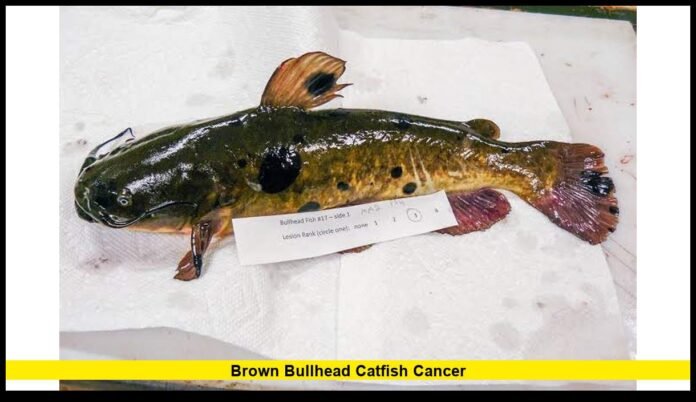

Brown bullhead catfish cancer has become one of the most important wildlife health discoveries of 2026 after scientists confirmed that a deadly skin tumor affecting fish in a North American lake is a naturally transmissible cancer. The finding has attracted worldwide attention because it marks the first time researchers have identified this type of contagious cancer in a fish species. The discovery is changing how experts study cancer, fish diseases, and the evolution of tumors in wild animal populations.
For years, researchers believed the unusual black growths found on brown bullhead catfish were caused by pollution, environmental stress, or an infectious organism. After conducting detailed genetic analyses, scientists reached a very different conclusion. Instead of finding separate tumors developing independently in each fish, they discovered that the cancer cells themselves move from one fish to another and continue growing inside a new host. That makes this disease one of only a handful of naturally occurring transmissible cancers ever identified in the animal kingdom.
A Discovery That Stands Out in Cancer Research
Cancer usually begins when normal cells inside one individual undergo genetic changes and start growing without control. Those cancer cells remain within that person’s or animal’s body and do not naturally spread to another individual.
The disease affecting brown bullhead catfish follows a completely different pattern.
Researchers found that the tumor itself behaves like an infectious biological lineage. Instead of each fish developing its own melanoma, the same cancer cells are passed from one fish to another, where they continue multiplying.
This type of cancer is exceptionally rare in nature. Scientists have documented only a few naturally transmissible cancers across all known animal species. The confirmation in brown bullhead catfish adds fish to that short list for the first time.
The discovery gives researchers a valuable opportunity to understand how cancer can survive, adapt, and spread over many generations while continuing to evade the immune systems of different hosts.
Where the Disease Was Identified
The transmissible melanoma has been confirmed in brown bullhead catfish living in Lake Memphremagog, a freshwater lake that stretches across the international border between Vermont in the United States and Quebec in Canada.
The lake has long supported healthy fish populations and recreational fishing. Around 2012, however, anglers and fisheries biologists began noticing fish with unusual dark patches covering portions of their bodies.
Some fish displayed only small black spots, while others had large raised tumors covering significant areas of the skin.
These abnormalities immediately drew scientific interest because they appeared in multiple fish throughout the lake rather than in isolated individuals.
Over several years, researchers continued monitoring affected fish to determine whether the condition represented an environmental problem, an infectious disease, or an unusual form of cancer.
Years of Research Led to the Answer
Finding the cause of the disease required patience and advanced scientific technology.
Scientists collected samples from both healthy fish and those carrying tumors. They carefully examined the tissue under microscopes and later analyzed the complete genetic material found inside the tumors.
The results revealed something unexpected.
If every fish had developed cancer independently, each tumor would closely match the DNA of its host fish.
Instead, the tumors shared nearly identical genetic characteristics regardless of which fish carried them.
This finding demonstrated that all of the cancers descended from the same original tumor that first developed years ago. Rather than forming independently, the cancer cells themselves have continued surviving by moving into new hosts.
That genetic evidence provided the strongest confirmation that researchers were observing a naturally transmissible cancer.
Why Scientists Once Believed Pollution Was Responsible
Brown bullhead catfish spend much of their lives near lake bottoms, where sediment collects.
Because pollutants often accumulate in sediment, these fish have traditionally served as environmental indicators. Scientists frequently study them to monitor the health of freshwater ecosystems.
When tumors first appeared, pollution seemed like a logical explanation.
Researchers considered whether industrial contaminants, agricultural runoff, or changing water conditions had triggered unusually high cancer rates.
Natural events, including severe flooding earlier in the decade, also received attention because floods can alter water quality and move contaminants into lakes.
Although environmental factors may still influence fish health, genetic research showed they could not explain why tumors from different fish shared the same biological origin.
The new evidence shifted scientific understanding from environmental causes alone to a transmissible cancer spreading through a population.
What Makes This Disease Different From Ordinary Cancer
Most cancers begin with new genetic mutations inside an individual.
Doctors and veterinarians treat those cancers as diseases unique to one patient.
The brown bullhead melanoma behaves differently.
Instead of creating new tumors from healthy cells, living cancer cells move into another fish and continue growing there.
Scientists describe this process as clonal transmission because every tumor belongs to the same original cancer lineage.
That means the cancer has effectively survived beyond the lifespan of its first host.
Rather than disappearing when the original fish died, the tumor continued existing by entering new fish and reproducing again and again.
This ability makes transmissible cancers remarkably unusual compared with almost every other known form of cancer.
Visible Signs Found in Affected Fish
Researchers observed several physical characteristics among infected brown bullhead catfish.
Many fish developed:
- Raised black skin lesions
- Dark patches spreading across the body
- Irregular melanoma growths
- Pigmented tumors of varying sizes
Some fish carried only a few lesions, while others displayed extensive tumor growth over large portions of their skin.
Scientists identified these tumors as melanoma, a cancer that develops from pigment-producing cells.
Unlike melanoma commonly discussed in humans, this disease affects fish skin and follows a very different biological pattern.
How Common Is the Disease?
Field surveys conducted over multiple years found a surprisingly high number of affected fish in Lake Memphremagog.
Researchers documented melanoma in a significant portion of the brown bullhead population during several sampling periods.
The consistently high number of cases strengthened the idea that researchers were observing an active disease process rather than isolated cancers developing randomly.
Continued monitoring showed that the condition remained present over many years instead of disappearing after a single season.
This long-term persistence also supported the conclusion that the same cancer lineage continued circulating within the fish population.
Researchers Looked for Other Possible Causes
Scientists carefully explored several explanations before reaching their final conclusion.
Among the possibilities investigated were:
- Viral infections
- Bacterial diseases
- Environmental contamination
- Water quality changes
- Chemical exposure
- Naturally occurring genetic mutations
Laboratory testing did not identify any virus or microbial organism consistently associated with the tumors.
The genetic evidence pointed overwhelmingly toward direct transmission of cancer cells rather than an infectious virus creating new cancers.
That distinction is important because the disease spreads through living tumor cells instead of another pathogen triggering cancer inside healthy fish.
Questions That Researchers Continue Investigating
Although scientists now understand the nature of the disease, several important questions remain unanswered.
Researchers are working to determine exactly how cancer cells pass from one fish to another.
Possible areas of investigation include:
- Contact between fish
- Skin injuries
- Open wounds
- Environmental exposure
- Seasonal influences
At this stage, scientists have confirmed that transmission occurs but have not identified the precise pathway responsible for moving cancer cells between fish.
Future studies are expected to focus heavily on answering this question.
Why Brown Bullhead Catfish Are Important to Scientists
Brown bullhead catfish are found throughout much of eastern North America.
They thrive in rivers, lakes, ponds, and reservoirs, making them one of the region’s familiar freshwater species.
Biologists have long relied on these fish to evaluate aquatic ecosystem health because they live close to lake sediments and remain in relatively small home ranges.
Changes affecting brown bullhead populations can provide valuable clues about environmental conditions.
The discovery of a transmissible cancer adds another reason why researchers consider this species scientifically valuable.
The fish now offer a unique opportunity to study cancer evolution in a natural environment rather than under laboratory conditions.
How This Changes Cancer Research
The discovery extends beyond fisheries science.
Cancer researchers around the world are interested because transmissible cancers remain among the rarest biological phenomena ever documented.
Studying this melanoma may improve understanding of several important questions, including:
- How cancer cells survive outside one host
- How tumors avoid immune rejection
- How cancer evolves over long periods
- Why transmissible cancers remain so uncommon
- How genetic changes accumulate over time
Every new finding helps scientists better understand how cancer behaves across different animal species.
Although the disease itself affects fish, the biological principles involved may influence future research in several fields of medicine and wildlife biology.
No Evidence of Risk to Humans
The discovery has naturally raised questions among anglers and people living near affected waters.
Current scientific evidence does not indicate that this cancer poses a risk to humans.
Researchers have found no evidence suggesting the disease spreads from fish to people.
Likewise, scientists have not confirmed transmission to other fish species living in the same lake.
The disease currently remains associated with brown bullhead catfish.
Wildlife agencies and researchers continue monitoring the situation to learn more about its distribution and long-term impact on fish populations.
A Timeline of the Discovery
The path toward understanding this disease developed over more than a decade.
2012: Anglers and researchers first noticed unusual black tumors on brown bullhead catfish.
Following years: Fisheries scientists documented increasing numbers of affected fish during field surveys.
Genetic investigations: Researchers collected tumor samples and compared DNA from healthy and diseased fish.
2026: Scientists confirmed that the melanoma represents the first naturally transmissible cancer identified in a fish species.
This timeline highlights how long-term monitoring and advances in genetic technology helped solve a biological mystery that remained unanswered for years.
What Makes This Finding Significant
Scientists discover new diseases regularly, but few reshape understanding of cancer itself.
The brown bullhead melanoma stands apart because it demonstrates that cancer can behave almost like a living organism capable of moving between hosts while maintaining the same genetic identity.
This challenges long-held assumptions about how cancers develop and spread in wild animal populations.
The discovery also suggests researchers may eventually identify similar diseases in additional species that have not yet been studied in enough detail.
As genomic technology continues improving, scientists are likely to uncover more information about rare diseases that previously went undetected.
Ongoing Monitoring Remains Essential
Researchers continue studying brown bullhead catfish in Lake Memphremagog to better understand how the disease behaves over time.
Future work will focus on monitoring fish populations, identifying transmission routes, measuring long-term impacts, and determining whether the cancer remains confined to one geographic area.
Those efforts will help wildlife biologists protect freshwater ecosystems while providing cancer researchers with valuable insights into one of the rarest forms of disease known in nature.
The confirmation of transmissible melanoma in brown bullhead catfish represents a major scientific milestone. It expands knowledge of cancer biology, strengthens wildlife disease research, and opens new opportunities for understanding how tumors evolve outside laboratory settings. As scientists continue investigating this remarkable disease, every new discovery will add to the growing understanding of one of the most unusual cancers ever documented.
What are your thoughts on this remarkable scientific discovery? Share your opinion in the comments and check back for the latest verified developments.