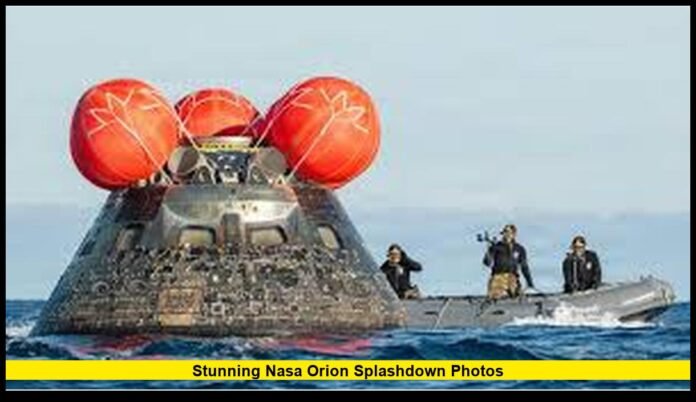

The latest nasa orion splashdown photos are drawing intense interest across the United States after a milestone moment in human space exploration. NASA’s Orion spacecraft completed a high-stakes return to Earth, splashing down in the Pacific Ocean following a crewed mission that carried astronauts around the Moon and back. The images released from the event showcase not only a successful landing, but also the precision, planning, and innovation driving the Artemis program forward.
The visuals tell a powerful story. From the first glimpse of parachutes opening high above the ocean to the final recovery of astronauts, every frame captures a historic achievement. These images are quickly becoming defining visuals of a new era in space exploration—one that aims to take humans farther than ever before.
Stay connected for continuing coverage of space missions and the next steps in America’s return to the Moon.
A High-Stakes Return From Deep Space
The Orion spacecraft’s journey back to Earth marked the conclusion of a mission that pushed both human endurance and engineering limits. After traveling hundreds of thousands of miles through deep space, the capsule approached Earth at speeds exceeding 24,000 miles per hour. The reentry phase is widely considered one of the most critical parts of any space mission, and this one was no exception.
As Orion entered the upper atmosphere, friction generated extreme heat, testing the spacecraft’s protective systems. The capsule followed a carefully calculated trajectory designed to manage heat buildup and maintain structural integrity. This phase required exact timing and flawless execution.
Once through the most intense part of reentry, Orion began its descent sequence. The parachute system deployed in stages, slowing the spacecraft dramatically and preparing it for a controlled ocean landing. The splashdown occurred in the Pacific Ocean off the California coast, where recovery teams were already in position.
Parachutes, Precision, and Perfect Timing
One of the most visually striking elements of the mission was the parachute deployment. The descent system used a sequence designed to ensure both safety and stability.
First, two drogue parachutes deployed to stabilize the spacecraft and reduce speed. Moments later, three large main parachutes opened, creating a dramatic visual against the sky. These parachutes slowed Orion to a safe landing speed before it touched the ocean surface.
The timing of each deployment is critical. Any delay or malfunction could significantly impact the landing. The success of this sequence is clearly visible in the photos, which show a smooth, controlled descent from high altitude to ocean splashdown.
The images also reveal how evenly the parachutes distributed the load, keeping the capsule balanced and upright as it approached the water.
Moments After Impact: What the Photos Reveal
After the spacecraft made contact with the ocean, another phase of the mission began. The capsule remained stable in the water thanks to an advanced flotation system. Inflatable structures automatically deployed to keep the spacecraft upright, even in shifting ocean conditions.
The nasa orion splashdown photos provide a close-up look at this phase. Water sprays upward at the moment of impact, followed by calmer scenes showing the capsule floating steadily on the surface. These visuals highlight how effectively the design handled the transition from air to sea.
Within minutes, recovery teams reached the capsule. Divers approached carefully, ensuring the spacecraft was secure before opening the hatch. The images show these teams working in coordination, moving with precision and purpose.
A Coordinated Recovery Operation
The recovery effort was a carefully planned operation involving multiple teams and support systems. A U.S. Navy ship served as the central recovery platform, supported by smaller boats and aircraft.
Divers were the first to reach Orion. Their initial tasks included checking for structural integrity, attaching stabilization equipment, and preparing the spacecraft for astronaut extraction. Communication between teams remained constant throughout the process.
Once conditions were confirmed safe, the hatch was opened. Each astronaut exited individually, assisted by trained personnel. Medical teams were on standby to conduct immediate health checks, ensuring that each crew member was in good condition after the journey.
Helicopters and onboard medical facilities provided additional support, demonstrating the level of preparation involved in every stage of the mission.
The Crew Behind the Mission
Four astronauts made the journey aboard Orion, representing a new generation of space explorers. Their mission marked the first crewed trip around the Moon in more than five decades.
The crew included experienced astronauts and international representation, reflecting the collaborative nature of modern space exploration. During the mission, they conducted system checks, captured images of Earth and the Moon, and gathered valuable data for future missions.
Their safe return is one of the mission’s greatest achievements. The images of astronauts emerging from the capsule, greeted by recovery teams, capture a moment of both relief and celebration.
Heat Shield Performance Under Extreme Conditions
One of the mission’s most important technical objectives was to evaluate Orion’s heat shield. During reentry, temperatures around the spacecraft reached thousands of degrees, creating conditions intense enough to melt most materials.
The heat shield is designed to absorb and dissipate this heat, protecting the crew inside. Early observations following splashdown show that the shield performed exceptionally well.
Images taken after landing reveal a surface that withstood the extreme conditions with minimal damage. This performance confirms that design improvements made since earlier test flights are working as intended.
The success of the heat shield is essential for future missions, especially those that will involve longer durations and more complex trajectories.
Why the Splashdown Images Matter
The release of these images goes beyond visual impact. They serve as a critical tool for engineers, scientists, and mission planners.
Each photo provides data points that can be analyzed to improve future missions. Engineers study parachute behavior, splashdown angles, and recovery timelines using these visuals. Even small details captured in the images can lead to meaningful refinements.
For the public, the photos offer a rare look at the realities of space travel. They bring viewers closer to the experience, transforming complex engineering into something tangible and relatable.
Public Engagement and National Interest
Across the country, the splashdown captured widespread attention. Many Americans followed the event through live broadcasts and updates, eager to witness a moment that connects directly to the nation’s history of space exploration.
The images quickly gained traction online, with people sharing and discussing the mission’s significance. For many, the visuals represent more than just a successful landing—they symbolize progress, ambition, and a renewed commitment to exploration.
This level of public engagement plays an important role in sustaining support for future missions and inspiring the next generation of scientists and engineers.
A Critical Step Toward Future Lunar Landings
The successful completion of this mission sets the stage for the next phase of exploration. It demonstrates that the systems required for deep-space travel are functioning as expected.
Future missions aim to build on this success, with plans to land astronauts on the Moon and eventually establish a sustained human presence. The lessons learned from this mission—including those documented in the splashdown imagery—will guide these efforts.
Every successful test, every safe return, and every image captured brings NASA closer to achieving its long-term goals.
Technology, Teamwork, and Precision
What stands out most in this mission is the combination of advanced technology and human expertise. The spacecraft’s systems, the recovery operation, and the coordination between teams all contributed to the successful outcome.
The photos highlight this collaboration. They show not just a spacecraft returning to Earth, but a network of professionals working together to make that return possible.
From engineers designing the capsule to recovery crews in the ocean, each role played a part in the mission’s success.
Looking Ahead to the Next Milestone
With Orion safely back on Earth, attention now turns to future missions. Preparations are already underway for the next steps in the Artemis program, which aim to expand human presence beyond Earth orbit.
The insights gained from this mission will influence everything from spacecraft design to mission planning. The images captured during splashdown will continue to be analyzed, providing valuable information for years to come.
The journey is far from over. In many ways, this mission represents a beginning—a foundation for the next era of exploration.
What are your thoughts on this historic splashdown and the future of lunar exploration? Share your perspective and stay tuned for more updates as space exploration continues to evolve.