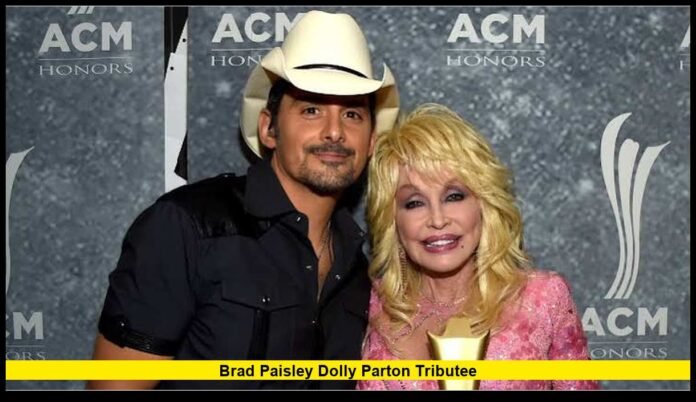

The brad paisley dolly parton tribute has emerged as one of the most emotional musical moments following Dolly Parton’s death, with Paisley returning to the stage to perform their beloved song “When I Get Where I’m Going” without the woman whose voice helped make the recording unforgettable. The performance carried an especially powerful meaning because Parton died at 80 on August 25, 2026, after a brief battle with cancer. Her death has triggered an extraordinary wave of remembrance across country music and beyond.
Paisley’s decision to revisit a song he originally recorded with Parton transformed a familiar country hit into something much more personal. The performance was not simply a rendition of an old favorite. It became a farewell to a friend, collaborator and defining figure in American music.
Brad Paisley Returns to the Stage After Dolly Parton’s Death
Paisley performed “When I Get Where I’m Going” during his August 27 concert in Bridgeport, Connecticut. The timing made the appearance particularly significant because it was his first show following Parton’s death.
Instead of recreating the original duet, Paisley sang the song alone. That change was impossible to overlook. Parton’s harmonies had been an essential part of the original recording, so hearing Paisley perform the song without her gave the familiar melody an entirely different emotional weight.
According to reports from the performance, Paisley struggled to contain his emotions while singing. The audience also responded to the moment with the kind of attention usually reserved for a deeply personal tribute rather than an ordinary concert song.
The choice of material was important. Paisley could have selected any of Parton’s countless classics, but “When I Get Where I’m Going” was the song that directly connected the two artists.
It was their song.
Why “When I Get Where I’m Going” Was the Perfect Choice
Released in the mid-2000s, “When I Get Where I’m Going” became one of the most recognizable collaborations of Paisley’s career. Parton joined him on the recording, providing the distinctive vocal presence that helped give the song its emotional character.
The song focuses on the hope of reaching a peaceful place beyond earthly struggles. Its themes involve leaving behind pain, finding freedom and looking forward to a destination where life’s difficulties no longer have the same power.
Those ideas inevitably sound different after Parton’s death.
A song that once represented faith and hope in the abstract now has a deeply personal association for listeners who admired Parton. Paisley’s performance made that connection even stronger because he was singing a composition that audiences already associated with the two performers together.
The song’s message also explains why it has quickly become one of the most meaningful pieces of music connected with Parton’s passing.
Paisley and Parton Shared a Special Musical Connection
Paisley and Parton represented different generations of country music, but their collaboration demonstrated how naturally the genre’s past and present could come together.
Paisley emerged as one of the leading stars of contemporary country music, known for his guitar playing, songwriting and often humorous approach to country storytelling. Parton, meanwhile, had already spent decades establishing herself as a songwriter, recording artist, actress, businesswoman and philanthropist.
Their collaboration gave Paisley an opportunity to work with one of the most influential performers in the history of country music.
For Parton, it was another example of her ability to connect with younger generations of artists without losing the qualities that had defined her own career.
The partnership also became personal away from the recording studio.
Paisley’s wife, actress Kimberly Williams-Paisley, had her own connection with Parton. Williams-Paisley recently recalled working with the country icon on the anthology series Dolly Parton’s Heartstrings and remembered her as extraordinarily talented, generous and approachable.
That history adds another layer to the grief surrounding Paisley’s recent performance.
Brad Paisley’s Emotional Response to Parton’s Death
Following the news of Parton’s death, Paisley shared an emotional remembrance of the singer.
His reaction reflected the disbelief felt by many people who had grown up viewing Parton as an almost permanent part of American culture.
For generations of fans, Parton seemed larger than life. She was not simply a performer who appeared on radio stations and television programs. Her personality, appearance, humor, songwriting and philanthropy made her one of the rare celebrities recognized around the world.
Paisley’s tribute reflected that extraordinary status while also emphasizing the personal relationship he had with her.
He remembered the impact she had on his life and described her as a person whose presence seemed almost timeless.
That sentiment became especially poignant when he stood on stage just days later and sang their signature collaboration.
Dolly Parton’s Death Has Reshaped the Meaning of Her Music
Parton’s death has led millions of listeners back to her catalog.
Streaming activity surged dramatically after the news of her passing, with songs including “Jolene,” “9 to 5” and “I Will Always Love You” attracting renewed attention. Her music has once again become a soundtrack for people remembering different periods of her extraordinary career.
But “When I Get Where I’m Going” occupies a unique position because of its connection to Paisley.
Parton’s voice is inseparable from the original recording. Her presence helped make the song a memorable collaboration, while its spiritual themes have made it particularly suitable for remembrance following her death.
Paisley’s solo performance therefore created a striking contrast.
The original version celebrated two voices together. The live tribute presented one voice carrying a song that once belonged to both performers.
That difference was enough to make the performance feel like a genuine farewell.
A Song That Had Already Been Used in a Tribute Earlier in 2026
There is another remarkable chapter in the history of Paisley’s relationship with the song.
Earlier in 2026, Paisley performed “When I Get Where I’m Going” as a tribute to NASCAR figure Kyle Busch during a difficult period for the racing community.
That earlier performance demonstrated how the song could function as a memorial piece even before Parton’s death.
Now, after losing Parton herself, the same song carries another and even more personal meaning for Paisley.
The coincidence has made the song one of the defining emotional pieces of his 2026 performances.
Dolly Parton’s Influence Went Far Beyond Country Music
Parton’s cultural influence was never limited to country radio.
Over a career spanning more than six decades, she became a successful songwriter, recording artist, actress, author, entrepreneur and philanthropist.
Her catalog includes songs that became standards far beyond country music. “I Will Always Love You” became a worldwide phenomenon after Whitney Houston recorded it for The Bodyguard. “9 to 5” became both a hit song and an enduring cultural reference. “Jolene” remains one of the most recognizable country songs ever written.
Her business career was equally remarkable.
Parton helped build Dollywood into a major Tennessee attraction, turning the theme park into an important part of the state’s tourism industry while maintaining a close connection to the Appalachian culture that shaped her childhood.
Her philanthropic work also became a central part of her public legacy.
Through Dolly Parton’s Imagination Library, millions of children have received books. Her support for education, literacy and medical research expanded her influence beyond entertainment.
That broader legacy is part of why tributes to Parton have come from such a wide range of communities.
Parton’s Legacy Is Also About Generosity
Many of the tributes following Parton’s death have focused not only on her music but also on her kindness.
Colleagues frequently described her as generous with her time, encouraging toward younger performers and committed to helping people in need.
That reputation was reinforced by her philanthropic projects.
Parton understood the power of celebrity but used it in ways that extended beyond promoting her own career. Her literacy program became one of the most visible examples of that philosophy.
The result is a legacy that cannot be measured simply through chart positions, awards or record sales.
For Paisley, however, the most personal part of that legacy may always be the friendship they developed through music.
Why Paisley’s Tribute Has Resonated With Fans
Tributes are often powerful because they reveal the relationship between the person performing and the person being remembered.
Paisley’s performance worked on several levels.
For casual listeners, it was an emotional performance of a familiar country song.
For longtime Paisley fans, it was a tribute from an artist who had shared an important recording with Parton.
For Parton’s longtime audience, it was an opportunity to hear one of her most meaningful collaborations at a moment when her absence was still new.
The performance also avoided unnecessary spectacle.
Paisley did not need an elaborate production to communicate the emotion of the moment. The song itself provided the message.
That simplicity likely contributed to its impact.
Dolly Parton’s Final Chapter Is Being Written Through Her Music
Parton’s death has created an enormous wave of public mourning, but her music continues to provide a way for audiences to celebrate her life.
Her recordings remain available to new listeners, while longtime fans are returning to songs that have accompanied them for decades.
That process is already visible in the dramatic increase in streaming activity surrounding her catalog.
It is also visible at concerts, where musicians are choosing Parton’s songs to express their grief.
Paisley’s choice stands apart because he was not merely performing a Parton classic. He was returning to a song they created together.
That distinction gives his tribute a personal authenticity.
What Brad Paisley’s Tribute Says About Dolly Parton’s Legacy
The most striking part of Paisley’s performance may be what it says about Parton’s place in country music.
She was able to work with artists from multiple generations and make those collaborations feel natural.
Paisley was one of many performers influenced by her career, but he also became one of the artists fortunate enough to share a recording with her.
That recording has now become a lasting piece of their shared history.
As Paisley continues his 2026 tour, fans will undoubtedly watch for additional moments in which he remembers Parton. Whether “When I Get Where I’m Going” becomes a regular part of his upcoming performances remains to be seen, but the Connecticut performance has already established an emotional benchmark.
A Lasting Musical Farewell
Dolly Parton leaves behind a body of work that will continue to be performed, streamed and rediscovered for decades.
Her songs have survived changing musical trends because they are rooted in universal subjects: love, heartbreak, ambition, family, faith, hardship and hope.
“When I Get Where I’m Going” now belongs to that legacy in an especially poignant way.
For Brad Paisley, the song is a reminder of someone who was both a musical icon and a personal friend. For listeners, his performance offered a chance to mourn Parton while celebrating the music they created together.
The image of Paisley standing on stage and singing a song once shared with Parton captures the complicated emotions surrounding her death. There is sadness in the absence of her voice, but there is also gratitude that the recording exists and can continue carrying her voice to future generations.
Parton may no longer be able to join Paisley for the song, but her contribution to it remains permanent.
And that may be the most fitting tribute of all: allowing the music they made together to continue speaking for them.
What are your thoughts on Brad Paisley’s emotional tribute, and which Dolly Parton song means the most to you? Share your memories and keep following for more updates on her enduring musical legacy.
Key Points Summary
╔════════════════════════════════════════════════════════════════════╗
║ – Brad Paisley performed “When I Get Where I’m Going” alone during his first concert after Dolly Parton’s death. ║
║ – Dolly Parton died at age 80 on August 25, 2026, following a brief battle with cancer. ║
║ – Paisley and Parton originally recorded the song together, making his recent performance especially personal. ║
║ – The song’s themes of hope, faith and reaching a peaceful destination have taken on deeper meaning after Parton’s passing. ║
║ – Parton’s influence continues through her music, philanthropy, business legacy and generations of artists she inspired. ║
╚════════════════════════════════════════════════════════════════════╝