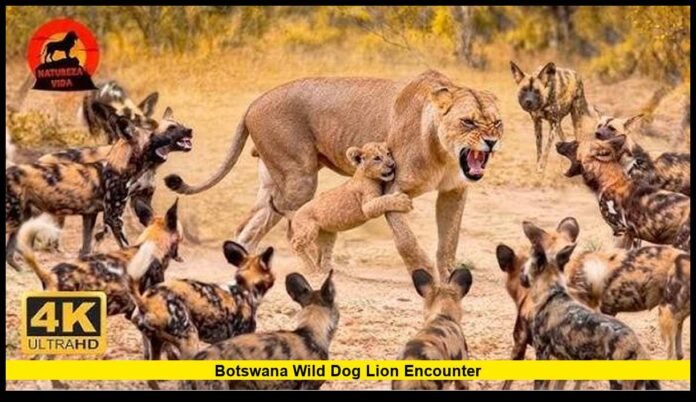

The Botswana wild dog lion encounter captured a rare and brutal moment in nature when an African wild dog ran directly into a pride of lions while pursuing an impala in Botswana’s Khwai region. The dramatic sighting occurred on July 20, 2017, and later became widely viewed through wildlife footage online. Although the dog escaped the immediate attack, its injuries proved fatal weeks later.
The incident continues to attract attention because it shows how quickly the balance between predators can change. One moment, the wild dog was chasing prey. Seconds later, it was fighting for survival against a much larger carnivore.
For viewers seeing the footage today, the date deserves emphasis. This was not a newly recorded 2026 confrontation. The original encounter happened in 2017, even though the footage and story have continued to resurface online.
Where the Dramatic Encounter Happened
The confrontation took place in the Khwai Community Concession of northern Botswana, near the greater Okavango Delta and Moremi ecosystem.
The region supports an exceptional variety of wildlife. Lions and African wild dogs share this landscape with leopards, spotted hyenas and numerous prey species.
Klaus Boehmer witnessed the encounter while on safari with his daughter, Kira. Their guide was taking them toward a wild dog den when activity around several safari vehicles caught their attention.
The group changed direction to investigate.
They found a lion pride gathered around a wildebeest kill. Two adult male lions were present along with lionesses and cubs.
At first, the scene appeared relatively settled.
That changed when an impala came racing toward the lions.
Two Wild Dogs Were Chasing an Impala
Two African wild dogs followed closely behind the fleeing impala.
Wild dogs are specialized pursuit hunters. They use endurance, speed and cooperation to chase prey over considerable distances.
During an intense pursuit, their attention naturally centers on the animal ahead.
That focus placed the dogs in serious danger.
The lions noticed them approaching. Instead of simply watching the chase pass by, the lions reacted to the incoming wild dogs.
One dog recognized the threat and avoided the pride.
The other ran into the danger zone.
An adult male lion immediately attacked.
Within seconds, the wild dog went from predator to potential victim.
The Male Lion Overpowered the Wild Dog
An individual African wild dog has little chance of physically overpowering an adult male lion.
Lions possess a massive advantage in body size and strength. Wild dogs rely far more heavily on pack coordination, stamina and mobility.
Once the lion caught the dog, the confrontation appeared to be over.
The wild dog stopped moving.
For the safari observers, the situation looked grim. The lion had delivered a violent attack, and the dog appeared lifeless.
Eventually, the lion relaxed its attention.
Then something unexpected happened.
The wild dog lifted its head.
It had survived.
Did the Wild Dog Play Dead?
The footage became famous partly because viewers interpreted the dog’s behavior as “playing dead.”
That description makes the sequence easy to understand, but the video cannot establish exactly why the injured animal remained motionless.
The dog had just experienced severe physical trauma. Injury and shock could have contributed to its lack of movement.
What is visible is remarkable enough without assigning a precise intention.
The wild dog remained still while the lion stayed nearby. Once the lion’s attention shifted, the injured animal began showing signs of life.
It did not immediately make a reckless escape attempt.
Instead, the dog waited.
That delay gave it a small opportunity to survive the immediate confrontation.
A Dangerous Escape Attempt
The lion eventually moved away from the injured dog.
The wild dog cautiously raised its head and assessed its surroundings.
Its injuries were already serious, so escaping required more than simply outrunning the lion. The animal needed enough distance before the pride reacted.
When the opportunity came, the dog got back onto its feet and fled.
One of the male lions noticed.
The lion gave chase, creating another tense moment for the injured animal.
Despite its condition, the wild dog managed to get away from the immediate pursuit.
For anyone watching only that portion of the video, the escape could easily look like a complete survival story.
The events that followed reveal a much more difficult outcome.
The Wild Dog Returned to Its Pack
The injured animal later reached the wild dog den area.
Its return demonstrated that it had survived both the initial attack and the subsequent chase.
However, its physical condition was poor.
The dog had significant injuries involving its hind leg and rib area. After reaching the pack, it collapsed.
African wild dogs have highly cooperative social structures. Pack members regularly share food and help support other members of their group.
The injured dog received attention from its pack mates.
They attempted to provide food, but the animal would not eat.
Its inability to recover became increasingly serious.
The Escape Was Not the End of the Story
The dog survived longer than viewers might expect after seeing the violence of the lion attack.
However, the damage ultimately proved too severe.
The animal survived for several weeks before dying from its injuries.
That fact provides essential context for the viral footage.
The wild dog did escape the lions alive, but it did not make a lasting recovery.
Its survival for several weeks nevertheless demonstrates the toughness of African wild dogs. These animals live in environments where injuries, competition and demanding hunts form part of everyday existence.
The incident also demonstrates why encounters with lions pose such a major threat.
Why Lions and Wild Dogs Come Into Conflict
The Botswana wild dog lion encounter was not simply a case of one predator hunting another for food.
Lions and African wild dogs occupy some of the same landscapes and can target overlapping prey.
That creates competition.
Lions represent one of the important natural threats to wild dogs. They can kill adult dogs as well as vulnerable pups.
Wild dogs therefore have strong reasons to avoid close contact with lions.
In this particular case, the lions already had access to a wildebeest carcass. The wild dogs arrived while pursuing an impala.
The resulting confrontation illustrates how competition between carnivores can trigger aggression even when food is already available.
Why the Wild Dogs Ran Toward the Lions
Wild dogs normally benefit from recognizing lions early and keeping their distance.
The circumstances here were unusual.
The two dogs were moving rapidly behind an impala. A high-speed chase gave them little time to respond once they entered the area occupied by the pride.
The second dog managed to avoid being caught.
The lead dog did not.
That difference shows how a few seconds can determine the outcome of a wildlife encounter.
The impala pursuit effectively led the wild dog into a far greater danger than the prey animal it was chasing.
Wild Dogs Depend on Teamwork
African wild dogs rank among Africa’s most effective cooperative hunters.
Rather than depending on the overwhelming individual strength seen in lions, they benefit from teamwork.
Pack members chase prey together and can maintain pursuits over long distances. Their social cooperation also extends beyond hunting.
Dogs help raise pups, defend the group and share food.
That social structure became visible after the injured animal returned.
Its pack mates attempted to feed it during its recovery period.
The support was not enough to save the dog, but the behavior highlights how strongly pack life shapes African wild dog survival.
Lions Hold a Major Physical Advantage
A direct one-on-one fight between an adult lion and an African wild dog is extremely uneven.
Wild dogs are built for movement and endurance.
Lions combine speed with considerably greater strength and body mass.
Wild dogs can sometimes confront larger predators as a group, particularly when defending pack members. Still, avoiding a close encounter with lions usually offers a safer option.
The Khwai incident demonstrates why.
The dog survived the first attack partly because the lion eventually reduced its attention. Had the confrontation continued, the animal might never have had an opportunity to escape.
Why Botswana Matters for African Wild Dogs
Botswana remains one of the most important countries for observing and protecting African wild dogs.
Northern Botswana contains large wildlife areas that allow predators to move across substantial distances.
The broader Okavango landscape supports lions, wild dogs, leopards, spotted hyenas and other carnivores alongside abundant prey populations.
These connected habitats are particularly important for wild dogs.
Packs travel widely and require extensive territories. Fragmented habitat can make their survival more difficult by limiting movement and increasing other risks.
Botswana has also become an important center for long-term research into wild dog ecology.
Scientists have spent decades studying pack behavior, reproduction, movement, survival and competition with other predators.
Wild Dogs Face More Than One Threat
Lion attacks represent only one challenge for African wild dogs.
The species also faces habitat loss and fragmentation in parts of its range. Disease can threaten populations, while conflict near human settlements can create additional problems.
Competition with other carnivores adds another layer of pressure.
Spotted hyenas can compete with wild dogs over kills. Lions pose a more direct physical threat because they can kill dogs and their pups.
For wild dog packs, survival therefore depends on more than successful hunting.
They must find food, protect young animals, maintain social groups and navigate landscapes occupied by larger predators.
The Khwai confrontation captured several of those pressures in a matter of minutes.
Why the Video Still Captures Attention
Wildlife footage can resurface repeatedly online.
A dramatic clip may appear on social platforms years after the original event, sometimes without a visible date.
That can make an old sighting look new.
The Botswana footage has remained compelling because its sequence contains several unexpected reversals.
First, viewers see wild dogs chasing an impala.
Then a lion attacks one of the dogs.
The animal appears motionless.
Next, it suddenly reveals that it survived and attempts an escape.
Finally, the full history shows that its injuries later proved fatal.
Few wildlife encounters contain so many changes in such a short period.
Why the Original Date Is Important in 2026
As of July 30, 2026, the verified Khwai incident should still be described as a July 20, 2017 sighting.
Its continued presence on social media does not change when it happened.
This distinction matters for anyone trying to understand viral wildlife content.
Videos can gain new audiences years after recording. Reposts can remove dates and other details that once accompanied the original footage.
In this case, the underlying encounter remains significant without presenting it as new.
The event offers a documented look at interactions between two of Africa’s most fascinating social predators.
The Encounter Shows the Reality of Predator Competition
Nature documentaries often show predators pursuing prey, but interactions between competing predators can be equally dramatic.
Lions and African wild dogs have different hunting strategies and social structures.
Both can occupy the same ecosystems.
When their paths cross, the size advantage of a lion can quickly become decisive.
The Botswana encounter demonstrates that reality with unusual clarity.
The wild dog entered the area as a hunter. It left badly injured after narrowly escaping a much stronger predator.
Its pack then tried to support it.
Weeks later, the injuries ended its life.
A Remarkable Wildlife Moment With a Sobering Ending
The full story behind the Botswana encounter is more complicated than a simple tale of an animal successfully fooling a lion.
An African wild dog pursued an impala into a lion pride’s location. A male lion attacked and severely injured the dog. The animal remained motionless, survived the immediate confrontation and later found an opportunity to flee.
It eventually returned to its pack.
Despite surviving the initial attack, its injuries prevented a full recovery. The wild dog died several weeks later.
That ending does not diminish the extraordinary nature of its escape. Instead, it illustrates how dangerous life can be for wild predators sharing the same landscape.
The encounter also highlights the importance of Botswana’s large connected wildlife areas. These ecosystems allow natural interactions between lions, wild dogs and their prey to continue largely as they have for generations.
Years after the sighting, the footage remains an unforgettable example of how quickly predator and prey roles can change in the African wilderness.
What part of this remarkable wildlife encounter surprised you most? Share your thoughts and stay tuned for more verified updates from the natural world.