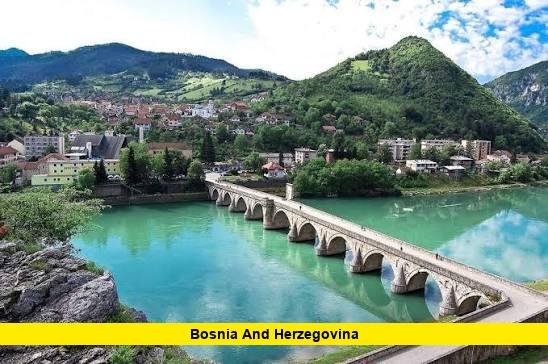

Bosnia and Herzegovina, a small but historically rich country in the heart of the Balkans, continues to draw global attention in 2026 for reasons ranging from politics to football. Nestled between Croatia, Serbia, and Montenegro, Bosnia and Herzegovina is a country of striking contrasts: medieval towns and Ottoman-era bridges sit alongside a modern state still working through the long aftermath of war, while its national football team has just made history on the world’s biggest sporting stage. Whether you are researching its geography, its politics, its culture, or its recent World Cup run, this guide brings together the most important and up-to-date information about Bosnia and Herzegovina.
Geography and Basic Facts
Bosnia and Herzegovina sits in Southeast Europe, sharing borders with Croatia to the north and west, Serbia to the east, and Montenegro to the southeast. It has a short but important coastline along the Adriatic Sea near the town of Neum. The country is divided into two main regions historically known as Bosnia, the larger northern and central area, and Herzegovina, the smaller southern region known for its warmer climate and vineyards.
The country’s population is approximately 3.3 million people, and it is home to three main ethnic and constituent groups: Bosniaks, who are predominantly Muslim; Bosnian Serbs, who are predominantly Orthodox Christian; and Bosnian Croats, who are predominantly Roman Catholic. This diversity is central to understanding both the culture and the political structure of Bosnia and Herzegovina.
Sarajevo, the capital, is the country’s largest city and cultural hub. Other major cities include Banja Luka, the administrative center of Republika Srpska, and Mostar, famous for its Ottoman-era Old Bridge, a UNESCO World Heritage Site.
Historical Background
Bosnia and Herzegovina’s modern identity cannot be separated from its complex history. For centuries, the region was ruled by the Ottoman Empire, followed by Austro-Hungarian administration in the late nineteenth century. It later became part of the Kingdom of Yugoslavia and then the Socialist Federal Republic of Yugoslavia after World War II.
The most defining and painful chapter in the country’s recent history was the Bosnian War, which lasted from 1992 to 1995 following the breakup of Yugoslavia. The conflict was the deadliest of the wars of Yugoslav succession and resulted in widespread displacement, destruction, and atrocities, including events later recognized internationally as genocide. The war ended with the Dayton Peace Agreement, which established the framework for the country that exists today.
Under the Dayton Agreement, Bosnia and Herzegovina became a decentralized state made up of two main entities: the Federation of Bosnia and Herzegovina, largely inhabited by Bosniaks and Croats, and Republika Srpska, largely inhabited by Bosnian Serbs. A small, self-governing area known as the Brčko District operates separately from both entities. This power-sharing structure was designed to end the conflict and give each constituent group a degree of autonomy, but it also created a famously complex and, at times, dysfunctional system of governance.
Political Structure and Current Affairs
Bosnia and Herzegovina operates under a consociational democracy, meaning that political power is deliberately shared among its three constituent peoples through mutual veto rights, coalition governments, and proportional representation. The country has a rotating tripartite presidency, with one Bosniak, one Croat, and one Serb member sharing executive authority.
Overseeing implementation of the Dayton Agreement is the Office of the High Representative, an international body with the authority to enforce decisions when domestic institutions fail to act. This office remains a significant and sometimes controversial part of Bosnian politics, particularly regarding tensions with Republika Srpska leadership. In recent years, political friction has centered on figures within Republika Srpska who have challenged the legitimacy of state-level institutions, prompting legal action and international sanctions aimed at preserving the country’s constitutional order.
Despite these tensions, Bosnia and Herzegovina’s economy and society have gradually moved beyond the immediate post-war period, even as ethnic and political divisions persist. European Union accession remains the country’s primary long-term goal, and while it holds candidate status, further progress depends on reforms related to the rule of law, anti-corruption measures, and economic modernization. The path to full EU membership is widely viewed as gradual, with political consensus among the three constituent groups seen as essential to moving forward.
Economy and Everyday Life
Bosnia and Herzegovina has a mixed economy that includes manufacturing, agriculture, energy production, and a growing services sector. The country exports goods such as metals, machinery, textiles, and furniture, while also relying on remittances from a large diaspora community living abroad. Unemployment and emigration, particularly among younger generations seeking opportunities in Western Europe, remain ongoing economic challenges.
Tourism has become an increasingly important part of the Bosnian economy. Sarajevo, once known primarily for the 1984 Winter Olympics and later for the siege it endured during the war, has reinvented itself as a vibrant destination blending Ottoman, Austro-Hungarian, and modern European influences. Mostar’s Old Bridge remains one of the most photographed landmarks in the Balkans and a symbol of the country’s postwar reconciliation. Meanwhile, the mountainous regions around Bjelašnica and Jahorina continue to attract skiers and outdoor enthusiasts.
Bosnia and Herzegovina on the World Stage: The 2026 FIFA World Cup
One of the biggest stories surrounding Bosnia and Herzegovina in 2026 has nothing to do with politics and everything to do with football. The Bosnian national team, nicknamed the Dragons, qualified for only the second FIFA World Cup appearance in the country’s history, and did so in dramatic fashion. After finishing second in their European qualifying group, Bosnia and Herzegovina had to navigate the playoff route, defeating Wales on penalties in the semifinal before stunning four-time world champions Italy, also on penalties, to secure their place at the tournament.
The team’s run to the World Cup captured national imagination back home, with celebrations stretching from Zenica to Sarajevo. Longtime head coach Sergej Barbarez, a former Bundesliga striker nicknamed the “Bosnian Diamond” during his playing days, guided the squad through qualifying and into the tournament in the United States, Mexico, and Canada.
In the group stage, Bosnia and Herzegovina showed resilience, opening their campaign with a draw against Canada before suffering a heavy defeat to Switzerland. The team responded with a strong 3-1 win over Qatar in their final group match, which was enough to send them through to the Round of 32 as one of the best third-placed teams, marking the first time in the nation’s history that it reached the knockout stage of a World Cup. Veteran striker Edin Džeko, still leading the line for the Dragons, and dynamic wingers such as Kerim Alajbegović have been central to the team’s attacking identity throughout the tournament.
The achievement resonated far beyond football circles. A song by the Bosnian band Dubioza Kolektiv became an unofficial anthem for supporters following the team throughout the World Cup, reflecting a wave of national pride around the squad’s historic run. In the Round of 32, Bosnia and Herzegovina faced host nation the United States in Santa Clara, California, a matchup that underscored just how far the program has come since qualifying for its first-ever World Cup back in 2014.
Culture, Identity, and Public Interest
Bosnia and Herzegovina’s cultural identity reflects centuries of overlapping influences. Sarajevo is often described as a meeting point between East and West, home to mosques, Catholic and Orthodox churches, and a historic synagogue standing within walking distance of one another. This multi-religious heritage, while a source of past conflict, is also central to the country’s cultural richness and remains a point of pride for many residents.
The Sarajevo Film Festival has grown into one of the most respected film events in Southeast Europe, drawing filmmakers and audiences from across the continent each summer. Bosnian cuisine, influenced heavily by Ottoman traditions, features dishes such as ćevapi, burek, and Bosnian coffee, all of which remain deeply embedded in daily social life.
Public interest in Bosnia and Herzegovina internationally often centers on two very different themes: the unresolved political legacy of the 1990s conflict and, increasingly, moments of national celebration like the football team’s World Cup breakthrough. Both threads illustrate a country that continues to balance a difficult past with an evolving, more optimistic present.
Final Thoughts
Bosnia and Herzegovina remains a country defined by resilience. Its political system, shaped by the scars of war and the compromises of the Dayton Peace Agreement, continues to face real challenges, particularly around governance and its long path toward European Union membership. At the same time, the country’s cultural vibrancy, from Sarajevo’s layered history to Mostar’s iconic bridge, continues to draw visitors and admiration from around the world.
The historic achievements of the national football team in 2026 have added a new and unifying chapter to the country’s story, showing a different side of Bosnia and Herzegovina to a global audience. As the country continues to navigate its political complexities and pursue closer ties with Europe, moments like this World Cup run serve as a reminder of the pride and potential that still define Bosnia and Herzegovina today.
Stay tuned for more updates on Bosnia and Herzegovina, and feel free to share your thoughts in the comments below.