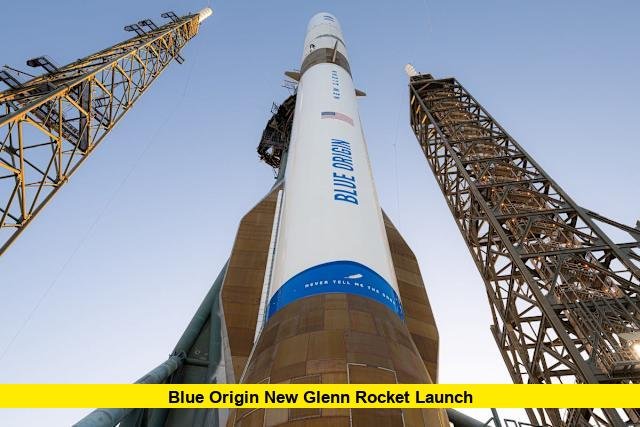

The Blue Origin New Glenn rocket launch on November 13, 2025, became one of the most important U.S. spaceflight milestones of the year. Within the first minutes of liftoff, the massive two-stage rocket soared from Cape Canaveral, delivered NASA’s twin ESCAPADE spacecraft toward their deep-space journey, and completed a smooth booster landing that immediately placed Blue Origin in a stronger competitive position within the heavy-lift launch market.
Below is a greatly expanded, fresh, and fully detailed account of the mission, written with clarity, accuracy, and a natural flow while staying centered exclusively on the key phrase.
A Major Step Forward for Reusable Heavy-Lift Flight
The New Glenn rocket stands out because of its size, capability, and design philosophy. At around 321 feet tall, it is one of the largest U.S. rockets currently flying. Its reusable first stage has long been advertised as a game-changing component for reducing launch costs and increasing cadence.
When the reusable booster separated just minutes after liftoff and began its guided return toward the Atlantic Ocean landing barge, Blue Origin crossed into a new era: proving that its heavy-lift vehicle could launch a deep-space mission and still recover the booster intact. This was a major technical achievement and the most important highlight of the Blue Origin New Glenn rocket launch.
Precision Liftoff and a Clean Ascent
Liftoff occurred mid-afternoon under favorable conditions at Cape Canaveral Space Force Station. The countdown had been adjusted earlier due to weather constraints and space-weather advisories, but when the window opened and winds cooperated, New Glenn ignited its BE-4 engines and climbed cleanly through Florida skies.
Shortly after launch:
- The first stage completed a nominal ascent.
- Stage separation occurred minutes into flight.
- The upper stage continued carrying the ESCAPADE payloads to the planned trajectory.
Everything about the early flight path demonstrated that the vehicle had matured since its debut earlier in the year. Engineers watching from mission control reported smooth communication links and stable performance across all major flight systems.
Booster Recovery: A Turning Point for New Glenn
The landing sequence was central to the mission’s significance. After separating, the first stage reoriented for descent and executed a series of controlled burns to reduce speed and align with the landing barge stationed more than 350 miles downrange in the Atlantic Ocean.
The touchdown itself was firm, centered, and steady—exactly the outcome Blue Origin had spent years preparing for. The company’s ambitions depend heavily on achieving rapid, reliable booster reuse, and this return landing validated the engineering behind its reusability architecture.
The recovered booster will now undergo inspection and refurbishment, with the goal of flying again on an upcoming mission.
Payload: A Science-Driven Mission to Mars
The payload on board this Blue Origin New Glenn rocket launch consisted of NASA’s twin ESCAPADE spacecraft. These identical probes will study Mars’ magnetosphere and help answer long-standing questions about how the Red Planet lost most of its atmosphere.
The spacecraft’s deployment occurred roughly half an hour after liftoff, and the satellites separated smoothly from the upper stage. Their long journey will involve months of looping, high-altitude Earth orbits before transitioning onto a Mars-bound trajectory.
This mission demonstrates New Glenn’s ability to support NASA’s scientific objectives, not just commercial clients. For Blue Origin, that capability opens the door to more federal contracts and expands its relevance beyond space-tourism-related activity.
New Glenn’s Engineering and Design Highlights
BE-4 Engine Power
The rocket’s BE-4 engines—running on liquefied natural gas and liquid oxygen—give New Glenn its distinctive power and efficiency. These engines have been central to the vehicle’s long development timeline, and their performance on launch day reinforced confidence in their reliability for future flights.
A Large, Flexible Fairing
New Glenn’s 7-meter fairing allows it to carry heavy and bulky payloads. This fairing size can accommodate satellites and mission components that many smaller rockets simply cannot support.
Built for Reuse
The first stage is designed for 25 flights, though the exact number may change as real-world testing progresses. Reusability will reduce the cost of large-scale missions once Blue Origin completes multiple booster refurbishment cycles.
A Pathway to Commercial Constellations
With its lift capacity and spacious fairing, New Glenn is positioned to carry multi-satellite batches for commercial operators—something vital for broadband constellation providers and next-generation space-based communication systems.
Challenges Leading Up to the Launch
The road to this successful Blue Origin New Glenn rocket launch was neither quick nor easy. The mission faced:
- Weather-triggered delays, including thick cloud layers near the pad.
- Storm-related postponements, driven by elevated solar activity, which can influence electronics and trajectory operations.
- Maritime interference, including the need to clear the downrange landing zone of civilian vessel traffic.
Although some delays frustrated spectators and mission followers, they reflected Blue Origin’s caution and commitment to a safe, fully aligned launch window.
Strengthening the U.S. Space Launch Landscape
New Glenn’s progress adds strength to the U.S. space industry. A reliable heavy-lift option built domestically boosts national capability and diversifies mission partners for government, scientific, and commercial needs.
The rocket allows the U.S. to:
- Maintain leadership in launch innovation.
- Reduce reliance on any single provider for heavy missions.
- Support multi-agency scientific projects requiring powerful vehicles.
- Advance long-term strategies for lunar and deep-space exploration.
What This Means for Blue Origin’s Future
The success of this flight stands to transform Blue Origin’s portfolio in several ways:
1. Stronger Position in the Heavy-Lift Market
Until now, competition in the heavy-lift class has been limited. With a successful orbital launch and successful booster recovery, New Glenn becomes a serious contender.
2. More Opportunities for Government Missions
Federal agencies seek launch vehicles with proven reliability. This mission gives Blue Origin the credentials needed to compete for national-security missions, larger NASA science missions, and high-investment payload launches.
3. Higher Launch Cadence
A reusable booster fleet could radically increase the company’s launch frequency and decrease costs—two major advantages for commercial customers.
4. Readiness for Commercial Mega-Constellations
As new internet and Earth-observation constellations move into deployment phases, Blue Origin is poised to secure significant demand because of New Glenn’s large fairing and lift capacity.
New Glenn’s Role in Future Exploration
Looking beyond this launch, New Glenn’s capabilities may support:
- Large-scale satellite deployments
- Lunar payload missions
- Cargo delivery for future Moon infrastructure
- Robotic deep-space probes
The potential of this rocket extends far beyond low Earth orbit. Its performance on this mission demonstrated the reliability needed for more complex endeavors, including missions to the Moon, near-Earth asteroids, or deep-space research.
A Detailed Look at Mission Phases
| Mission Phase | Description |
|---|---|
| Ascent | Stable climb, clean staging, precise trajectory tracking. |
| Stage Separation | Smooth BE-4 shutdown and upper-stage ignition. |
| Booster Return | Controlled descent, entry burn, landing burn. |
| Landing | Successful touchdown on the ocean barge. |
| Payload Deployment | Both ESCAPADE probes deployed on schedule. |
| Post-Launch Operations | Booster secured for transport, upper-stage operations complete. |
Each stage of the launch reflected detailed engineering and preparation. The combination of upper-stage precision and booster recovery gave New Glenn the balanced performance profile needed in today’s competitive launch market.
A Turning Point for Private-Sector Innovation
The Blue Origin New Glenn rocket launch highlights a broader shift in the U.S. space sector: private companies now routinely execute missions once exclusive to government agencies. With more companies entering the market and rockets becoming more advanced, the pace of innovation continues to accelerate.
Blue Origin’s success provides NASA and other organizations with more options, more flexibility, and more competitive pricing. This dynamic benefits the entire U.S. space ecosystem.
In Summary
The Blue Origin New Glenn rocket launch on November 13, 2025, not only sent scientific payloads toward Mars but also validated the rocket’s design, performance, and reusability goals. The successful liftoff, mission execution, spacecraft deployment, and booster landing collectively represent a powerful step forward for the company and the nation’s heavy-lift capability.
New Glenn has now proven it belongs among the leading U.S. launch vehicles, setting the stage for higher-cadence missions, deeper-space exploration, and a more competitive launch market in the years ahead.
Share your thoughts below and stay informed as New Glenn continues shaping the next chapter of America’s spaceflight future.