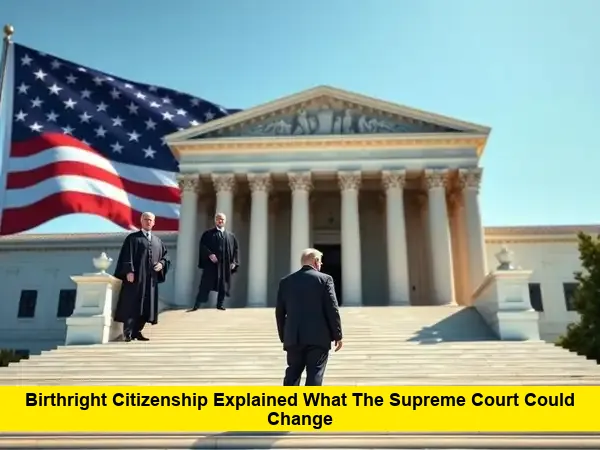

Birthright citizenship explained — what the Supreme Court could change has become a central legal and political question in the United States as immigration policy debates intensify and court challenges move forward. The issue focuses on whether people born on U.S. soil automatically receive citizenship under the Constitution — and whether the Supreme Court could reshape how that rule is applied.
The debate centers on the 14th Amendment, which states that anyone born or naturalized in the United States and subject to its jurisdiction is a citizen. For more than a century, this principle has guided U.S. citizenship policy. Recent lawsuits and policy proposals have renewed scrutiny of how that constitutional language should be interpreted.
Readers across the country are watching closely as court challenges move through lower courts and raise questions that could eventually reach the nation’s highest court.
If you want clear updates on major Supreme Court decisions affecting immigration and citizenship, follow this story as it develops.
What birthright citizenship means
Birthright citizenship refers to the legal rule that a child born in the United States automatically becomes a U.S. citizen regardless of the parents’ immigration status.
This rule comes primarily from the 14th Amendment and a landmark Supreme Court ruling in 1898 that affirmed citizenship for children born in the U.S. to non-citizen parents who were lawfully residing in the country.
Since then, federal agencies have applied that interpretation broadly. Birth certificates issued by U.S. states serve as proof of citizenship for millions of Americans.
The policy affects immigration enforcement, social programs, and long-term demographic trends, which is why it frequently becomes part of national political debates.
Why the issue is back in the spotlight
The topic has returned to national attention due to renewed legal challenges and policy efforts seeking to reinterpret the phrase “subject to the jurisdiction” in the 14th Amendment.
Some policymakers argue that children born to certain categories of non-citizens should not automatically receive citizenship. Others maintain that longstanding precedent leaves little room for reinterpretation without a constitutional amendment.
These competing views have triggered lawsuits, state-level actions, and federal policy discussions. Legal experts widely agree that any significant shift would likely require Supreme Court involvement.
As a result, immigration attorneys, civil rights groups, and state governments are preparing for potential litigation that could shape how courts address the issue.
Key constitutional foundation
The 14th Amendment, ratified in 1868 after the Civil War, established citizenship for formerly enslaved people and set a national standard.
The amendment’s citizenship clause states that all persons born or naturalized in the United States and subject to its jurisdiction are citizens. Courts historically interpreted this language broadly.
The 1898 Supreme Court decision widely cited in birthright citizenship debates held that a child born in the United States to immigrant parents was a citizen under the Constitution. That ruling remains central to current legal arguments.
Because the case has not been overturned, it continues to guide federal policy today.
What the Supreme Court could change
While the core principle of birthright citizenship remains intact, the Supreme Court could address several legal questions if a new case reaches it:
- Whether “subject to the jurisdiction” allows exceptions beyond diplomats and certain foreign officials
- How federal agencies must interpret citizenship rules
- Whether executive branch policies attempting to narrow birthright citizenship comply with the Constitution
- The limits of state authority related to citizenship documentation
Any ruling would likely clarify interpretation rather than eliminate the constitutional clause entirely, since altering the amendment itself would require a constitutional amendment.
Even a narrow decision could have significant administrative and legal effects nationwide.
Current legal landscape
Lower federal courts have historically blocked attempts to restrict birthright citizenship through executive action, emphasizing existing precedent.
Legal disputes now focus on interpretation, administrative policy, and the scope of federal authority.
Attorneys on both sides are building arguments around constitutional text, historical context, and prior Supreme Court rulings. This preparation suggests that future cases could present the Court with an opportunity to revisit the issue — particularly if conflicting lower-court decisions emerge.
The timing of any Supreme Court review depends on how quickly litigation progresses.
Why this matters for families and policy
Birthright citizenship affects millions of families each year. It determines eligibility for passports, federal benefits, voting rights later in life, and legal status protections.
Changes to interpretation could influence immigration enforcement strategies, documentation processes, and long-term policy planning.
State governments also pay close attention because citizenship status shapes education systems, healthcare programs, and population data used for funding formulas.
Businesses, schools, and public agencies rely on consistent citizenship rules for administrative planning.
Political debate surrounding the issue
Birthright citizenship has been debated across multiple presidential administrations and Congress sessions.
Supporters argue it reflects constitutional guarantees, promotes stability, and prevents the creation of large stateless populations.
Critics argue the current interpretation encourages unauthorized immigration and believe Congress or the courts should clarify limits.
Because the issue intersects with immigration policy, constitutional law, and federal authority, it remains politically sensitive and legally complex.
Legal experts’ expectations
Constitutional scholars often note that Supreme Court involvement typically follows clear legal conflicts between lower courts or a major federal policy shift.
If such a case arrives, the Court would examine:
- Constitutional text
- Historical interpretation
- Precedent
- Government authority boundaries
The Court’s approach could focus on technical interpretation rather than sweeping change.
Even clarification could shape how future administrations design immigration policy.
What happens next
The path forward depends on ongoing litigation, policy proposals, and potential administrative actions.
If conflicting rulings appear in federal appeals courts, the likelihood of Supreme Court review increases.
Until then, existing precedent continues to guide citizenship determinations nationwide.
Observers expect the issue to remain a recurring legal topic as immigration policy continues to evolve.
Long-term implications
The long-term impact of any Supreme Court decision could extend beyond immigration.
Citizenship rules influence census data, representation, workforce trends, and social programs. Legal clarity also affects international perceptions of U.S. immigration policy.
Because of these wide-ranging effects, birthright citizenship remains one of the most consequential constitutional questions tied to immigration.
Understanding how courts interpret the 14th Amendment helps explain why each new legal challenge draws national attention.
Conclusion
The debate captured in Birthright citizenship explained — what the Supreme Court could change reflects a broader national conversation about constitutional interpretation and immigration policy.
While existing precedent continues to support automatic citizenship for those born on U.S. soil, legal challenges and policy proposals ensure the issue remains active in the courts.
Future Supreme Court action would likely focus on clarifying interpretation rather than rewriting the Constitution, but even clarification could shape policy for decades.
As litigation progresses, Americans across the political spectrum are watching how courts address one of the Constitution’s most important clauses.
Staying informed helps families, policymakers, and communities understand what is at stake as the legal process unfolds.
Want more clear breakdowns of major Supreme Court and immigration developments? Keep following for straightforward updates that matter.
What do you think about the future of birthright citizenship — join the conversation and stay updated as this story evolves.